NASA's Hubble Captures a Stunning Red, White, and Blue Stellar Nursery
Hubble has captured images of the LH 95 stellar nursery, revealing how massive blue stars and crimson gas shape the ongoing processes of star formation.
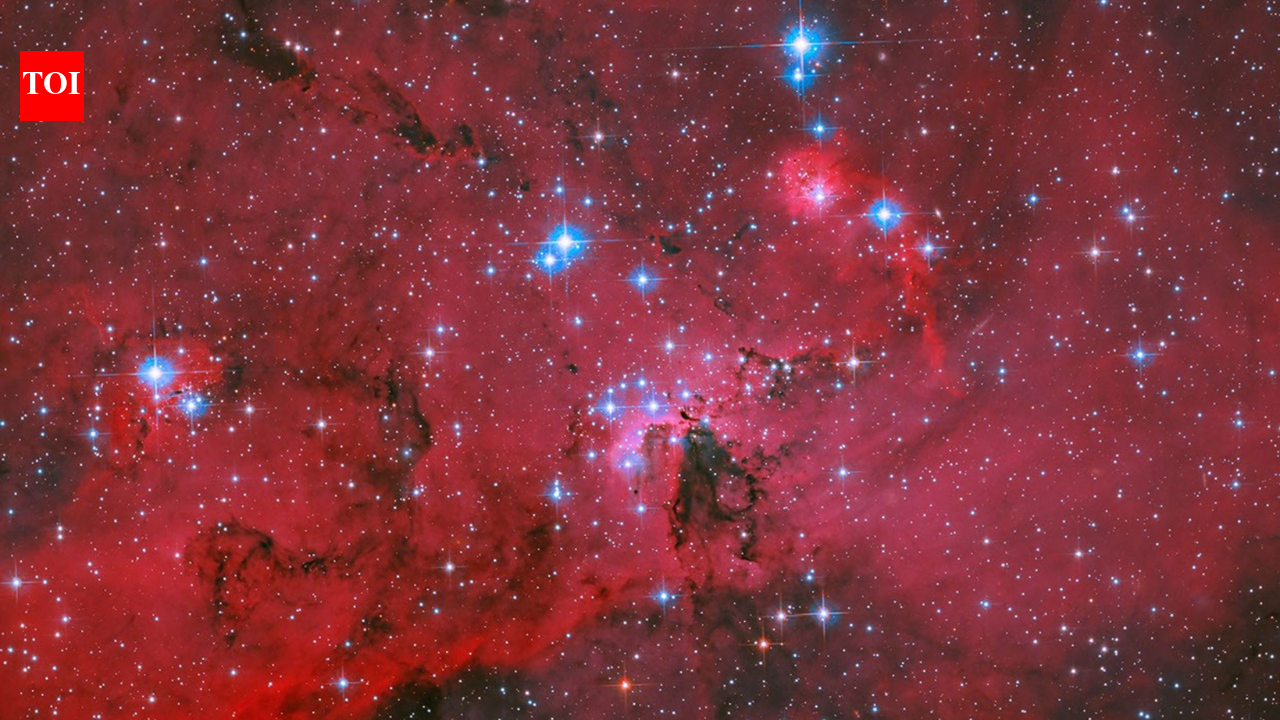
NASA’s Hubble Space Telescope has captured a detailed view of the stellar nursery LH 95, a region located within the Large Magellanic Cloud. This dwarf galaxy, which orbits the Milky Way, serves as a site where brilliant blue and white stars sparkle against a backdrop of crimson gas. The resulting image evokes the appearance of fireworks fading through drifting smoke.
The crimson glow characterizing the region arises from hydrogen-alpha emissions, a hallmark signature of active star formation. Astronomers utilize this specific wavelength to identify young stars currently developing within the gaseous environment. Within LH 95, researchers have identified approximately 2,500 pre-main-sequence stars. These objects have accumulated nearly all the mass necessary for their existence but have not yet achieved the internal temperatures or densities required to ignite nuclear fusion. Consequently, these stars continue to contract under the influence of their own gravity.
Related media
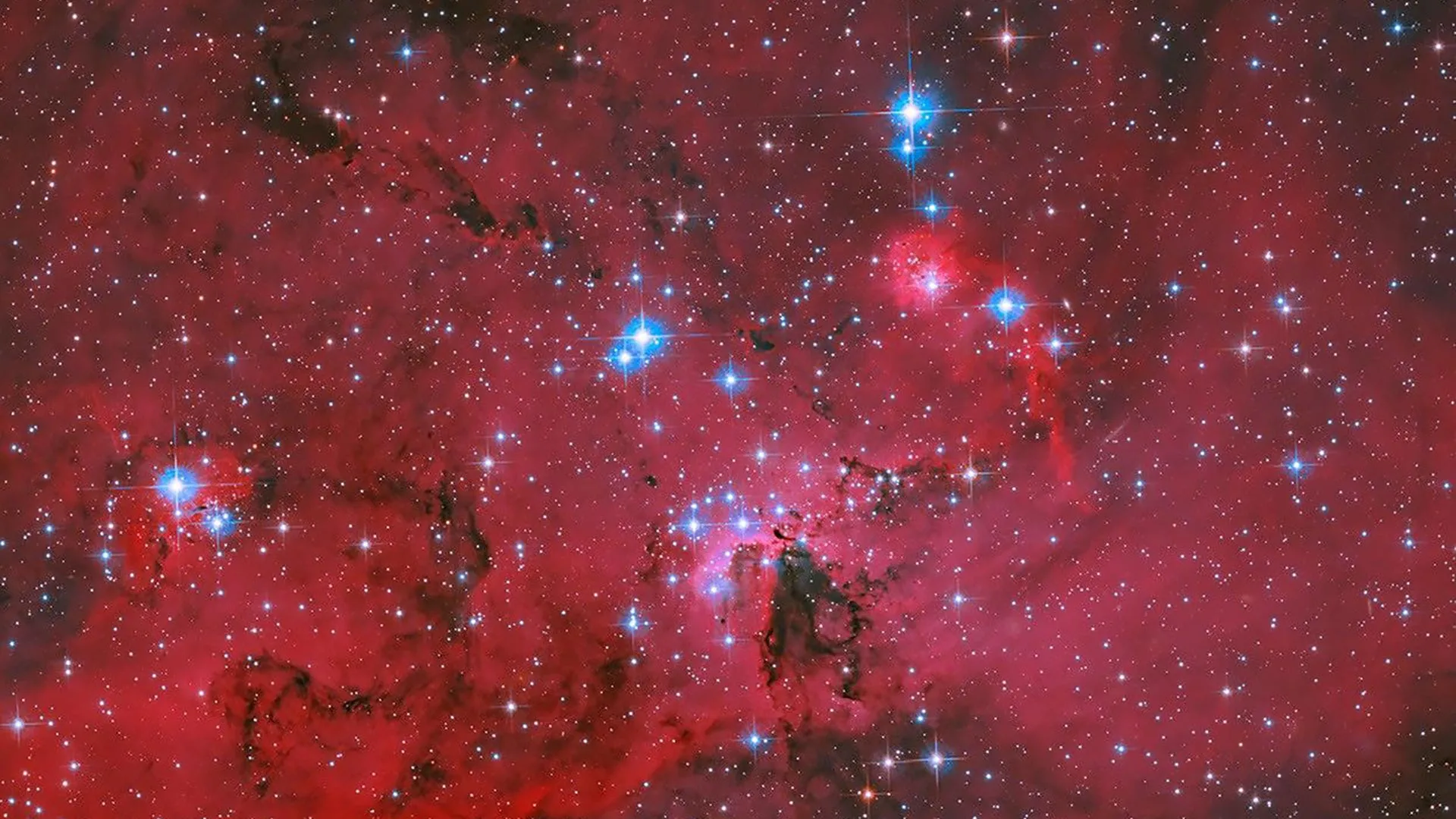
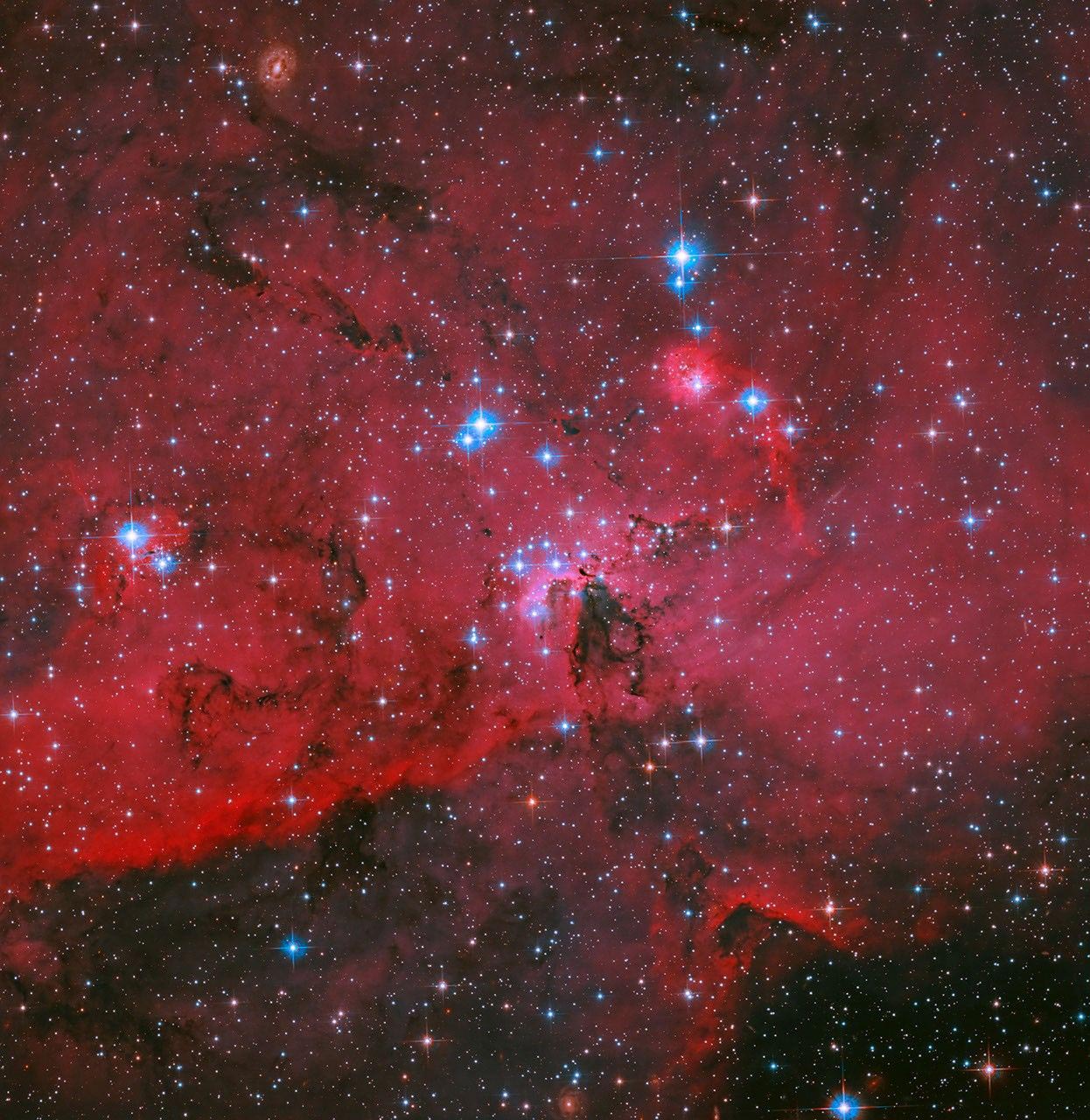

The region is categorized by astronomers as a stellar association, hosting a diverse population that includes both newly forming low-mass stars and massive blue giants. The massive stars in this association exert a significant influence on their environment; they possess at least three times the mass of the Sun and release intense ultraviolet radiation combined with powerful stellar winds. These forces heat the surrounding hydrogen gas and gradually sculpt the nebula. Denser filaments of dust remain visible as dark lanes, as they possess enough mass to resist erosion from the energetic radiation of the nearby stars.
The colors captured in the Hubble image are not representative of natural human vision but instead correspond to specific wavelengths of light. Blue highlights shorter visible wavelengths, while red combines longer visible wavelengths with some near-infrared light. According to NASA’s Goddard Space Flight Center,
"A glowing landscape of gas and dust is heated and illuminated by a thriving population of young stars in the LH 95 region of the Large Magellanic Cloud."
Claire Andreoli, NASA's Goddard Space Flight Center, via ScienceSprings
Observations of LH 95 have provided researchers with data regarding the lifecycle of stars and their surrounding disks. The findings confirm that the rate at which a young star gathers material, known as the accretion rate, naturally decreases as the star ages. However, the study indicates that this growth process can persist for several million years, a duration exceeding some earlier scientific assumptions. Furthermore, the region shows no evidence of a single, sudden burst of star formation. Instead, multiple generations of stars exist side by side, suggesting that the nursery has been active over an extended period.
A notable star exists within the region, located slightly left of center near the top of the image. This object contains approximately 60 to 70 times the mass of the Sun. Despite its massive size, it appears to be roughly one million years younger than its stellar neighbors, which are estimated to be approximately 4 million years old. Such massive stars are expected to burn through their fuel rapidly, ultimately ending their lives in supernova explosions that will seed the region with heavy elements.
LH 95 serves as an important laboratory for researchers because it is relatively nearby and contains less obscuring dust than similar star-forming regions found within the Milky Way. This provides astronomers with a clearer window to observe thousands of stars at various stages of evolution within the same vicinity.
The ongoing investigation into stellar birth relies on a collaborative approach using multiple observatories. Hubble continues to capture high-resolution images in visible and ultraviolet light to track the evolution of stellar disks. These observations are supplemented by the James Webb Space Telescope, which employs infrared capabilities to peer through dust clouds that remain opaque to Hubble. Looking ahead, the scientific community anticipates the launch of the Nancy Grace Roman Space Telescope, which is expected to provide a wider field of view and further expand the census of stellar nurseries.
How significant is this development?
Contribute your assessment to the aggregated reader intelligence ledger.
Archypedia is dedicated to independent, evidence-backed reporting. This briefing was synthesized from primary source reporting, corroborated across independent newsrooms, and verified against our Editorial Standards.
Transparency record
Evidence behind this report
This report synthesizes 8 distinct sources. Open the source ledger below to compare the underlying coverage.
- timesofindia.indiatimes.com
- sciencedaily.com
- scitechdaily.com
- science.nasa.gov
- europesays.com
- sciencesprings.wordpress.com
- impactful.ninja
- yahoo.com
Prepared under the Archypedia Editorial Policy by the Niko Vale editorial desk profile. AI-assisted tools may support drafting and verification; public accountability remains with Archypedia. Report an error.