Spriggina fossils provide earliest evidence of behavioral handedness
Researchers found evidence of behavioral handedness in Spriggina fossils, suggesting these early animals possessed an evolutionary preference for the right side.
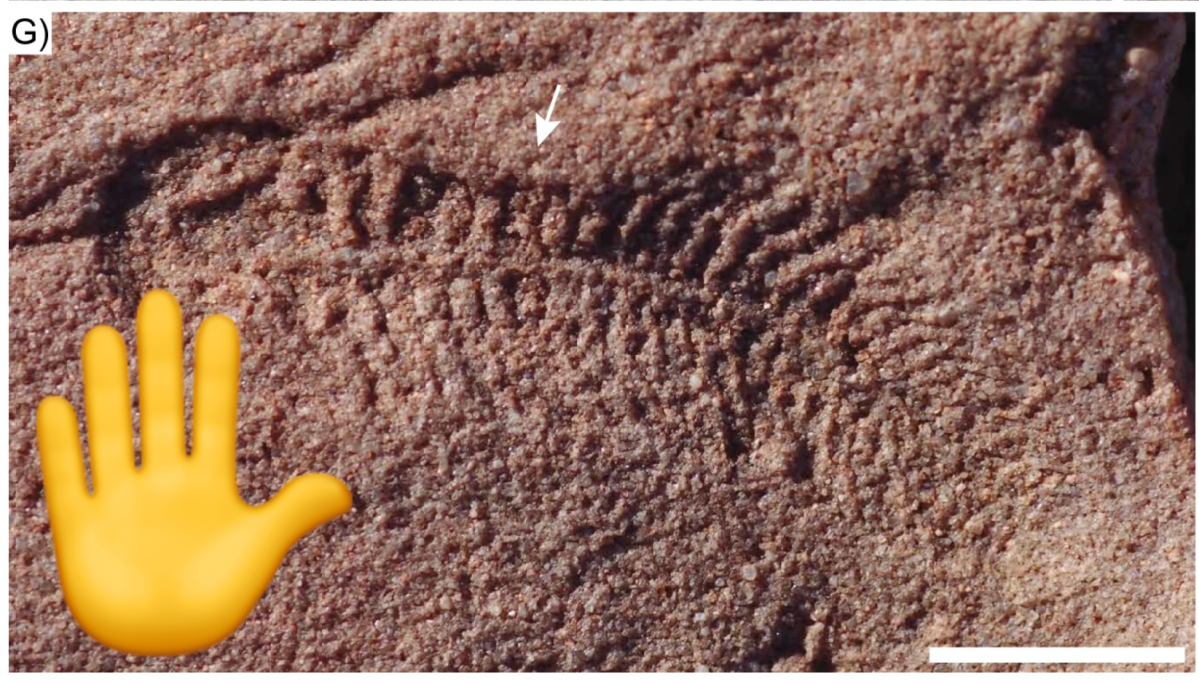
Research published in the journal Scientific Reports provides evidence that behavioral handedness—a trait typically associated with complex, modern organisms—may have originated roughly 550 million years ago. By examining fossils of Spriggina floundersi, a worm-like creature from the Ediacaran Period, scientists have identified a consistent bias in how these organisms bent their bodies, suggesting an early evolutionary preference for the right side.
The study, led by researchers from the American Museum of Natural History, Florida State University, Harvard University, and the University of California, Riverside, centers on over 100 well-preserved specimens collected from Nilpena Ediacara National Park in South Australia. These creatures, which measured between 0.8 and 1.2 inches in length with a maximum of 4 inches, lived during a time when multicellular life was first diversifying. Spriggina is widely regarded as one of the first animals to possess a head and exhibit bilateral symmetry, featuring a distinct left, right, front, and back.
Related media

The researchers observed that a significant majority of the fossilized specimens were bent toward the left side. Because these fossils represent mirror-image impressions formed when the animals were buried in sand during ancient storm events, this pattern indicates that the organisms predominantly favored bending to their right during life. According to the team, this two-to-one ratio of left-bent fossils mirrors statistical findings in modern animals that exhibit right-handedness, such as certain primates, mice, frogs, and insects.
"The dominance of bends to the left in fossils of Spriggina suggests a preference for right turns in life and represents the oldest evidence of behavioural handedness among animals."
Researchers, via Scientific Reports
Scott Evans, the study’s lead author and an assistant curator of invertebrate paleontology at the American Museum of Natural History, noted that while the creatures lacked limbs, the ability to exhibit a directional preference suggests an advanced nervous system connected to their muscles. The researchers carefully evaluated whether these curves were caused by environmental factors, such as water currents or sediment shifts. By analyzing the orientation of the fossils within the rock layers, the team concluded that the bending was not consistent with external forces, as individual specimens showed varying degrees of curvature and orientation, sometimes exhibiting multiple bends.
This discovery pushes back the timeline for the emergence of behavioral handedness, which was previously thought to have appeared much later in the evolutionary record. Russell Bicknell of Flinders University, who was not involved in the study, noted that the presence of such functional asymmetry in the deep fossil record provides significant insight into the evolution of complex behaviors. The findings suggest that the foundations for modern animal traits, including movement and sidedness, were established well before the Cambrian Period.
Paleontology continues to grapple with the interpretation of soft-bodied fossils, where direct observation of behavior is impossible. Some researchers, such as Diego García-Bellido of the South Australian Museum, have praised the methodology of the study, citing the authors' consideration of alternative hypotheses and the exclusion of environmental bias.
What to watch next
- Expanded Analysis: Scientists intend to continue examining additional specimens and related Ediacaran organisms to determine if this right-handed bias was a trait limited to Spriggina or a widespread characteristic of early mobile life.
- Technological Advances: The application of microtomography and spectroscopy continues to allow for higher-resolution studies of ancient remains, which may reveal further details about the nervous systems and muscle development of these organisms.
- Evolutionary Timeline: Future research will continue to assess how these foundational asymmetries influenced the diversification of body plans leading up to the Cambrian explosion.
How significant is this development?
Contribute your assessment to the aggregated reader intelligence ledger.
Archypedia is dedicated to independent, evidence-backed reporting. This briefing was synthesized from primary source reporting, corroborated across independent newsrooms, and verified against our Editorial Standards.
Transparency record
Evidence behind this report
This report synthesizes 7 distinct sources. Open the source ledger below to compare the underlying coverage.
- climatecosmos.com
- popsci.com
- cnas.ucr.edu
- newscientist.com
- yahoo.com
- gizmodo.com
- timesofindia.indiatimes.com
Prepared under the Archypedia Editorial Policy by the Niko Vale editorial desk profile. AI-assisted tools may support drafting and verification; public accountability remains with Archypedia. Report an error.