Researchers observe ambipolar diffusion in prestellar core to map star birth
Scientists identified a velocity drift between ionized gas and neutral particles in a prestellar core, revealing how gravity overcomes magnetic resistance.

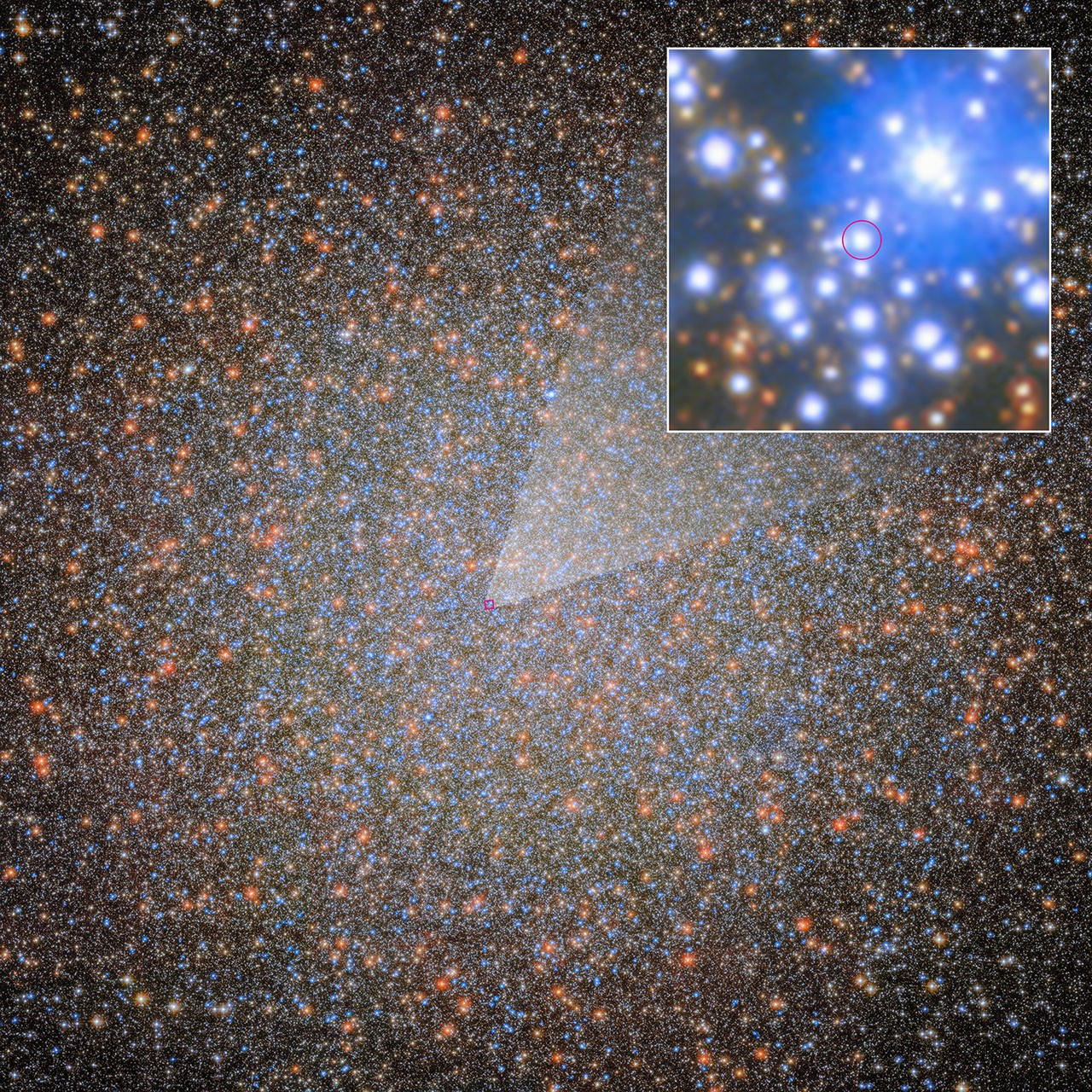
Researchers have gained a clearer understanding of the forces governing star birth by observing a phenomenon called ambipolar diffusion within a prestellar core. This discovery, detailed in a study published in Astronomy & Astrophysics, captures the moment gas and dust decouple from magnetic fields to begin the gravitational collapse that eventually ignites a new star. By tracking specific molecular signatures, the team identified the drift between ionized gas and neutral particles, providing new clarity on how magnetic support is shed before collapse.
Tracing the Invisible Shift
Prestellar cores are cold, dense regions of gas and dust. While magnetic fields are necessary for the initial stability of these cores, they also act as a buffer that can delay star formation if the field strength remains too high. According to researchers from Kyushu University and the Max Planck Institute for Extraterrestrial Physics, the process of ambipolar diffusion allows neutral particles to slip past the magnetic field lines, which remain coupled only to the ionized portion of the gas. As density increases within the core, the coupling weakens, allowing gravity to overtake magnetic resistance.
Related media

Identifying this drift required selecting specific molecular tracers, as most common molecules freeze onto dust grains in the extreme cold of a prestellar core. The team focused on Diazenylium-d1 and para-monodeuterated ammonia. By modeling the velocity of these molecules in the L1544 core located in the Taurus molecular cloud, they detected a velocity difference of 0.05 km/s, providing evidence of the ion-neutral drift.
Cosmic Tug-of-War
The role of gravity in star formation is further corroborated by large-scale surveys of massive star-forming regions. Using the Atacama Large Millimeter/submillimeter Array (ALMA), an international team led by Dr. Qizhou Zhang of the Center for Astrophysics | Harvard & Smithsonian mapped magnetic fields across 17 distinct regions. Their observations indicate that as gas density rises, gravity decisively reorients magnetic field lines, aligning them with the flow of infalling matter. This survey effectively settles a long-standing debate, confirming that gravity prevails over turbulence and magnetic pressure as gas is compressed to densities ten trillion times higher than its initial state.
Environmental Impacts on Stellar Nurseries
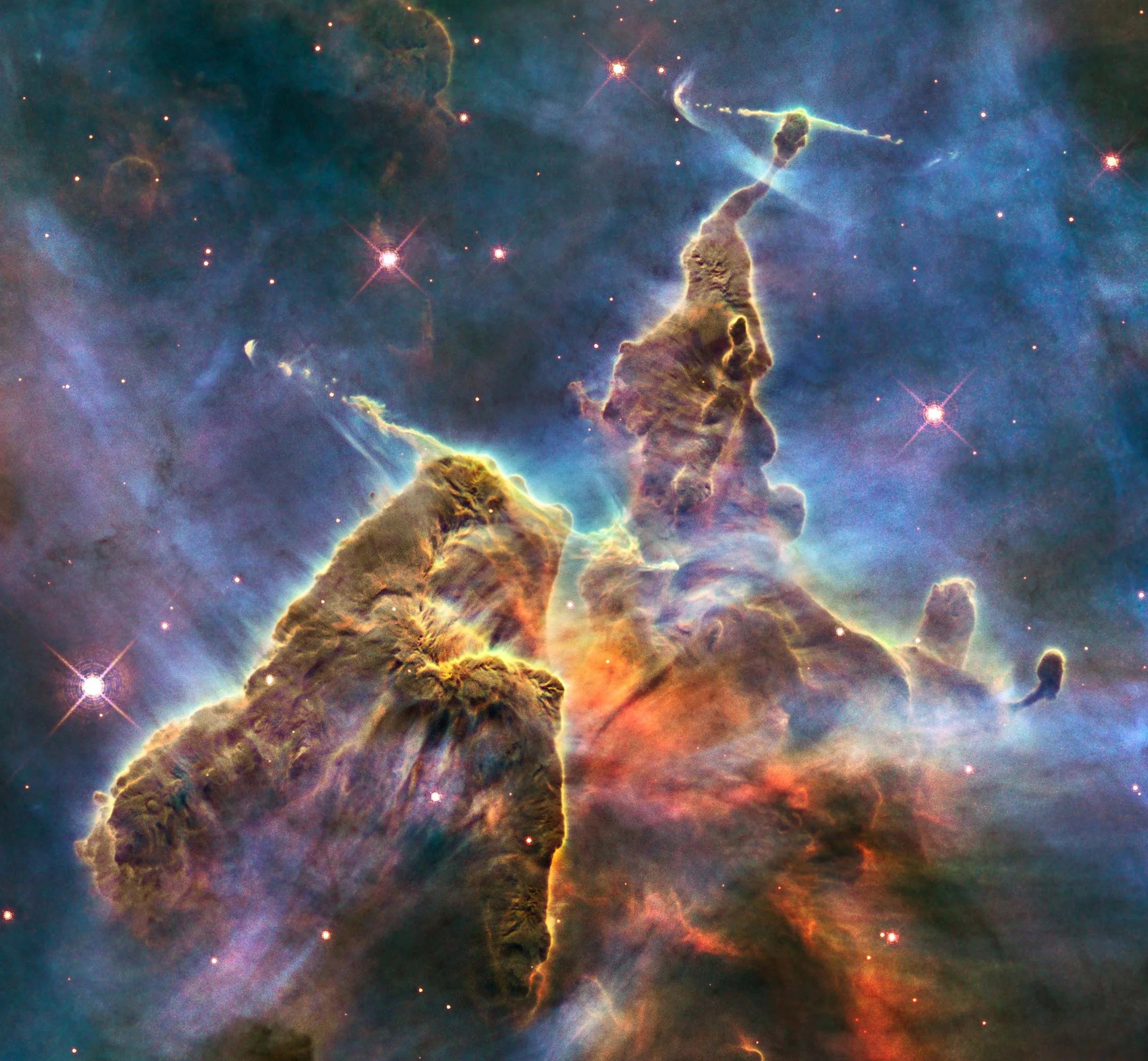
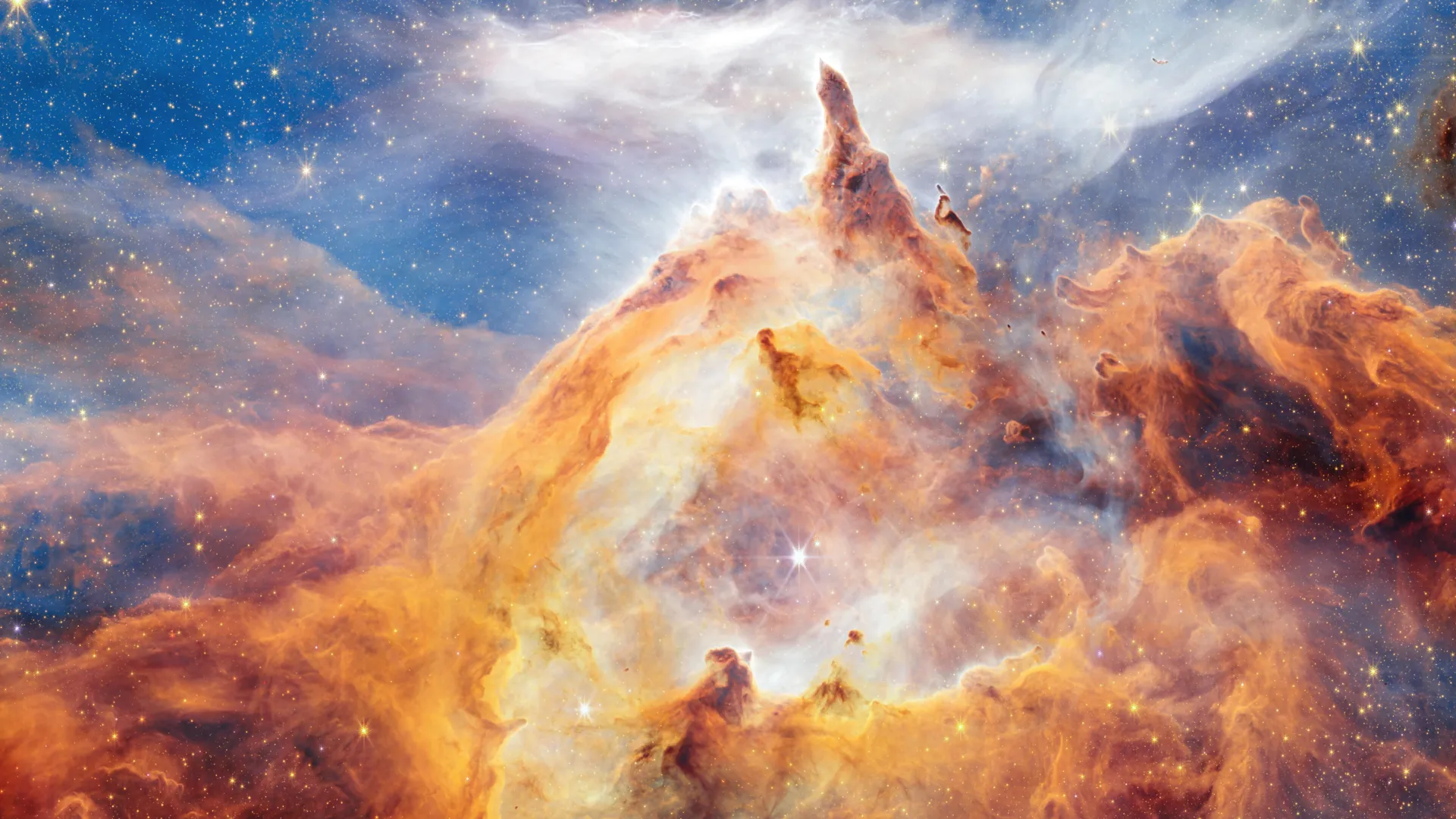
Once a protostar begins to form, the environment becomes increasingly volatile. Observations from the James Webb Space Telescope (JWST) and the Hubble Space Telescope reveal how newly born stars interact with their surroundings. Energetic plasma jets, often referred to as Herbig-Haro objects, shoot out from the poles of forming stars at supersonic speeds. In the Lobster Nebula, located roughly 5,500 light-years away, Webb’s NIRCam has captured how massive, hot stars carve cavities into their birth clouds. The intense radiation and stellar winds from these stars act as both a destructive and creative force, compressing nearby gas into new pillars where further star formation is triggered. In the cluster Pismis 24, for example, massive stars are actively sculpting their environment, with individual pillars spanning over 5 light-years.
Balancing the Cooling of Clusters
On a larger scale, the suppression of star formation is just as vital to the evolution of the universe as its initiation. Research conducted using the Chandra X-ray Observatory on the Perseus and Virgo galaxy clusters suggests that turbulence acts as a heating mechanism. While gas in these massive clusters should theoretically cool to trigger rapid star birth, the activity of central supermassive black holes prevents this. These black holes create jets that carve cavities into the hot gas, generating chaotic, turbulent motion that dissipates energy as heat. This "feedback" mechanism ensures the gas remains too hot to collapse into new stars for billions of years.
What to Watch Next
- Refining Models: Researchers hope to conduct higher-angular resolution observations to further map the velocity drift of ion and neutral molecules in additional prestellar cores.
- Long-term Monitoring: Ongoing utilization of the JWST and Hubble allows astronomers to track the evolution of jets and stellar nurseries over years, providing a "time-lapse" understanding of how these regions change.
- Theoretical Integration: The new metrics provided by the ALMA survey regarding magnetic field orientation are expected to improve existing theories on the life cycles of galaxies and their constituent stellar clusters.
How significant is this development?
Contribute your assessment to the aggregated reader intelligence ledger.
Archypedia is dedicated to independent, evidence-backed reporting. This briefing was synthesized from primary source reporting, corroborated across independent newsrooms, and verified against our Editorial Standards.
Transparency record
Evidence behind this report
This report synthesizes 6 distinct sources. Open the source ledger below to compare the underlying coverage.
Prepared under the Archypedia Editorial Policy by the Niko Vale editorial desk profile. AI-assisted tools may support drafting and verification; public accountability remains with Archypedia. Report an error.