Rare goblin shark filmed alive for the first time in the deep sea
New research documents goblin sharks in their natural deep-sea habitat and provides insights into the physiology and foraging of basking sharks.

Scientists have achieved a milestone in marine biology by documenting the elusive goblin shark (Mitsukurina owstoni) alive in its natural deep-sea habitat. These observations, which provide a rare look at one of the ocean's most mysterious species without removing it from its environment, were detailed in research published in the Journal of Fish Biology. Previously, visual records of a living goblin shark were confined to individuals accidentally ensnared by fishing lines; these animals typically perished soon after being brought to the surface, limiting the data available to researchers.
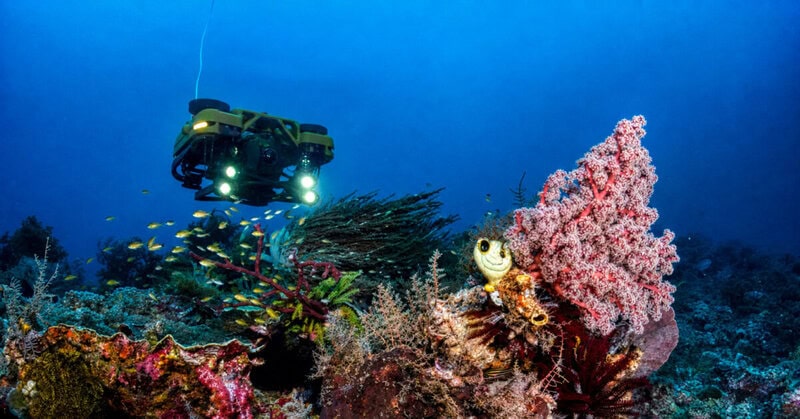
The research, led by a team from the University of Hawai'i at Mānoa, identifies two distinct sightings. The first occurred in 2019 near a seamount close to Jarvis Island, captured by the remotely operated vehicle Hercules during an expedition by the Ocean Exploration Trust. The second encounter was recorded in 2024 within the Tonga Trench using a baited camera on a bottom lander during an expedition aboard the R/V Dagon. According to Aaron Judah, the study's lead author, the Tonga Trench observation establishes a new depth record for the entire order of Lamniformes—the group that includes the great white, mako, and basking shark. This sighting was nearly 700 meters deeper than the species was previously known to inhabit.
Related media


Expanding Deep-Sea Understanding
The goblin shark is often characterized as a living fossil, representing the sole surviving member of a shark family that dates back nearly 125 million years. Before these Central Pacific sightings, the species was known primarily from regions off Japan, Australia, the western United States, and small areas of the Indian and Atlantic Oceans. These findings expand the species' known geographic distribution and confirm their presence in the Central Pacific, allowing scientists to incorporate the shark into regional biodiversity lists and management strategies.
Physiological Insights into the Basking Shark
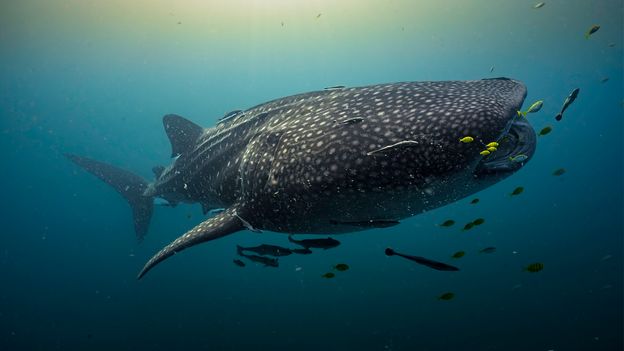
While the goblin shark marks a breakthrough in observation, researchers have simultaneously been uncovering the physiological secrets of its relative, the basking shark (Cetorhinus maximus). Despite being the second-largest fish in the ocean, much of this endangered species' biology remained obscure until recent investigations into stranded specimens and satellite tracking.
Recent Biological Discoveries
- Regional Endothermy: Research led by teams in Ireland has revealed that basking sharks possess regional endothermic traits. By dissecting stranded specimens and tagging free-swimming individuals, scientists found that these sharks maintain a subcutaneous body temperature 1.0 to 1.5°C warmer than the surrounding water. This challenges the long-held assumption that such internal temperature regulation was exclusive to fast-moving apex predators.
- Dermal Denticle Structure: Investigations into basking shark skin have uncovered a specialized arrangement of tooth-like scales known as dermal denticles. Unlike the streamlined, hydrodynamically efficient scales of most sharks, basking shark denticles are arranged in tight, paver-like clusters. Scientists suggest this structure allows the skin to stretch significantly to accommodate the shark's massive, open-mouthed filter-feeding patterns.
- Twilight Zone Foraging: Long-term tracking data indicate that basking sharks, contrary to previous beliefs that they fast during migration, actively feed at depths between 200 and 1,000 meters. This suggests they forage within the ocean's "twilight zone," relying on food sources at depths previously thought too physiologically demanding for them to frequent.
Conservation Challenges
Basking Sharks face threats from by-catch, habitat loss, and the potential impacts of ocean acidification on their denticles, which can impair swimming efficiency and prey detection. As scientists continue to explore these deep-sea species, the loss of such animals is noted to carry potential risks for marine industries, tourism, and the preservation of traditional ecological knowledge.
How significant is this development?
Contribute your assessment to the aggregated reader intelligence ledger.
Archypedia is dedicated to independent, evidence-backed reporting. This briefing was synthesized from primary source reporting, corroborated across independent newsrooms, and verified against our Editorial Standards.
Transparency record
Evidence behind this report
This report synthesizes 8 distinct sources. Open the source ledger below to compare the underlying coverage.
- miragenews.com
- sciencedaily.com
- forbes.com
- sharks.org
- yahoo.com
- divemagazine.com
- en.wikipedia.org
- elasmo-research.org
Prepared under the Archypedia Editorial Policy by the Niko Vale editorial desk profile. AI-assisted tools may support drafting and verification; public accountability remains with Archypedia. Report an error.