US forces disable 3 Iranian oil tankers after missile attacks on Navy ships
The US military has pivoted to an 'asset-for-missile' doctrine, sinking the MT Kylo and disabling two other carriers to bankrupt funding for the IRGC.
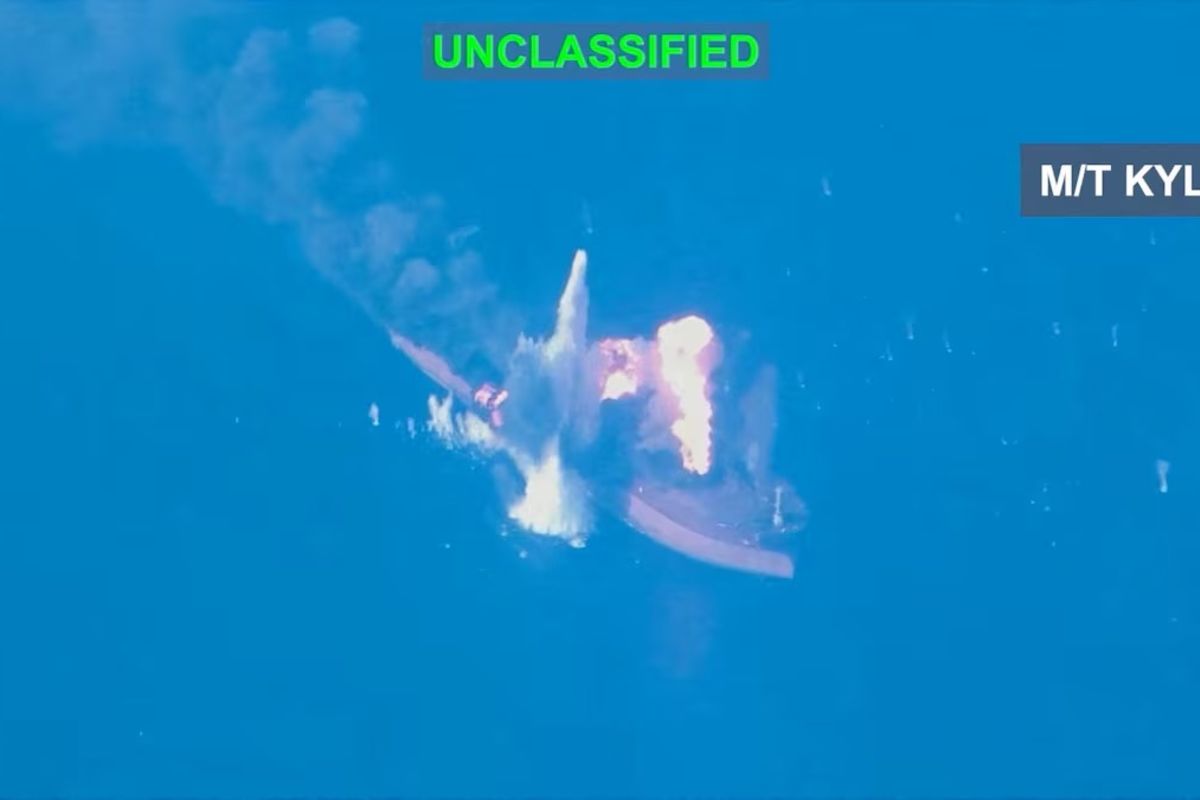
Retail diesel prices in the United States have reached a record average of $5.85 per gallon. The price spike, reported by Financial Express via AAA data, coincides with a new naval doctrine: replacing military-for-military retaliation with asset-for-missile destruction.
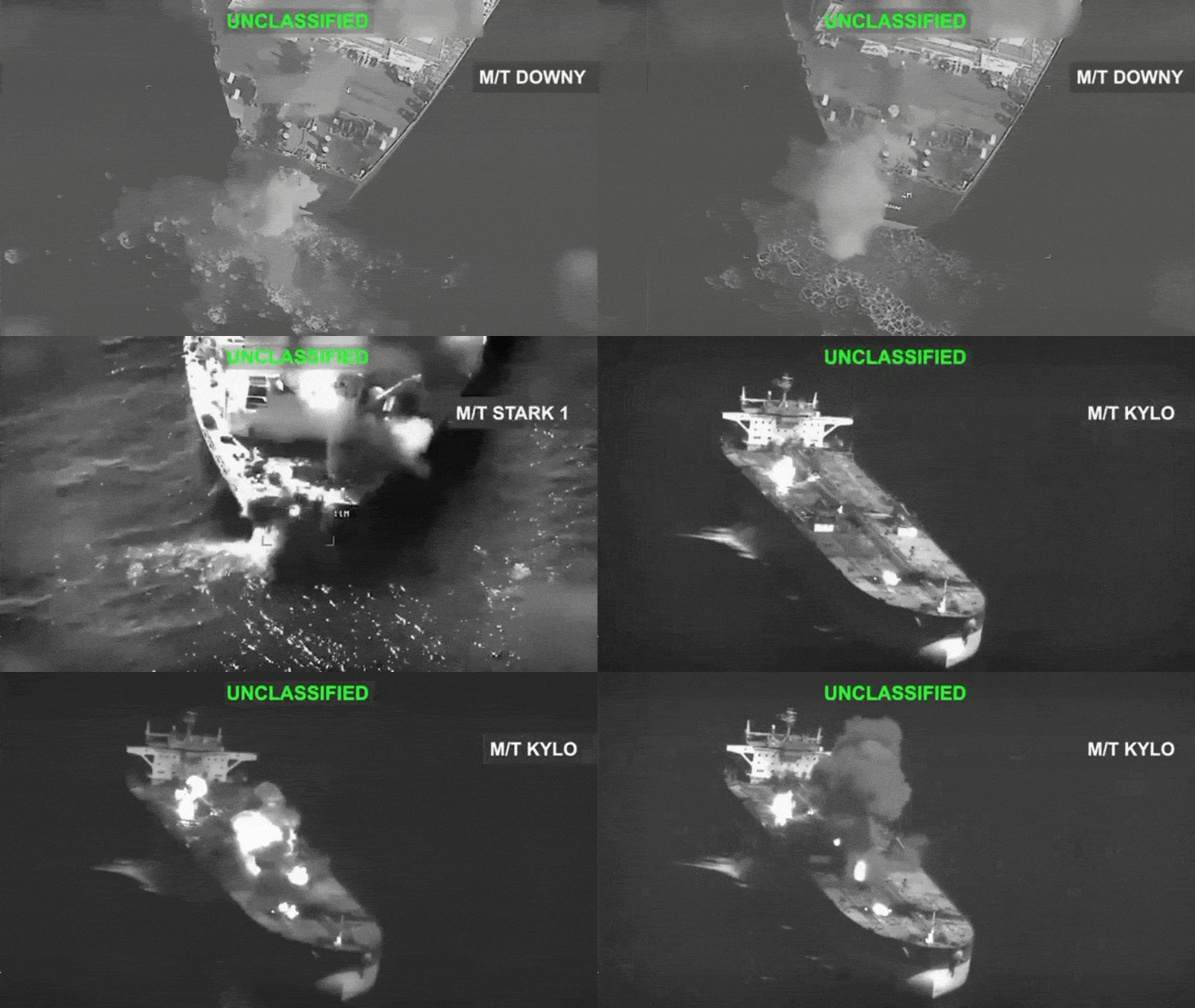
On Saturday, US forces sank the MT Kylo in the Gulf of Oman and permanently disabled two other Iranian crude oil carriers. The operation followed a ballistic missile attack by the Islamic Revolutionary Guard Corps (IRGC) against two US Navy warships — an aircraft carrier and a guided-missile destroyer — which successfully evaded the strikes with no personnel injured, according to US Central Command (CENTCOM).
Related YouTube video
Economic Warfare and the 'Shadow Fleet'
The destruction of the tankers represents a calculated effort to dismantle the multibillion-dollar "shadow network" that Times of India reports funds the IRGC and its regional proxies.
Admiral Brad Cooper, head of CENTCOM, explicitly framed the operation as a financial penalty.
"Let the message to the IRGC be clear: If you shoot at two of our ships, we will impose an even higher economic cost — taking out three of yours,"
Admiral Brad Cooper, head of US Central Command, via The Citizen
This strategy targets the only mechanism Tehran has left to bypass the US blockade imposed in mid-April. According to CBC, Iran relies on this shadow fleet to move oil to buyers and ease economic pressures after negotiations over its nuclear program collapsed.
| Vessel Name | Location of Strike | Outcome |
|---|---|---|
| MT Kylo (Noxen) | Gulf of Oman | Sunk / Completely Destroyed |
| MT Downy | Off Kharg Island | Permanently Disabled |
| MT Stark 1 | Near Jask | Permanently Disabled |
The Collapse of Diplomacy
The current hostilities follow a failed attempt at stabilization. In mid-June, Washington and Tehran signed a memorandum of understanding and an interim agreement on June 17 intended to end a war that began with US and Israeli strikes on February 28. However, Cbc reports that these negotiations fell apart shortly after signing.
Diplomats indicate that the US, France, Germany, and Britain are now seeking to refer Iran to the UN Security Council for failing to meet nuclear nonproliferation obligations. In response, Tehran's new hard-line leadership has signaled a willingness to "dig in" against sanctions. To leverage this position, Iran has restricted the Strait of Hormuz, a waterway that carried approximately one-fifth of global oil supplies before the war, prompting the US to blockade Iranian ports in retaliation.
The human cost of this escalation is becoming evident. Iranian semi-official news agency Tasnim reported that crews were evacuated from a tanker struck near Kharg's anchorage. Additionally, a US bombardment of southern Iran earlier in the week killed at least five people, according to CBC.
Competing Claims of 'War Crimes'
Tehran has characterized the US shift toward targeting commercial tankers as a violation of international law. The Iranian Foreign Ministry stated that these actions constitute a war crime
and a violation of Article 2(4) of the UN Charter, according to Financial Express.
The IRGC Navy further claimed the US acted out of desperation to close the Strait of Hormuz
. As a counter-move, the IRGC claimed it targeted three tankers using unauthorised routes
through the Strait, as well as three other vessels affiliated with the US.
On Sunday, Iran claimed it struck an unmanned US vessel attempting to enter the Strait of Hormuz. The US has not immediately confirmed this attack, though it continues to pursue a "dual-prong" approach of military strikes and targeting foreign financial institutions that handle Iranian money.
The Kharg Island Trigger
The most volatile point of the current conflict is Kharg Island, the hub through which Iran exported 90 per cent of its crude before the war. The US military's strike on the MT Downy occurred specifically off the coast of this island.
This operational focus follows a provocative social media post by President Donald Trump on August 31, which included an AI-generated video showing Kharg Island being blown to smithereens
. While Trump previously ruled out a military operation on the island in June, the current trajectory suggest a return to that possibility.
A spokesperson for Khatam al-Anbiya Central Headquarters, quoted by IRIB, warned that if the naval blockade and harassment of Iranian ships continue, strikes against US military vessels will be more severe than before
with a possibility of its expansion
.
Escalation Chronology and Market Impact
The current naval clashes on September 5 and 6 are the latest surge in a conflict that began with US and Israeli strikes on February 28. While a ceasefire and an interim agreement were signed on June 17, CBC reports that negotiations collapsed shortly thereafter, leading to the resumption of attacks last week after a month of relative calm.
This volatility has triggered immediate instability in global energy markets. Brent crude futures reached $96.28 a barrel on Friday, the highest level since July 24. According to Financial Express, Brent crude rose 7.6% during the week, while US crude gained nearly 10%.
The economic consequences extend beyond crude prices to US domestic inflation and government borrowing costs. Economists cited by Reuters via Financial Express warn that retail diesel prices could climb further than the current $5.85 record due to a sharp drawdown in inventories and the arrival of planting and harvesting seasons in US agricultural states.
Military Posturing and Next Triggers
The IRGC Navy has attempted to frame the US operations as an act of desperation to close the Strait of Hormuz. In response to the losses of the MT Kylo, MT Downy, and MT Stark 1, the IRGC claims it targeted three US-linked vessels and three other tankers using unauthorised routes
through the Strait. The IRGC further warned via state television that any further suspicious movement
in these waterways would be met with force.
The focus now returns to the physical security of Kharg Island. Given that the island handled 90 per cent of Iranian crude exports before the war, any direct strike there would further cripple an economy already strained by the April blockade. A spokesperson for Khatam al-Anbiya Central Headquarters warned via IRIB that if the blockade and harassment persist, strikes against US vessels will be more severe than before
.
With the US pursuing a dual-prong strategy of military strikes and financial targeting, the next step remains whether the US will move from disabling tankers to a direct military operation on Kharg Island, a possibility previously ruled out in June but recently signaled via social media.
Archypedia is dedicated to independent, evidence-backed reporting. This briefing was synthesized from primary source reporting, corroborated across independent newsrooms, and verified against our Editorial Standards.
Transparency record
Evidence behind this report
This report synthesizes 4 distinct sources. Open the source ledger below to compare the underlying coverage.
Prepared under the Archypedia Editorial Policy by the Samir Haddad editorial desk profile. AI-assisted tools may support drafting and verification; public accountability remains with Archypedia. Report an error.


