NASA's Webb Pinpoints Millions of Stars Within Cigar Galaxy
New high-resolution imagery from the James Webb Space Telescope pierces through dense galactic dust to unveil the internal structure of the starburst galaxy M82.

Researchers have utilized the James Webb Space Telescope to conduct a high-resolution imaging survey of Messier 82, a starburst galaxy widely recognized as the Cigar Galaxy. By capturing 65 hours of observation time with the telescope’s Near-Infrared Camera, the team successfully pierced through dense clouds of galactic dust that have historically obscured the core of this structure. The resulting data has allowed astronomers to resolve approximately 16.5 million individual stars, providing a clearer look at the galaxy’s complex internal composition and its history of rapid star formation.
Located 12 million light-years away in the constellation Ursa Major, Messier 82 serves as a rare laboratory for studying galaxy evolution. According to the Space Telescope Science Institute, the galaxy generates new stars at a rate 10 times faster than the Milky Way. This intense phase, which scientists believe was triggered by a past merger with another galaxy, is estimated to last for only a few hundred million years before it is eventually disrupted by the very activity it produces. The galaxy’s edge-on orientation and proximity make it a one-of-a-kind environment for observing how extreme stellar birth affects a galaxy's structure and drives material into the interstellar medium.
Related media
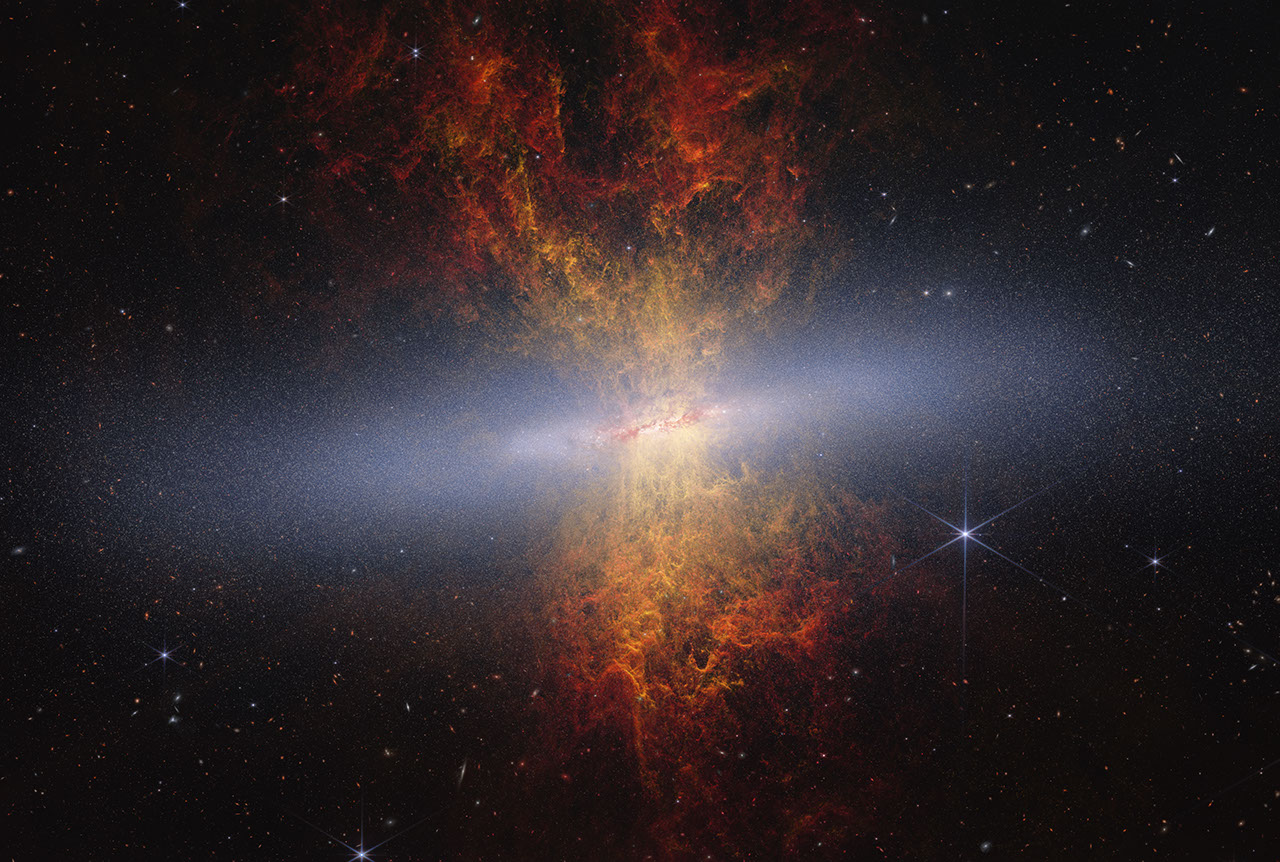

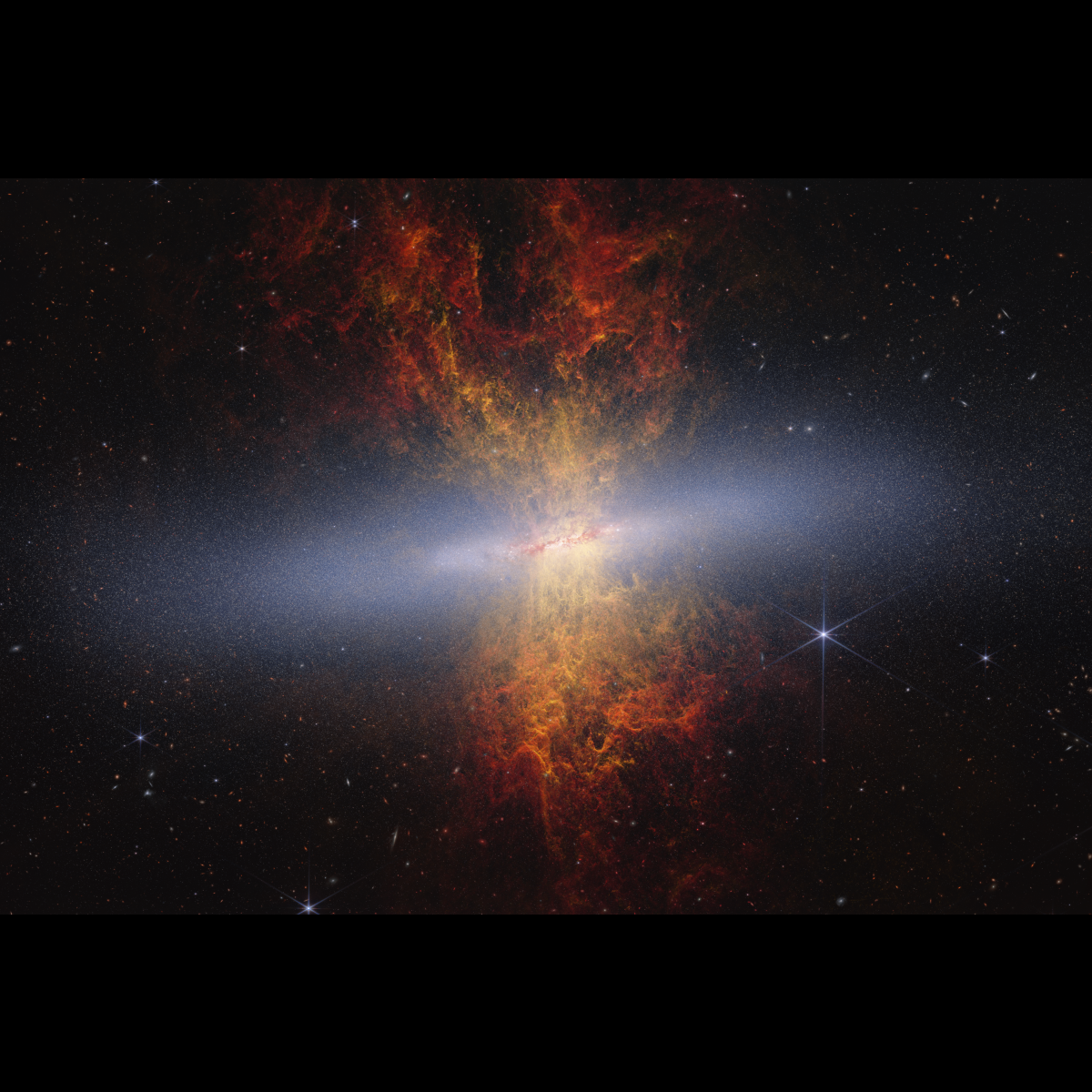
"M82 is a mess, but it’s a beautiful mess. We don’t fully understand what’s going on, especially concerning its evolutionary history. What could have triggered such an elevated rate of star formation? How long has this galaxy been driving plumes of material away from its center?"
Adam Smercina, NASA Hubble Fellow at the Space Telescope Science Institute, via NASA
The new imagery highlights the galaxy’s distended disk and reveals powerful, hourglass-shaped outflows of material being ejected above and below the galactic plane. By combining Webb’s infrared data with archival imagery from the Hubble Space Telescope, researchers have been able to map the composition of these outflows. Yellow-toned tendrils represent ionized gas closer to the disk, while orange-colored material further out corresponds to polycyclic aromatic hydrocarbons, which serve as markers for dust grains within the interstellar medium. The use of a composite approach allows scientists to visualize both the hidden stellar populations resolved by Webb’s infrared sensitivity and the gaseous structures captured by Hubble in visible light.
The project’s principal investigators emphasize that while Webb’s infrared sensitivity is necessary for viewing the stellar population, it remains one part of a multi-mission approach. Earlier observatories, such as Hubble and the retired Spitzer Space Telescope, provided essential data regarding the galaxy's gas and dust structures. By integrating these different data sets, scientists aim to create a comprehensive "fossil record" of how Messier 82 has grown and shifted over time. Team member Eric Bell of the University of Michigan noted that the asymmetrical shape and differing radii of the galaxy's disk suggest a distorted structure, a common occurrence during intense galaxy mergers.
"Galaxies are such intricate ecosystems that if you truly want to understand them, you have to pull datasets from different missions together. One mission cannot fully answer all of the questions we have about M82. Combining the data collected by different telescopes, like Webb and Hubble, is powerful. When you marry the datasets, you expand what you can probe, and the questions that you can pose are even more complex."
Kristen McQuinn, Space Telescope Science Institute team member, via NASA
Comparing Observations of Messier 82
| Instrument/Mission | Primary Observational Focus | Visual Outcome |
|---|---|---|
| Hubble Space Telescope | Visible light; dust and gas structure | Detailed mapping of ionized hydrogen and dust grains |
| James Webb Space Telescope | Near-infrared light; stellar populations | Pierces dust to resolve 16.5 million individual stars |
For astronomers and observers alike, Messier 82 remains a distinct target. First spotted in 1774 by Johann Elert Bode, the galaxy holds an apparent magnitude of 8.4, placing it within reach of amateur astronomers using modest equipment under sufficiently dark skies. While professional researchers continue to analyze the new 223-megapixel composite to understand the underlying causes of the galaxy’s distorted shape and asymmetrical disk, the international partnership between NASA, the European Space Agency, and the Canadian Space Agency continues to coordinate further study of the region.
Moving forward, the data collected from the 65-hour survey will serve as a foundational resource for modeling how galaxies recycle material and lose raw star-forming resources into intergalactic space. As team member Benjamin Williams of the University of Washington noted, the resolution of these millions of stars offers a glimpse into a world previously unseen by earlier generations of telescopes. The team expects that marrying these datasets will enable them to address ongoing mysteries, such as how star formation has migrated within the galaxy over the last few billion years.
How significant is this development?
Contribute your assessment to the aggregated reader intelligence ledger.
Archypedia is dedicated to independent, evidence-backed reporting. This briefing was synthesized from primary source reporting, corroborated across independent newsrooms, and verified against our Editorial Standards.
Transparency record
Evidence behind this report
This report synthesizes 11 distinct sources. Open the source ledger below to compare the underlying coverage.
- science.nasa.gov
- yahoo.com
- nasa.gov
- stsci.edu
- esawebb.org
- photographytalk.com
- thisiscolossal.com
- timesofindia.indiatimes.com
- petapixel.com
- linkedin.com
- newswise.com
Prepared under the Archypedia Editorial Policy by the Niko Vale editorial desk profile. AI-assisted tools may support drafting and verification; public accountability remains with Archypedia. Report an error.