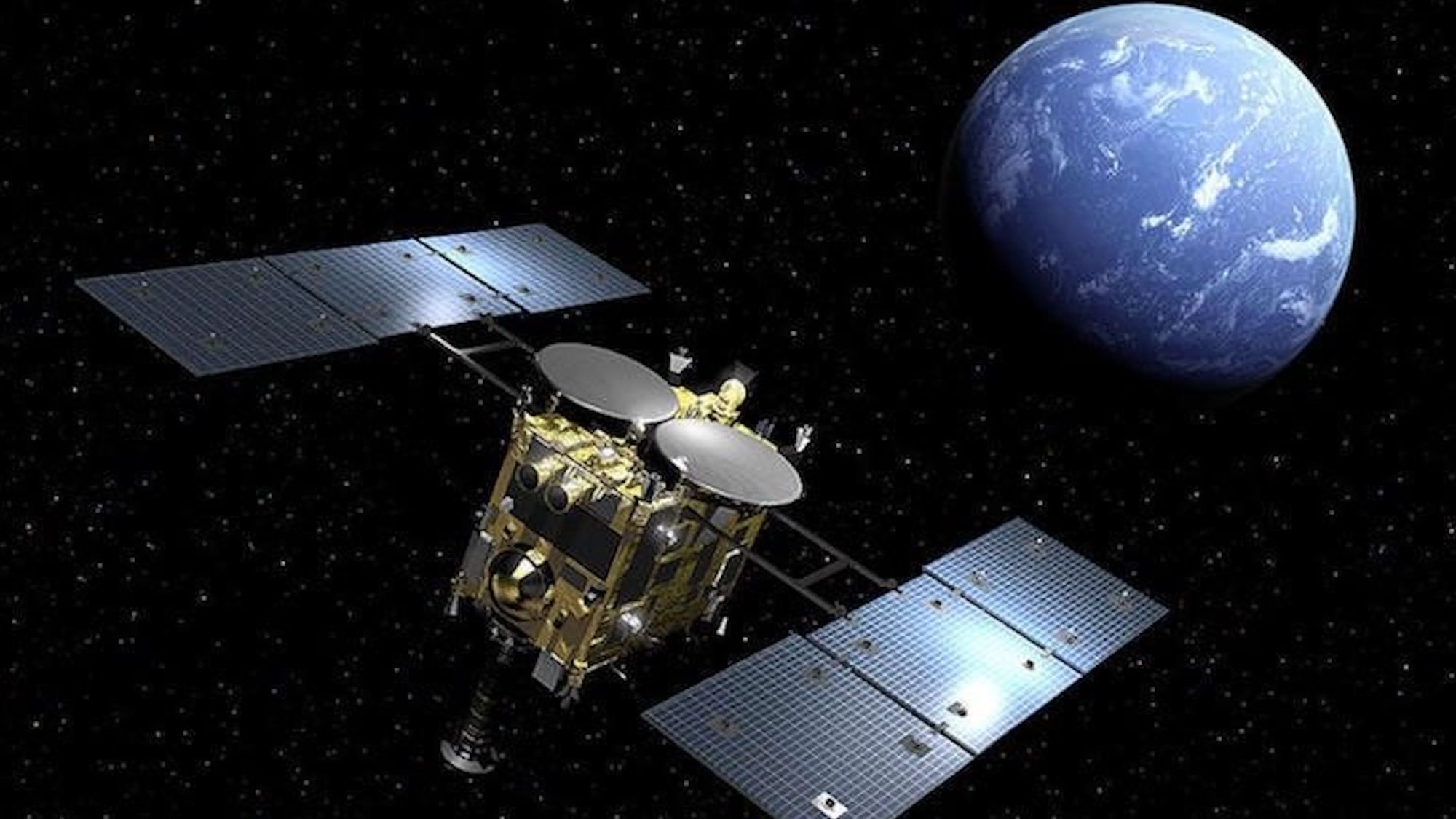
JAXA Hayabusa2 probe captures image of snowman-shaped asteroid Torifune
The Hayabusa2 spacecraft successfully completed a high-speed flyby of asteroid Torifune, proving Japan's capability to precisely target near-Earth objects.
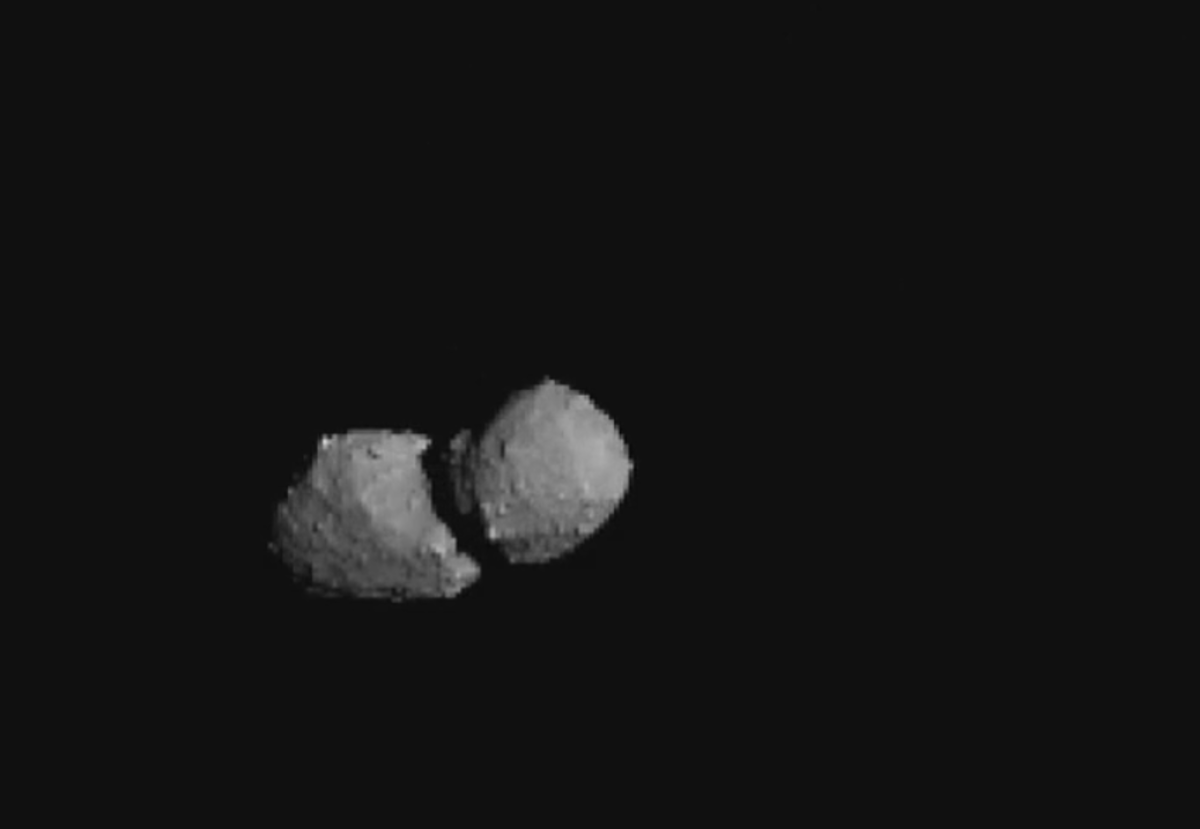
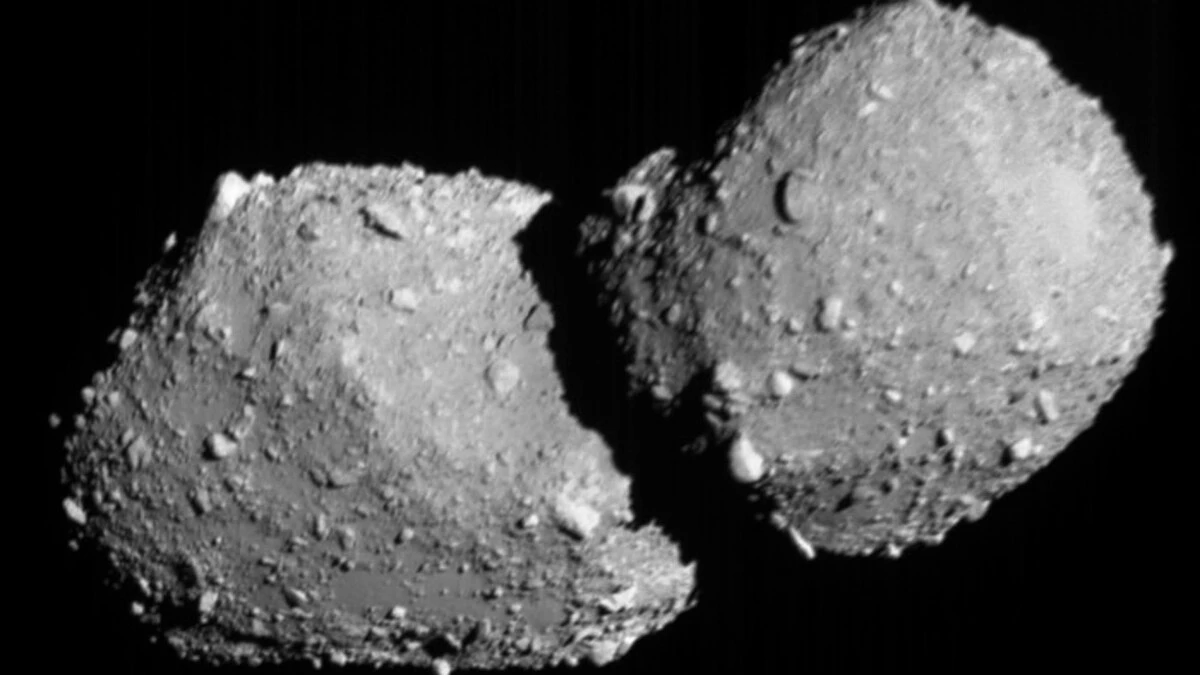
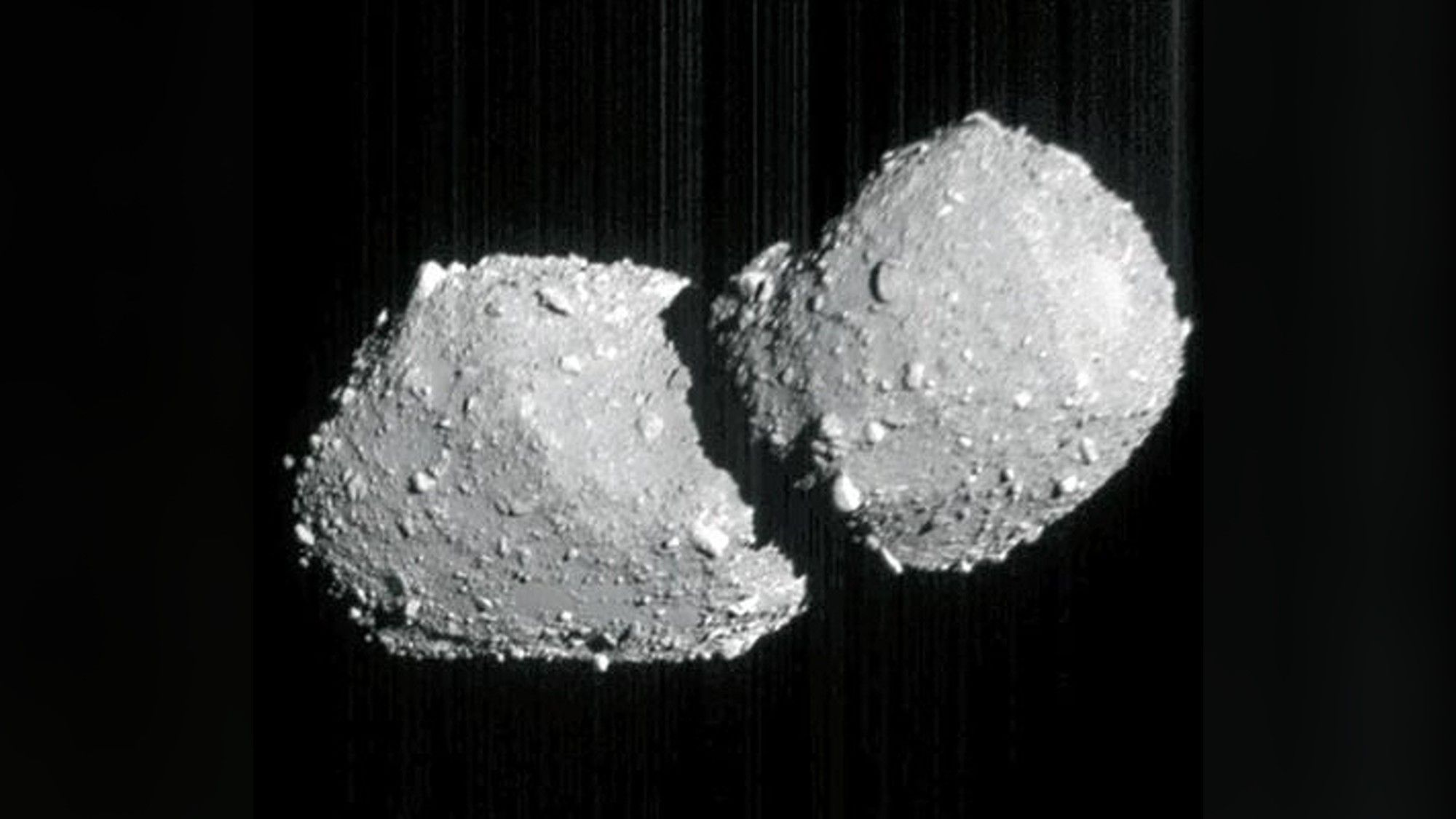
The Japan Aerospace Exploration Agency (JAXA) has released high-resolution imagery of asteroid Torifune, revealing that the near-Earth space rock resembles a snowman. The images were captured on July 5, 2026, during a high-speed flyby that served as a critical demonstration of planetary defense
technology intended to protect Earth from potential asteroid collisions.
The probe, Hayabusa2, raced past the asteroid at a relative speed of 5 kilometers per second—approximately 18,000km per hour—at 6:30 p.m. Japan time. The black-and-white photograph, taken by a telescopic camera just one second before the closest approach, shows two round celestial bodies joined together. According to JAXA, the distinctive shape suggests Torifune may have formed when two small celestial bodies collided and merged.
Related media

Yuya Mimasu, head of JAXA’s Hayabusa2 extended mission team, described the moment he saw the data as giving him goosebumps
. Speaking at a press conference in Tokyo on July 6, Mimasu stated:
"I can't forget how shocked I was when I saw the image. I was in awe about the fact that Hayabusa2 took such a good picture in a fleeting moment of the flyby."
Yuya Mimasu, JAXA Team Lead, via Nationthailand
Mimasu added that he had been nervous throughout the process and felt immense relief
following the success of the operation. He also expressed a desire to tell the probe that it did a good job
.
Precision Navigation and Planetary Defense
The flyby was categorized as a risky operation
due to unknowns surrounding the asteroid, according to reporting by Space. The spacecraft was expected to pass within 800 meters of the surface, though JAXA will determine the exact closest approach distance through later analysis. Some preliminary estimates suggest the probe was only a few hundred meters from Torifune. Mimasu noted that his goal was for the distance from the asteroid's center to be at least 800 meters.
JAXA Associate Professor Makoto Yoshikawa compared the technical difficulty of the maneuver to Yabusame
, the traditional Japanese art of archery from a galloping horse. He noted that the ability to target a body only a few hundred meters in size from a distance of 100 million kilometers demonstrates orbital guidance technology that is currently second only to that of the United States.
This capability is directly applicable to planetary defense, mirroring efforts such as NASA's 2022 test that successfully altered the orbit of the asteroid Dimorphos. While the U.S. Has led these efforts, Yoshikawa asserted that Japan is now capable of hitting an asteroid
.
Scientific Data and Observations
Beyond optical imagery, Hayabusa2 utilized a suite of scientific instruments to analyze the rocky asteroid, which is estimated to be 800 meters long and 400 meters wide. The probe successfully gathered readings from:
- The Mid-Infrared Camera (TIR): Used to measure surface temperatures, thermal inertia, and surface roughness. These images revealed that shadowed regions of Torifune are much cooler than areas facing the sun.
- NIRS3 (Near-Infrared Spectrometer):
- LIDAR (Light Detection and Ranging): Used to measure the distance from the spacecraft to the asteroid surface.
Observations began in mid-June, with the Optical Navigation Camera – Telescopic (ONC-T) directly imaging Torifune on June 20. These observations continued to support optical-radio hybrid navigation. JAXA confirmed on July 6 that it succeeded in acquiring data to examine the existence of water and measure distance. While some data has been transmitted to Earth, JAXA expects the remaining data to be sent by the end of the year.
An Extended Legacy
Hayabusa2 was launched in December 2014 from the Tanegashima Space Center in Kagoshima Prefecture. In December 2020, it delivered 5.4 grams of material from Ryugu to Earth, providing evidence of five nucleobases found in DNA and RNA. These samples have provided clues about the solar system at its birth some 4.6 billion years ago.
Because the probe retained approximately 30 kg of its original 66 kg of xenon propellant, engineers plotted an extended mission to visit further targets. This flexibility is described as the essence of Japan's space exploration technology.
The timing of the Torifune flyby coincided with a surge in Asian asteroid exploration. On July 6, Chinese authorities announced that the unmanned probe Tianwen-2 had reached asteroid Kamoʻoalewa, as reported by Ars Technica. This event has been characterized as a symbol of the intensifying space development race between the two nations.
Mission Timeline and Future Targets
| Date | Event / Target | Objective |
|---|---|---|
| December 2014 | Launch | Departure from Tanegashima Space Center |
| June 2018 | Ryugu Rendezvous | Survey and sample collection |
| December 2020 | Sample Return | Delivery of Ryugu capsule to Australia |
| July 5, 2026 | Torifune Flyby | Planetary defense test and imaging |
| July 2031 | 1998 KY26 | Planned rendezvous with an 11-meter asteroid |
Looking ahead, Hayabusa2 is expected to travel toward asteroid 1998 KY26. This target is significantly smaller than Torifune, measuring only 36 feet (11 meters) across. Upon arrival in 2031, the probe will orbit the rock before attempting a touchdown to help scientists understand the structure and composition of small asteroids.
How significant is this development?
Contribute your assessment to the aggregated reader intelligence ledger.
Archypedia is dedicated to independent, evidence-backed reporting. This briefing was synthesized from primary source reporting, corroborated across independent newsrooms, and verified against our Editorial Standards.
Transparency record
Evidence behind this report
This report synthesizes 10 distinct sources. Open the source ledger below to compare the underlying coverage.
- lifetechnology.com
- insiderpaper.com
- nationthailand.com
- www3.nhk.or.jp
- space.com
- finance.biggo.com
- global.jaxa.jp
- arstechnica.com
- scientificamerican.com
- en.wikipedia.org
Prepared under the Archypedia Editorial Policy by the Niko Vale editorial desk profile. AI-assisted tools may support drafting and verification; public accountability remains with Archypedia. Report an error.