DGIST-Caltech team develops efficient photocatalyst to turn CO2 into fuel
International research teams are developing advanced catalysts, including photocatalysts and copper nanoclusters, to convert carbon dioxide into chemical fuels. These atomic-level modifications aim to improve efficiency and product selectivity for future industrial applications.

Researchers are making advancements in carbon dioxide conversion technology, focusing on methods to transform greenhouse gas emissions into high-value chemical fuels. By manipulating materials at the atomic level, various international teams are overcoming traditional barriers in catalytic efficiency and product selectivity, with multiple studies reported as of July 6, 2026.
Solar-Driven Methane Production
A joint research team from DGIST, led by Professor Suil In, and the California Institute of Technology, led by Professor William A. Goddard III, has developed a photocatalyst that converts carbon dioxide into methane using sunlight. This process functions as a form of artificial photosynthesis. The catalyst structure combines silver sulfide nanowires with amorphous titanium dioxide. To improve performance, the team introduced defects into the titanium dioxide to create titanium tertiary (Ti³⁺) active sites. This structure, combined with non-stoichiometric silver sulfide nanowires, facilitates efficient charge separation through a Z-scheme channel. In a concentrating reactor environment, this catalyst achieved a methane production rate of 30.31 μmol/g, a fivefold increase compared to standard conditions. The findings were published in the journal ACS Catalysis.
Related media


Atomic Engineering of Copper Catalysts
Parallel research focuses on electrochemical reduction, using copper-based nanoclusters to catalyze the conversion of carbon dioxide. While copper is an abundant material capable of forming carbon–carbon bonds, standard copper catalysts often produce unwanted byproducts such as formate. To address this, a team from Tohoku University and the Indian Institute of Technology Indore, led by Professor Yuichi Negishi, developed a sulfide-templated copper nanocluster, [S@Cu₅₀S₁₂(StBu)₂₀(CF₃COO)₁₂]. By modulating the Cu(I)/Cu(II) valence ratio within a core-shell architecture, the team successfully suppressed formate production to below 11% while promoting the selective production of methanol. These findings were published on June 30, 2026, in JACS Au.
In another study, researchers at Tsinghua University addressed copper's tendency to oxidize at the nanoscale by developing a stable "superatom" cluster, [Cu₄₅ H₆ (C≡CR)₁₈ (OAc)₁₅], referred to as Cu₄₅. This cluster features a protective shell of organic ligands that resists heat and oxidation. Testing showed that the Cu₄₅ system achieved a high efficiency in converting carbon dioxide into multi-carbon products, with ethylene accounting for 58% of the output. This performance surpassed standard commercial copper nanoparticles by 17%.
Comparative Performance of Copper-Based Nanocatalysts
| Catalyst System | Primary Output | Key Innovation |
|---|---|---|
| S@Cu₅₀ Nanocluster | Methanol | Modulated Cu(I)/Cu(II) valence ratio |
| Cu₄₅ Superatom | Ethylene, Ethanol, Acetic Acid | Ligand-protected shell |
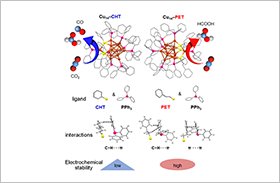
| Cu₁₄ Nanocluster | Variable Selectivity | Ligand engineering (PET vs CHT) |
Ligand Engineering and Stability
Scientists are also refining catalyst performance through "ligand engineering," which involves modifying molecules attached to the surface of copper clusters. A collaborative study involving the University of Adelaide, Tohoku University, and the Tokyo University of Science demonstrated that altering thiolate ligands on Cu₁₄ nanoclusters shifts product selectivity. According to Professor Yuichi Negishi, modifying these surfaces is a precise task, noting:
"However, it's very challenging since the geometry of the NCs was heavily dependent on the precise parts that we needed to alter. It was like trying to move a supporting pillar of a building."
Yuichi Negishi, Professor at Tohoku University, via Tohoku University
Experts note that while these atomic-level modifications show promise in laboratory settings, challenges remain. As highlighted by researchers at Khalifa University, the next stage of development involves achieving high selectivity at industrial scales. The objective is to design systems that can consistently produce high-purity chemicals to prove the industrial viability of these atomic-level design strategies.
How significant is this development?
Contribute your assessment to the aggregated reader intelligence ledger.
Archypedia is dedicated to independent, evidence-backed reporting. This briefing was synthesized from primary source reporting, corroborated across independent newsrooms, and verified against our Editorial Standards.
Transparency record
Evidence behind this report
This report synthesizes 9 distinct sources. Open the source ledger below to compare the underlying coverage.
- www2.tagen.tohoku.ac.jp
- eurekalert.org
- news.sustainability-directory.com
- shorty-news.com
- tohoku.ac.jp
- ku.ac.ae
- tus.ac.jp
- sciencedaily.com
- chemistryworld.com
Prepared under the Archypedia Editorial Policy by the Niko Vale editorial desk profile. AI-assisted tools may support drafting and verification; public accountability remains with Archypedia. Report an error.