Great apes and humans share rhythmic laughter patterns dating back 15 million
A study identifying shared rhythmic structures in the laughter of humans and great apes suggests our vocal control evolved gradually over millions of years.

Great apes and humans share rhythmic laughter patterns dating back 15 million years
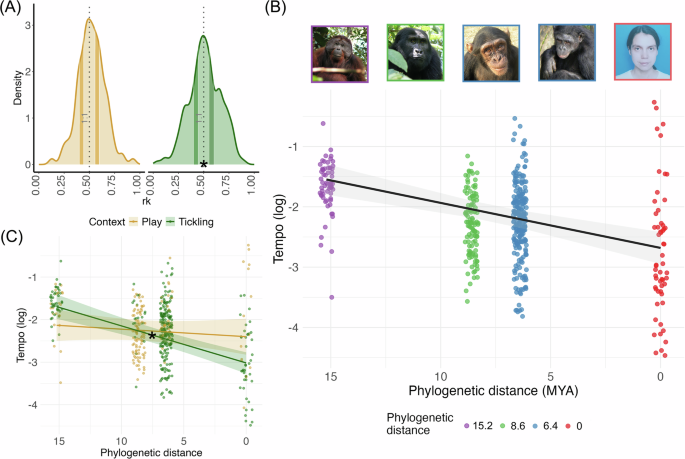
A study published on 25 June 2026 suggests that the vocal roots of humanity run deeper than previously understood, extending back through an evolutionary timeline of 15 million years. Researchers from the University of Warwick have identified that humans and great apes — chimpanzees, bonobos, gorillas, and orangutans — share a consistent, rhythmic structure in their laughter. This discovery, detailed in the journal Communications Biology, offers a new perspective on the evolution of speech, a trait that leaves no fossils behind.
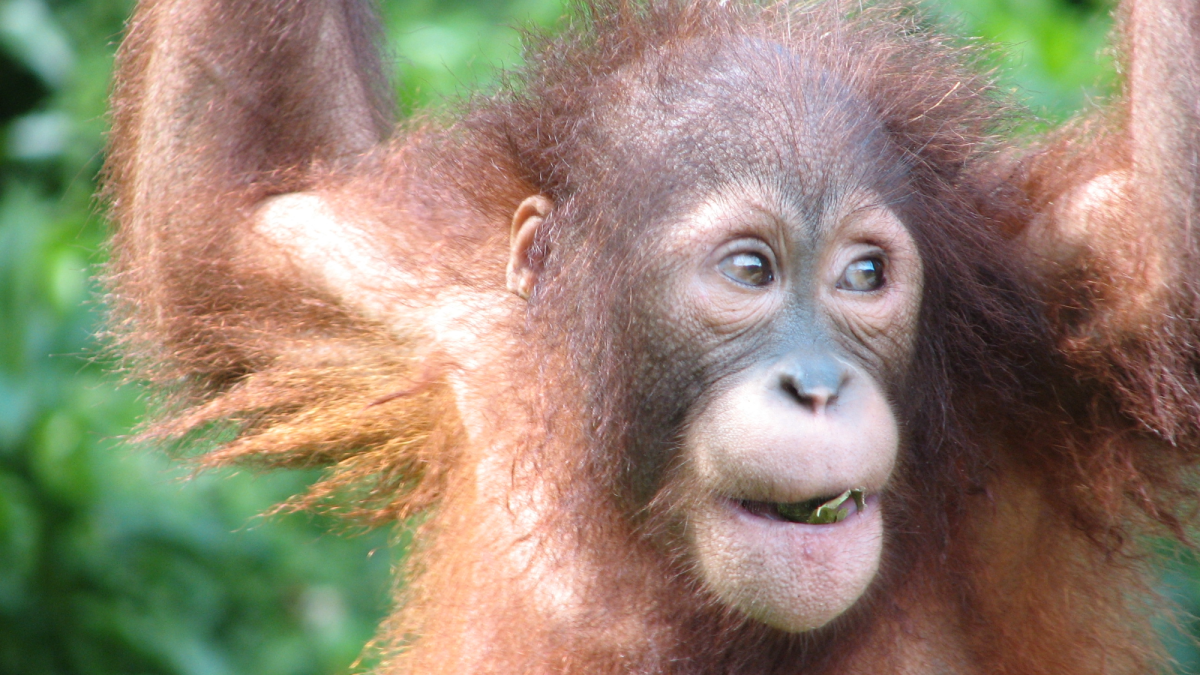
The research team, led by primatologist Chiara De Gregorio, examined 140 laughter sequences recorded from four orangutans, two gorillas, three bonobos, four chimpanzees, and four human children between six months and seven years of age. By focusing on the intervals between successive bursts of sound rather than pitch or volume, the scientists determined that all five species maintain evenly spaced, isochronous rhythms when tickled.
Related media


Evolutionary continuity
According to the authors, this rhythmic skeleton was likely present in the common ancestor shared by all living great apes 15 million years ago. Simon Townsend, who studies primate communication at the University of Zurich, notes that the analysis supports an growing body of data suggesting that great apes possess more control over their vocal systems than earlier scientific models assumed. This indicates a gradual accumulation of vocal capabilities rather than a sudden, uniquely human leap.
"Contrary to the classic notion that the first humans suddenly acquired vocal control capacities remarkably different from their predecessors, laughter evolution tells us that humans lay on a continuum, a prolongation of vocal control capacities that were already being cumulatively honed in for 15 million years."
Adriano Lameria, Associate Professor at the University of Warwick, via University of Warwick
The divergence of human laughter
While the underlying rhythm remains conserved across the hominid family, human laughter has diverged in significant ways. As evolution progressed, human laughter became faster, more varied, and increasingly subject to context-dependent control. While great apes primarily use laughter during play or tickling, humans have developed the ability to modulate their laughter for social purposes, such as expressing nervousness, maintaining politeness in formal settings, or signaling irony.
Researchers suggest that as social structures became more intricate throughout human evolution, the pressure to communicate nuanced social signals drove the development of the precise vocal tract control, involving the tongue, lips, and breathing, required for language.
Future directions in primate research
The findings have prompted further discussion regarding the scope of such vocal studies. Brittany Florkiewicz, a researcher at Lyon College who was not involved in the study, noted that the results highlight the need for broader investigations. She suggests that recording other mammals known to display "play faces," such as dogs, horses, and cats, could clarify whether these rhythmic traits are exclusive to the great ape lineage or shared more widely across the animal kingdom.
Research highlights
- Species studied: Orangutans, gorillas, bonobos, chimpanzees, and humans.
- Methodology: Comparison of 140 laughter sequences recorded during spontaneous play and tickling.
- Key finding: All species exhibit an evenly spaced, isochronous rhythm in laughter.
- Human distinction: Humans show greater speed, higher variability, and context-dependent control.
- Scientific implication: Laughter provides a pathway to understanding the gradual evolution of vocal control required for speech.
How significant is this development?
Contribute your assessment to the aggregated reader intelligence ledger.
Archypedia is dedicated to independent, evidence-backed reporting. This briefing was synthesized from primary source reporting, corroborated across independent newsrooms, and verified against our Editorial Standards.
Transparency record
Evidence behind this report
This report synthesizes 12 distinct sources. Open the source ledger below to compare the underlying coverage.
- apnews.com
- nature.com
- popsci.com
- bbc.co.uk
- sciencealert.com
- yahoo.com
- nationalgeographic.com
- discoverwildlife.com
- detroitnews.com
- devdiscourse.com
- ap.org
- warwick.ac.uk
Prepared under the Archypedia Editorial Policy by the Niko Vale editorial desk profile. AI-assisted tools may support drafting and verification; public accountability remains with Archypedia. Report an error.