Earth reaches annual aphelion as farthest point from the Sun
Earth has reached its annual farthest point from the Sun, highlighting the role of axial tilt over orbital distance in creating seasons.

Earth reached its annual aphelion on Monday, July 6, 2026, marking the point in its orbit farthest from the Sun. According to Space & Telescope, the event occurred at 17:31 UTC, with the planet sitting 1.0166440 AU — approximately 152.1 million kilometers — away from the star. Despite this maximum distance, the Northern Hemisphere is currently experiencing summer, a paradox that reinforces a fundamental astronomical reality: the planet's distance from the Sun does not dictate the seasons.
The phenomenon is the result of Earth's elliptical, or "egg-shaped," orbit. FreeAstroScience reports that at the precise moment of aphelion, Earth was 152,087,775 kilometers from the Sun's center. This is about 5 million kilometers farther than it was during perihelion, the closest point in the orbit, which occurred on January 3, 2026, at roughly 147.1 million kilometers.
Related Instagram post


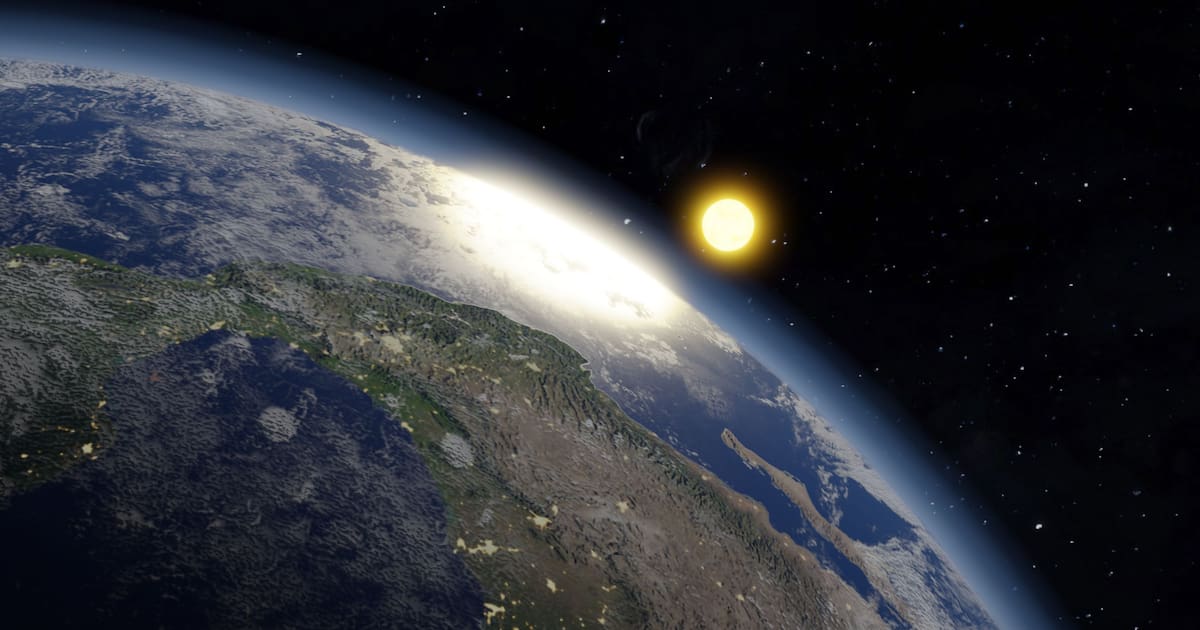
The Tilt vs. Distance Debate
The timing of aphelion often leads to misconceptions about why the Northern Hemisphere remains hot in July. However, scientists from the Jeddah Astronomy Society and the Noor Astronomy Society, cited by Arab News, clarify that seasonal changes are driven by Earth's axial tilt rather than its distance from the Sun.
Majed Abu Zahra, director of the Jeddah Astronomy Society, stated that the approximately 23.4-degree tilt of Earth's rotational axis allows the Sun's rays to strike the Northern Hemisphere more directly during the summer, even while the planet is at its most distant point. This is echoed by Cronista, which notes that NASA confirms a 23.5-degree angle produces the seasons. When the northern half of the globe tilts toward the Sun, it receives more direct sunlight, resulting in summer regardless of the orbital gap.
The impact of this tilt is far more significant than the orbital distance. FreeAstroScience notes that at a latitude of 45 degrees, solar energy arriving at noon in summer reaches about 250% of the winter value. In contrast, the extra 5 million kilometers of distance at aphelion only trims incoming sunlight slightly.
Orbital Speed and Seasonal Length
While distance does not cause the seasons, it does influence their duration. Based on Kepler’s second law of planetary motion, planets travel more slowly when they are farther from the Sun. Earthsky explains that because Earth is traveling at its slowest point in early July, the Northern Hemisphere's summer is longer than its winter.
The difference in orbital speed is measurable. According to FreeAstroScience, Earth's speed at perihelion in January is about 30.3 km/s (over 109,000 km/h), but it slows to roughly 29.3 km/s (around 105,480 km/h) at aphelion. This slow-down makes the Northern Hemisphere's summer nearly five days longer than its winter.
The effect is reversed for the Southern Hemisphere, where summer is the shortest season of the year. Forbes reports that while the general difference is about four days, gravitational influences from the Sun, Moon, and Jupiter can cause slight year-to-year variations in the orbital path.
Visual and Temporal Shifts
At aphelion, the Sun appears slightly smaller in the sky than it does at perihelion. Space & Telescope reports that the Sun appears about 3.4% smaller, though it notes this difference is too small to be detected by the naked eye. Forbes specifies this as a mere arcminute, or 1/60th of a degree, smaller than at perihelion.
The date of aphelion is not fixed and typically wanders between July 3 and July 7. FreeAstroScience attributes this drift to three factors:
- The Calendar: Earth's orbital year is 365 days and 6 hours, causing the event to slip about 6 hours annually before leaping back during leap years.
- The Moon: The satellite's gravitational pull causes Earth to wobble slightly around their common center of mass.
- Planetary Gravity: The gravitational pull of other planets slowly reshapes the orbit.
Comparative Orbital Extremes
| Metric | Perihelion (Closest) | Aphelion (Farthest) |
|---|---|---|
| Approximate Date | Early January | Early July |
| Distance (km) | ~147.1 million | ~152.1 million |
| Orbital Speed | ~30.3 km/s | ~29.3 km/s |
| Sun's Apparent Size | Largest | Smallest (3.4% smaller) |
Looking ahead, the dates of these extremes continue to drift. EarthSky reports that the perihelion and aphelion dates have shifted by one day every 58 years since 1246. Astronomers estimate that in the year 6430, perihelion will coincide with the March equinox.
How significant is this development?
Contribute your assessment to the aggregated reader intelligence ledger.
Archypedia is dedicated to independent, evidence-backed reporting. This briefing was synthesized from primary source reporting, corroborated across independent newsrooms, and verified against our Editorial Standards.
Transparency record
Evidence behind this report
This report synthesizes 10 distinct sources. Open the source ledger below to compare the underlying coverage.
- arabnews.com
- spaceandtelescope.com
- earthsky.org
- forbes.com
- cronista.com
- arabnews.pk
- saudigazette.com.sa
- aol.com
- foxweather.com
- freeastroscience.com
Prepared under the Archypedia Editorial Policy by the Niko Vale editorial desk profile. AI-assisted tools may support drafting and verification; public accountability remains with Archypedia. Report an error.