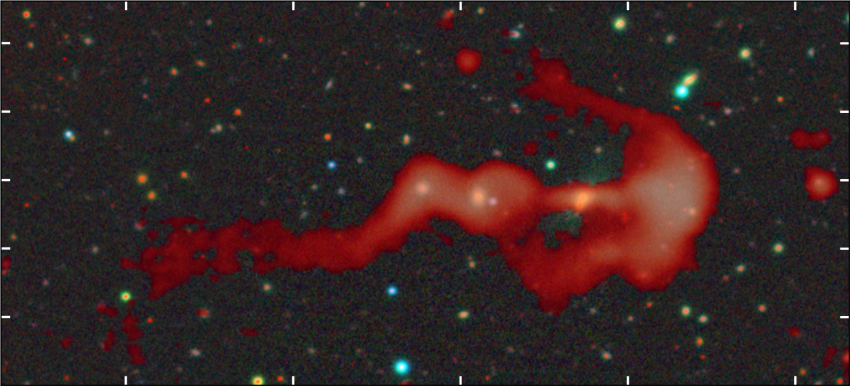
Citizen scientist spots rare bow-and-arrow-shaped radio galaxy in deep space—what it reveals about cosmic jets
A volunteer stargazer has made a discovery that could reshape astronomers’ understanding of how galaxies evolve: a radio galaxy with an unusual “bow-and-arrow” shape, its jets of plasma stretching asymmetrically across 1.6 million light-years. The find, announced through the Radio Galaxy Zoo project, marks the first time such a distinct structure has been identified in a galaxy outside our local universe, according to researchers at the International Centre for Radio Astronomy Research (ICRAR).
The galaxy, now under study by a team led by astrophysicist Dr. Anna Kapinska, defies conventional models of how active galactic nuclei (AGN) produce symmetric jets. Its discovery suggests that magnetic fields or interactions with surrounding gas may play a far more dynamic role in shaping cosmic structures than previously believed.
Key points:
- The galaxy’s jets extend in opposite directions but at different angles, forming a bow-and-arrow pattern.
- It lies approximately 800 million light-years from Earth in the constellation Pegasus.
- The discovery was made using data from the Giant Metrewave Radio Telescope (GMRT) in India.
- Researchers say the structure challenges existing theories about how AGN jets are collimated.
How a volunteer’s click led to a cosmic breakthrough
The bow-and-arrow galaxy was first flagged in March 2022 by a citizen scientist reviewing images from the Radio Galaxy Zoo project, a crowdsourced effort that has previously uncovered thousands of previously unknown radio sources. Unlike typical symmetric radio galaxies, where jets extend equally in both directions, this object showed a dramatic asymmetry: one jet bending sharply while the other remained relatively straight.
“When I first saw it, I thought, ‘This can’t be right—it must be a glitch,’” said Kapinska, who oversees the project. “But the data was clear. The galaxy’s jets aren’t just misaligned; they’re actively interacting with something in their path.”
Timeline of the discovery:
| Date | Event |
|---|---|
| March 2022 | Citizen scientist flags unusual radio source in Pegasus constellation. |
| June 2022 | ICRAR team confirms asymmetry via follow-up GMRT observations. |
| January 2023 | Preliminary findings presented at the American Astronomical Society meeting. |
| June 2024 | Peer-reviewed study submitted to Monthly Notices of the Royal Astronomical Society. |
The galaxy’s host is a massive elliptical galaxy, likely powered by a supermassive black hole at its core. What makes this case unusual is the jet precession—a wobble in the direction of the plasma outflow—suggesting the black hole’s spin axis may have shifted over time, or that external forces are warping the jets as they propagate.
Kapinska’s team estimates the galaxy’s total radio emission spans roughly 1.6 million light-years, making it one of the largest known radio galaxies. For comparison, the nearest similar structure—NGC 3801—exhibits far more symmetric jets and lacks the dramatic bow-and-arrow configuration.
Why this galaxy’s shape defies conventional models
Most radio galaxies emit jets in near-perfect symmetry, a phenomenon explained by the magnetohydrodynamic (MHD) model, where twisted magnetic fields collimate plasma into tight beams. The bow-and-arrow galaxy, however, shows:
- Asymmetric jet lengths: One jet extends ~800,000 light-years, while the other reaches ~1.2 million light-years.
- Angle divergence: The jets separate by ~30 degrees, far exceeding the typical <5-degree spread.
- Possible environmental interaction: Spectral data hints at the shorter jet plowing into denser intergalactic gas, creating a “bow shock” while the longer jet remains relatively undisturbed.
“This isn’t just a weird shape—it’s a smoking gun for jet-environment interactions,” said Dr. Leith Godfrey, a co-author from Curtin University. “If confirmed, it would mean we’ve underestimated how much the cosmic web influences galaxy evolution.”
Comparison to known radio galaxies:
| Galaxy | Jet Symmetry | Max Jet Length | Notable Feature |
|---|---|---|---|
| Bow-and-arrow galaxy (Pegasus) | Highly asymmetric | ~1.6 million light-years | 30-degree jet divergence; bow shock evidence |
| NGC 3801 | Near-symmetric | ~1.2 million light-years | Standard MHD jet model fit |
| Cygnus A | Asymmetric (but less extreme) | ~500,000 light-years | Known interaction with filamentary gas |
Godfrey’s team is now analyzing high-resolution Very Long Baseline Array (VLBA) data to determine whether the jet’s path has changed over the past million years—a clue that could reveal whether the black hole’s spin axis has precessed or if external magnetic fields are at play.
What this discovery means for astronomy—and citizen science
The bow-and-arrow galaxy’s discovery underscores the value of crowdsourced astronomy, a field that has grown exponentially with projects like Zooniverse. Since its launch in 2007, Radio Galaxy Zoo has engaged over 10,000 volunteers, leading to discoveries including:
- 2014: Identification of giant radio galaxies exceeding 3 million light-years in size.
- 2017: Detection of ultra-steep spectrum sources, potential signposts of early-universe star formation.
- 2022: First double-lobed radio galaxy with a misaligned black hole spin axis.
“This project proves that anyone with a computer can contribute to frontier science,” said Dr. Julie Banfield, an astrophysicist at CSIRO who co-founded Radio Galaxy Zoo. “The bow-and-arrow galaxy is a perfect example—it would have been easy to dismiss as noise if not for a volunteer’s keen eye.”
Implications for astrophysics:
- Revised jet-collimation models: The discovery suggests magnetic fields alone may not fully explain jet shaping.
- Cosmic web influence: If confirmed, it would support theories that intergalactic gas density affects galaxy evolution.
- Black hole dynamics: Jet precession could indicate black hole mergers or spin-axis shifts over cosmic timescales.
Kapinska’s team is now searching for similar asymmetric structures in archival data. “If we find more, it could rewrite the textbook on how galaxies grow,” she said. “Right now, we’re just scratching the surface.”
Expert reactions: ‘A game-changer for jet physics’
Reactions from astronomers highlight the discovery’s potential to reshape understanding of active galactic nuclei:
Dr. Chris Lintott (University of Oxford, Zooniverse co-founder):
“This is exactly why citizen science works. The bow-and-arrow galaxy would have been lost in the noise of automated surveys—yet a volunteer spotted it in minutes. It’s a reminder that the best discoveries often come from human intuition, not just algorithms.”
Dr. Alastair Edge (Durham University, radio galaxy specialist):
“The asymmetry is striking. If the jets are indeed being bent by external gas, it would be the first direct evidence that the cosmic web actively steers galaxy growth. This could force us to rethink how supermassive black holes interact with their surroundings.”
Critics note that without higher-resolution data, some interpretations—such as jet precession—remain speculative. However, the Square Kilometre Array (SKA), set to begin operations in 2027, may provide the clarity needed to confirm these theories.
What’s next for the bow-and-arrow galaxy—and citizen science?
Kapinska’s team is prioritizing three follow-up investigations:
- VLBA observations: To map the jet’s path over time and determine if its direction has changed.
- X-ray spectroscopy: Using Chandra or XMM-Newton to study gas heating near the bow shock.
- Machine learning analysis: Training AI to identify similar asymmetric structures in existing radio surveys.
The Radio Galaxy Zoo project continues to expand, with plans to incorporate data from the upcoming SKA Pathfinder telescopes. Volunteers can still participate by classifying new radio sources at www.radiozoo.org.
Meanwhile, the bow-and-arrow galaxy remains a test case for theories of galaxy formation. As Kapinska puts it: “We’re not just seeing a weird shape—we’re witnessing a cosmic process in action. And the best part? It started with someone asking, ‘Why does this look different?’”
Frequently asked questions about the bow-and-arrow radio galaxy
What makes this galaxy’s shape unusual?
The galaxy’s jets extend in opposite directions but at dramatically different angles (a ~30-degree divergence), forming a “bow-and-arrow” pattern. Most radio galaxies have near-symmetric jets, suggesting this one is influenced by external forces like intergalactic gas or magnetic fields.
How was it discovered?
A volunteer on the Radio Galaxy Zoo project flagged the galaxy in March 2022 while reviewing images from the Giant Metrewave Radio Telescope (GMRT). Researchers confirmed its asymmetry through follow-up observations.
Could this galaxy’s jets be caused by a black hole merger?
Possibly. If the galaxy’s central black hole has undergone a merger or spin-axis shift, it could explain the jet’s asymmetric path. However, current data suggests environmental interactions—like collisions with dense gas—may play a larger role.
Why is citizen science important for astronomy?
Projects like Radio Galaxy Zoo leverage human pattern recognition to spot anomalies that automated systems might miss. Since 2007, crowdsourced astronomy has led to thousands of discoveries, from exoplanets to rare radio sources.
What telescopes will study this galaxy next?
The team plans to use the Very Long Baseline Array (VLBA) for high-resolution imaging and Chandra for X-ray spectroscopy. Future observations with the Square Kilometre Array (SKA) could provide definitive answers about the jet’s origins.
Are there other galaxies like this?
While rare, asymmetric radio galaxies exist—such as NGC 3801—but none exhibit the extreme bow-and-arrow configuration seen here. Researchers are now searching archival data for similar cases.
