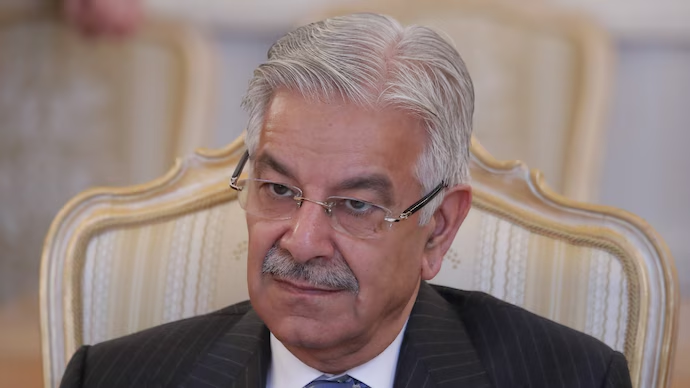
Pakistan’s PM Pushes Reconciliation Amid Political Tensions: What Khawaja Asif’s Stance Means for Democracy
ISLAMABAD — Pakistan’s economy has stabilized after years of crisis, but political divisions remain a major hurdle as Prime Minister Shehbaz Sharif’s government navigates protests, economic recovery, and calls for national unity. In a rare public address, Finance Minister and senior leader Khawaja Asif framed the government’s approach as a deliberate shift toward political reconciliation and the establishment of new democratic traditions—even as opposition parties escalate rhetoric and regional tensions flare.
Speaking at a high-level economic forum, Asif emphasized that Pakistan’s post-IMF recovery depends not just on fiscal reforms but on bridging the deep political fractures that have paralyzed governance. His remarks come as lawmakers clash over budget priorities, separatist movements in Azad Kashmir intensify, and the military’s role in national stability remains a contentious topic. Analysts say Asif’s push for reconciliation reflects a strategic effort to consolidate support ahead of critical economic reforms and potential elections.
Yet the path forward is complicated. While Asif’s government points to economic progress—including a 4.7% GDP growth forecast for the fiscal year—opposition parties accuse the ruling coalition of backtracking on democratic commitments. Meanwhile, the defense minister’s recent warnings about “complete obedience to state” amid unrest in Azad Kashmir highlight the delicate balance between civilian leadership and military authority.
What does this mean for Pakistan’s political future? And how will Asif’s calls for reconciliation play out against a backdrop of economic recovery, regional instability, and deep-seated political divisions?
—
What Khawaja Asif’s Reconciliation Push Actually Means
Khawaja Asif’s recent statements mark a deliberate pivot in the government’s political strategy, one that goes beyond economic recovery to address the structural weaknesses in Pakistan’s democratic institutions. His framing centers on three key pillars:
- Political reconciliation: Acknowledging that Pakistan’s democracy has been strained by frequent crises, Asif’s government is positioning itself as a mediator between rival factions. This includes outreach to opposition leaders, though progress has been slow.
- New democratic traditions: Asif has repeatedly stressed the need for institutional reforms to prevent the cyclical breakdowns that have plagued past administrations. This includes calls for a more transparent budget process and reduced military interference in civilian matters.
- Economic stability as a unifying force: By highlighting Pakistan’s exit from the IMF’s “intensive care unit” (as Asif phrased it), the government aims to shift public focus from political squabbles to shared economic gains.
However, the challenge lies in execution. While Asif’s rhetoric aligns with international calls for democratic consolidation, his government’s track record on reforms remains mixed. Critics argue that past attempts at reconciliation—such as the 2017 military-backed political settlement—often led to short-term stability but failed to address root causes of division.
Key Point: Asif’s approach is less about grand gestures and more about incremental changes, such as:
- Encouraging dialogue between the ruling Pakistan Muslim League-Nawaz (PML-N) and opposition parties like the Pakistan Tehreek-e-Insaf (PTI).
- Pushing for a more inclusive budget approval process in the National Assembly (NA), where verbal clashes have become routine.
- Publicly distancing the government from hardline stances on regional issues, such as Azad Kashmir, to avoid provoking further unrest.
Yet, as one political analyst noted, “Reconciliation in Pakistan is often a euphemism for compromise. The real test will be whether Asif can deliver tangible reforms—not just rhetoric.”
—
Who Is Khawaja Asif, and Why Does His Stance Matter?
As Pakistan’s finance minister and a key strategist in Prime Minister Shehbaz Sharif’s cabinet, Khawaja Asif has emerged as the public face of the government’s economic and political recovery efforts. A seasoned politician with decades in national and provincial governments, Asif’s influence stems from his dual role:
- Economic architect: He spearheaded the negotiations with the IMF that led to a $3 billion bailout package, a critical step in stabilizing Pakistan’s foreign reserves.
- Political troubleshooter: Asif has mediated between rival factions within the PML-N and, more cautiously, with opposition leaders like Imran Khan’s PTI.
His recent warnings—such as the “beginning of sedition” remark in response to protests in Azad Kashmir—reflect a tougher stance on national security, but they also underscore the government’s vulnerability. By citing the Quran to justify state authority, Asif is appealing to conservative constituencies while attempting to undercut separatist movements.
Why it matters: Asif’s dual role as both an economic stabilizer and a political mediator makes him a linchpin in Pakistan’s current transition. His ability to navigate these tensions will determine whether the government can sustain its recovery—or if it risks repeating the cycles of instability that have defined Pakistan’s political history.
—
When and Where Is This Happening?
The push for reconciliation is unfolding against a backdrop of multiple crises, each with its own timeline and geographic focus:
| Issue | Timeline | Location | Key Developments |
|---|---|---|---|
| Economic Recovery | 2023–Present | National (Islamabad, Karachi, Lahore) |
|
| Political Reconciliation Efforts | 2024–Ongoing | Islamabad (National Assembly) |
|
| Azad Kashmir Unrest | March–June 2024 | Muzaffarabad, Mirpur, and other regions |
|
While economic recovery is a national issue, the political and regional tensions are concentrated in specific areas. The National Assembly in Islamabad remains the epicenter of political negotiations, while Azad Kashmir’s unrest highlights the government’s struggle to maintain control over peripheral regions.
—
Why This Matters: The Broader Context of Pakistan’s Political Crisis
Pakistan’s current political landscape is shaped by three intersecting crises:

- The IMF and economic survival: The country’s reliance on international bailouts has become a symbol of its inability to achieve self-sustaining growth. Asif’s economic management is critical, but public trust remains fragile.
- Democratic erosion vs. consolidation: Pakistan’s history of military interventions and political instability has led to a cycle where every government must prove its legitimacy. Asif’s calls for “new democratic traditions” are an attempt to break this cycle.
- Regional instability: Unrest in Azad Kashmir and Balochistan reflects long-standing grievances over resource distribution and political representation. The government’s handling of these issues could determine its long-term stability.
Comparison: Asif’s approach contrasts sharply with past attempts at reconciliation, such as the 2017 “political settlement” brokered by the military. That agreement temporarily reduced tensions but ultimately failed to address structural issues like judicial independence and military-civilian relations. This time, Asif is betting on economic progress as a catalyst for political unity—a strategy that has worked in some emerging democracies but remains untested in Pakistan’s context.
One expert compared the situation to South Africa’s post-apartheid reconciliation efforts, where economic recovery and truth commissions played key roles in healing divisions. “Pakistan doesn’t have the same historical context, but the principle is similar: economic stability can create the space for political dialogue,” the analyst said.
—
Reactions: How Opposition Parties and Experts Are Responding
The government’s reconciliation push has drawn mixed reactions:
- Pakistan Tehreek-e-Insaf (PTI): Opposition leader Imran Khan’s party has dismissed Asif’s overtures as insincere, accusing the government of using economic recovery as a smokescreen for political repression. PTI lawmakers have continued to disrupt budget sessions, though with reduced intensity.
- Military establishment: While publicly supportive of civilian governance, military leaders have privately urged caution, particularly on regional issues like Azad Kashmir. The defense minister’s recent statements suggest a hardening stance on separatist movements.
- International community: The IMF and Western donors have welcomed Pakistan’s economic progress but have urged deeper political reforms. The U.S. and EU have expressed concern over rising tensions in Azad Kashmir.
- Civil society: Activists and human rights groups have praised Asif’s calls for dialogue but warn that without concrete steps—such as judicial reforms and reduced military influence—reconciliation will remain hollow.
Key Quote: “The biggest challenge isn’t the opposition—it’s the government’s own inability to deliver on promises,” said Dr. Ayesha Siddiqa, a defense and security analyst. “Asif’s economic achievements are real, but political reconciliation requires more than speeches. It requires action on the ground.”
—
What Happens Next? Three Scenarios for Pakistan’s Political Future
The coming months will be critical in determining whether Asif’s reconciliation efforts gain traction. Three possible outcomes emerge from current trends:

- The Dialogue Scenario: If opposition parties like PTI respond to Asif’s overtures, Pakistan could see a rare period of political cooperation. This would likely focus on:
- Passing the budget without major disruptions.
- Agreeing on judicial reforms to reduce military influence.
- Launching economic initiatives to benefit marginalized regions like Azad Kashmir.
This scenario would require significant concessions from both sides and remains unlikely in the short term.
- The Stalemate Scenario: More probable is a continuation of the current dynamic—economic progress without meaningful political reconciliation. Key indicators:
- Budget approved but with ongoing disputes.
- Protests in Azad Kashmir continue, but without escalating into full-scale unrest.
- Military maintains a low profile but remains a silent arbiter.
This would keep Pakistan in a state of uneasy stability, with no major breakthroughs.
- The Crisis Scenario: If tensions in Azad Kashmir escalate or economic recovery stalls, the government could face a legitimacy crisis. Possible triggers:
- A major protest turning violent in Kashmir.
- Failure to meet IMF targets, leading to another bailout request.
- Military intervention in political disputes.
This would risk derailing Asif’s economic gains and plunging Pakistan back into instability.
What to Watch: The next budget session in July and the government’s response to Azad Kashmir protests will be critical. If Asif can secure even a partial agreement with PTI, it could mark a turning point. If not, Pakistan may be heading toward another period of political paralysis.
—
Common Misconceptions About Pakistan’s Political Reconciliation Efforts
Several myths persist about Asif’s push for reconciliation and its chances of success:
- Myth: This is just another political gimmick.
Reality: While past reconciliation efforts have failed, Asif’s approach is distinct in its focus on economic recovery as a foundation for political dialogue. Unlike previous attempts, this one is tied to tangible progress—something opposition parties cannot easily dismiss.
- Myth: The military will always override civilian efforts.
Reality: While the military remains a powerful force, its role has evolved. Recent statements from defense officials suggest a willingness to allow civilian leadership to handle political disputes—at least for now. However, this could change if stability is threatened.
Khawaja Asif Targets Opposition in Fiery Assembly Speech | PM Arrives During Session | Pakistan News - Myth: Reconciliation means the government will abandon its hardline stance on Kashmir.
Reality: Asif’s warnings about “sedition” in Kashmir show that the government is not softening its position on national security. Instead, he is attempting to manage unrest through dialogue rather than force—a shift in tactics, not policy.
- Myth: Economic recovery alone will solve political problems.
Reality: While economic stability is necessary, it is not sufficient. Pakistan’s history shows that without institutional reforms—such as independent judiciary and reduced military influence—political divisions will persist.
—
FAQ: Key Questions About Pakistan’s Political Reconciliation and Economic Recovery
Q: Is Pakistan’s economy really recovering, or is this just government propaganda?
A: According to the State Bank of Pakistan, foreign reserves have increased from $4.1 billion in January 2023 to over $17 billion in June 2024, and inflation has peaked. However, challenges remain, including high unemployment (around 7.5%) and debt servicing costs that consume over 40% of government revenue.
Q: Why is Azad Kashmir protesting, and how does it affect national stability?
A: Protests in Azad Kashmir stem from long-standing grievances over economic neglect, political marginalization, and perceived discrimination. The government’s handling of these issues is critical—escalation could destabilize the region and draw military intervention, while de-escalation could ease tensions.
Q: Will Khawaja Asif’s reconciliation efforts succeed?
A: Success depends on three factors: opposition parties’ willingness to engage, the government’s ability to deliver economic benefits, and the military’s tolerance for civilian-led politics. As of now, the outlook is cautious but not hopeless.
Q: How does Pakistan’s situation compare to other countries with similar political challenges?
A: Pakistan’s struggle mirrors Nigeria’s post-election tensions and Sri Lanka’s economic crisis recovery, where political reconciliation was tied to economic stability. However, Pakistan’s military’s role complicates any direct comparison.
Q: What role does the military play in this political reconciliation?
A: Officially, the military supports civilian governance, but its influence remains significant. Recent statements by defense officials suggest they are monitoring the situation closely, ready to intervene if stability is threatened.
Q: Could early elections disrupt Asif’s plans?
A: Early elections are unlikely in the short term, but if political tensions escalate, they could become a possibility. The government would prefer to avoid elections until economic recovery is more secure.
—
Pakistan’s political future hangs in the balance as Khawaja Asif navigates a delicate tightrope between economic recovery and national unity. His calls for reconciliation are a rare moment of optimism in a country accustomed to instability—but whether they translate into lasting change remains to be seen. For now, the focus remains on the budget, the protests in Azad Kashmir, and the unspoken question: Can Pakistan’s democracy survive without the military’s constant oversight?
One thing is clear: The next few months will determine whether Asif’s vision of new democratic traditions becomes a reality—or just another chapter in Pakistan’s long history of unfulfilled promises.
