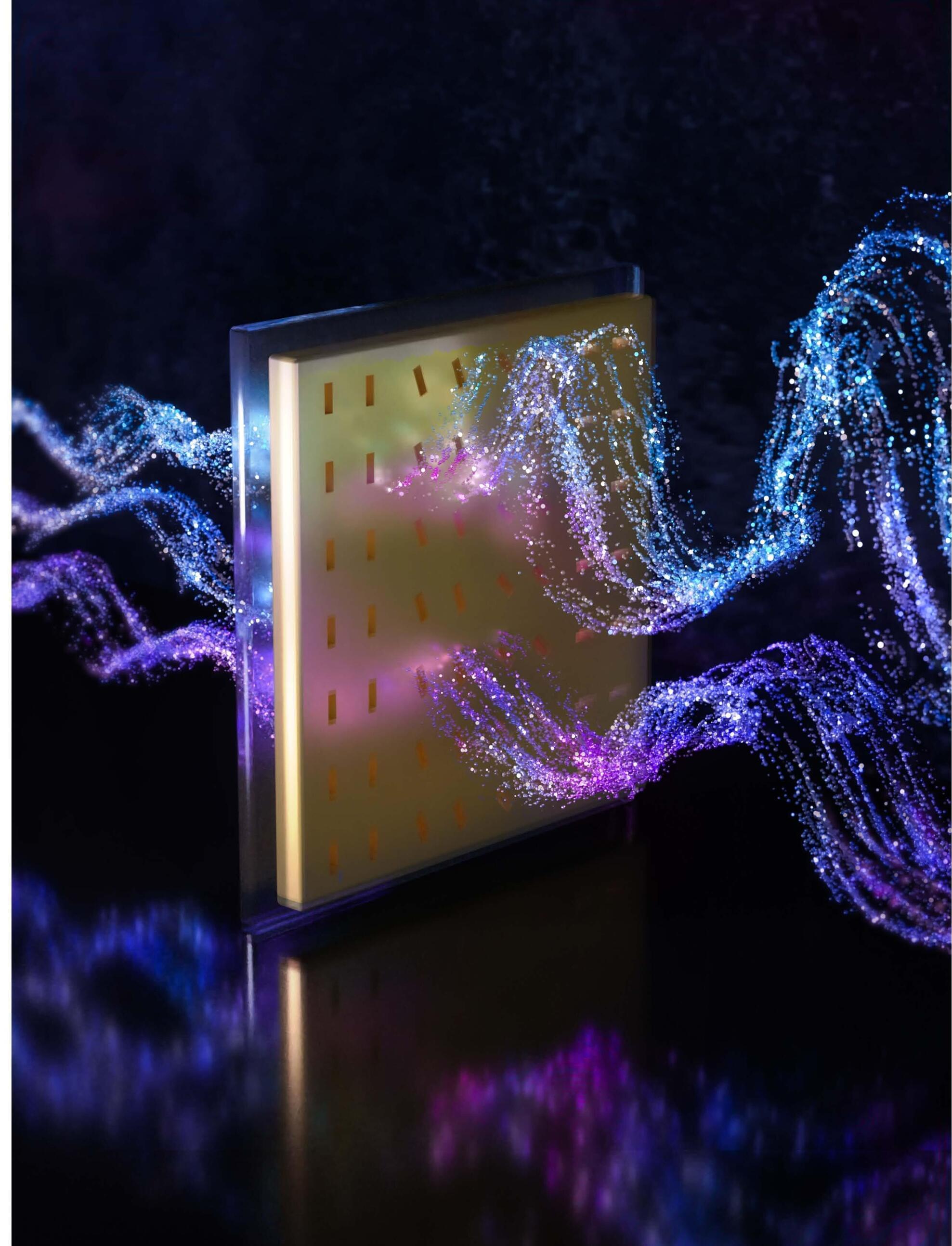
How OLCF's QCUP Enabled Particle Physics on IBM Quantum
Using the OLCF’s Quantum Computer User Program, scientists successfully modeled quark hadronization on IBM quantum hardware. This achievement provides a new approach to studying the strong nuclear force that overcomes the limitations of classical supercomputing.

Researchers have reached a milestone in computational particle physics by successfully simulating hadronization — the process by which quarks bind together to form protons and neutrons — using IBM quantum hardware. This achievement, reported on 30 June 2026, marks a shift in how scientists attempt to model the fundamental building blocks of the universe, moving beyond the inherent limitations of classical supercomputing.
The research project was led by Anthony Ciavarella, a research scientist at the Lawrence Berkeley National Laboratory. The work was made possible through the Quantum Computer User Program (QCUP), an initiative managed by the Oak Ridge Leadership Computing Facility (Olcf) at the Department of Energy’s Oak Ridge National Laboratory. This program provides scientists with remote, cloud-based access to commercial quantum computing systems to facilitate discovery and innovation in scientific computing applications.
Related media


For decades, physicists have relied on particle accelerators like the Large Hadron Collider (LHC) at CERN to study subatomic collisions. While these high-energy experiments provide essential data, the process of hadronization itself remains difficult to observe directly. Scientists must bridge this observational gap using computer simulations. However, traditional binary systems struggle with the complexities of quantum chromodynamics (QCD). The strong force that binds quarks and gluons involves entanglement and quantum correlations that demand exponential increases in memory and processing power as new particles or time steps are added to a calculation, making the task increasingly intractable for classical machines.
Ciavarella addressed these computational challenges by utilizing 104 of the 156 qubits available on an IBM Heron processor. To manage current hardware constraints, he implemented a specific set of techniques:
- Heavy Quark Limit: By focusing on heavier, more massive quarks, the simulation becomes more stable. Because these particles do not spread out across the grid as rapidly as lighter quarks, they are easier to model as points on a simulation grid, allowing researchers to extrapolate results to lighter particle behavior.
- Scalable Circuitry: Ciavarella employed a "scalable circuit concurrent variational quantum solver," a method he co-developed during his graduate studies at the University of Washington. This technique prepares the qubits in a stable, low-energy quantum vacuum state.
- Dimensional Reduction: The simulation was constrained to one dimension, where particles move only left to right and back, providing a controlled test environment for studying string-breaking, the fundamental mechanism where gluon strings snap to create new quark-antiquark pairs.
"In principle, we know the theory that describes hadronization, but we are unable to make predictions using it because the calculations have been too difficult for a classical computer. However, on a quantum computer, we should be able to directly make predictions for the details of how hadronization occurs, which will help with the searches for new physics performed at colliders such as the LHC."
Anthony Ciavarella, Berkeley Lab research scientist, via OLCF
The results of the project, which were published in Physical Review D, matched findings from previous classical supercomputer models. Beyond validation, the team observed that the gluon string, the connection between quarks that stretches and eventually snaps during the binding process, appears to exhibit a gasifying
effect at a finite temperature immediately before it separates. Ciavarella noted that if this phenomenon is reproduced across a wider range of simplified models, it could indicate a genuine, previously unverified feature of the strong nuclear force.
While the simulation was limited to one dimension, it serves as a proof of concept for more complex calculations. Future work is expected to focus on several key areas:
- Dimensional Expansion: Researchers intend to incorporate additional dimensions into the model as quantum hardware capabilities and algorithm efficiencies improve.
- System Scaling: By optimizing vacuum preparation circuits on small qubit counts (10–12), researchers intend to extrapolate the methodology to simulate larger subatomic systems on hundreds of qubits.
The OLCF is supported by the Department of Energy’s Advanced Scientific Computing Research program. The laboratory is managed by UT-Battelle for the Department of Energy’s Office of Science, which is the largest supporter of basic research in the physical sciences in the United States.
How significant is this development?
Contribute your assessment to the aggregated reader intelligence ledger.
Archypedia is dedicated to independent, evidence-backed reporting. This briefing was synthesized from primary source reporting, corroborated across independent newsrooms, and verified against our Editorial Standards.
Transparency record
Evidence behind this report
This report synthesizes 5 distinct sources. Open the source ledger below to compare the underlying coverage.
Prepared under the Archypedia Editorial Policy by the Niko Vale editorial desk profile. AI-assisted tools may support drafting and verification; public accountability remains with Archypedia. Report an error.