Scientists Realize Stable "Boron Graphene" and Uncover Quantum Liquid Crystal State
Researchers stabilized boron layers by exposing them within the LaRh3B2 crystal. This discovery revealed an electronic nematic state with potential applications for future quantum technologies.
Researchers at Tohoku University have achieved a significant advancement in condensed matter physics by successfully stabilizing a version of "boron graphene." The findings, published on July 2, 2026, in Science Advances, detail a method for bypassing the traditional difficulties associated with creating two-dimensional materials.
Graphene has long served as a focal point for electronics research. Despite its potential, its utility in specialized fields such as high-temperature superconductivity remains constrained by relatively weak electron interactions. In contrast, borophene—a two-dimensional sheet composed of boron atoms—has long been theorized to possess the stronger electron interactions necessary to manifest exotic quantum states. However, the inherent fragility of its honeycomb structure has rendered the production of a free-standing sheet a consistent manufacturing challenge.
Related media

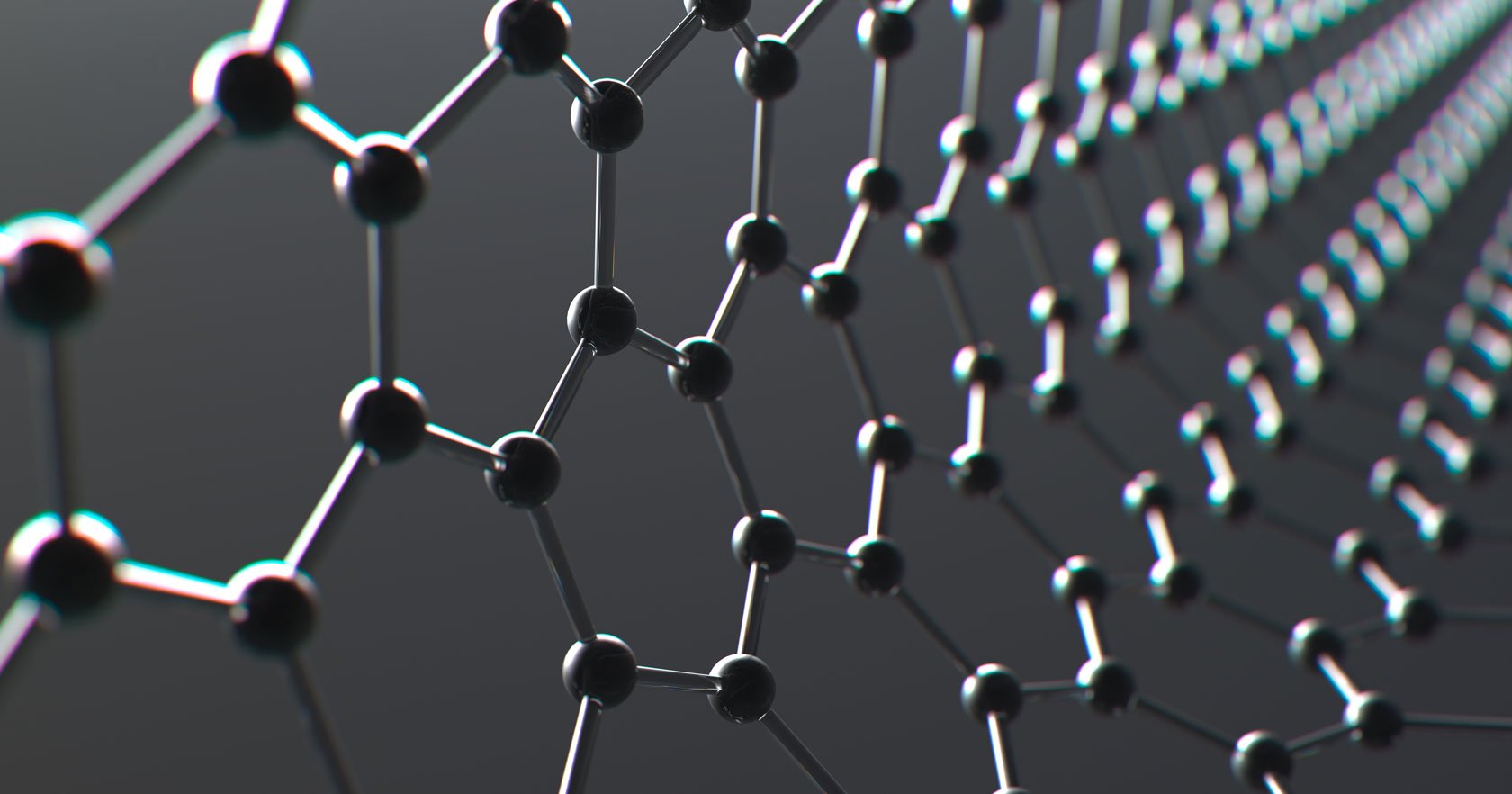
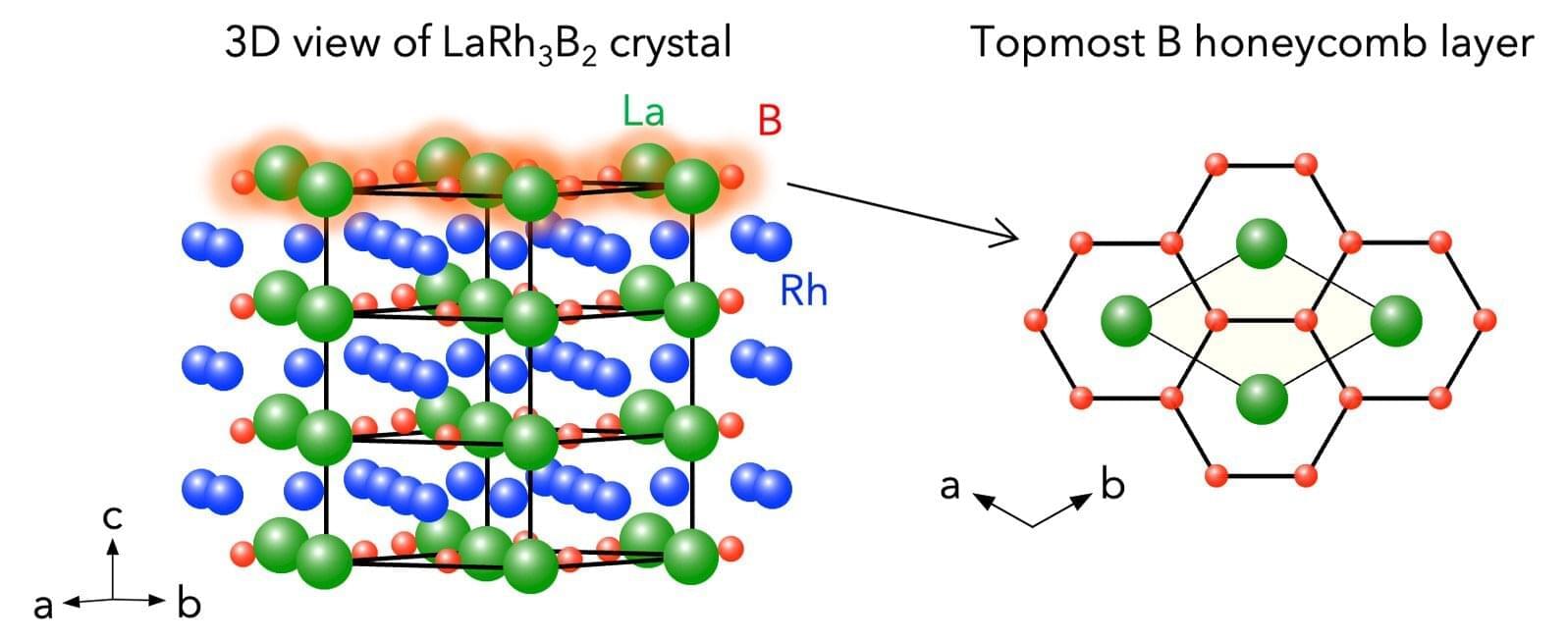
To overcome this, the team at the university's Advanced Institute for Materials Research (WPI-AIMR) shifted the focus of their synthesis strategy. Instead of attempting to manufacture a thin sheet in isolation, the researchers identified a stable three-dimensional crystal, LaRh3B2, which naturally houses layers of boron atoms arranged in a honeycomb configuration.
"We demonstrated a fundamentally new way of creating two-dimensional quantum materials. Rather than attempting to produce an unstable free-standing sheet of boron atoms, we exposed a naturally occurring honeycomb boron layer that already exists within a stable three-dimensional crystal called LaRh3B2."
Takafumi Sato, WPI-AIMR, via Tohoku University press release
By exposing these intrinsic layers at the surface of the crystal, the researchers created a stable two-dimensional electronic environment. Subsequent analysis via angle-resolved photoemission spectroscopy (ARPES) at synchrotron radiation facilities revealed an unusually high concentration of electrons near the material's Fermi level. This phenomenon, categorized as a van Hove singularity, is identified as a critical factor in intensifying electron interactions, which in turn acts as a catalyst for emerging quantum behaviors.
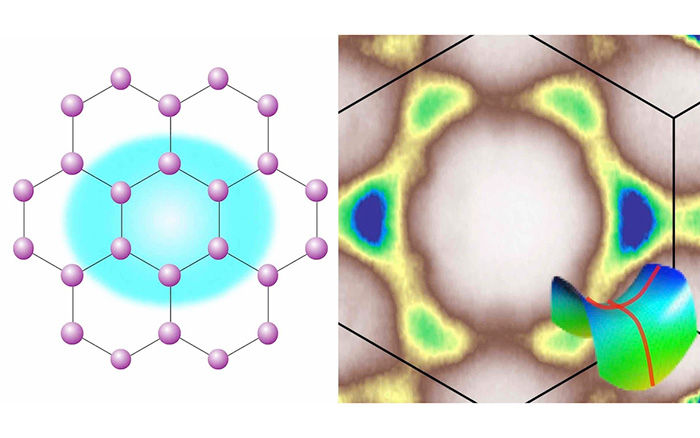
The investigation into these properties required a dual-imaging approach. By combining ARPES, which identified an electronic "hot spot" where instability was predicted, with scanning tunneling microscopy and spectroscopy (STM/STS), the team was able to map the electrons in real space. These combined techniques revealed that the electrons spontaneously organized into a preferred orientation. This development broke the original six-fold symmetry of the crystal, resulting in an "electronic nematic state."
The team notes that this state shares functional similarities with the behavior of molecules found in liquid crystal displays. In a standard honeycomb lattice, electronic distributions typically display six-fold rotational symmetry, meaning they overlap after a 60-degree rotation. In the newly identified nematic state, the electronic distribution elongates, changing into a two-fold symmetric state that only regains symmetry after a 180-degree rotation.
"Neither technique alone could have revealed the full picture. By combining momentum-space information from ARPES with real-space observations from STM, we were able to connect the electronic instability with the emergence of the nematic state. This synergy was essential to understanding the physics behind this new quantum phase."
Kosuke Nakayama, Graduate School of Science, via WPI-AIMR
The researchers emphasize that the LaRh3B2 crystal family allows for the substitution of various chemical elements. This structural flexibility provides a platform for fine-tuning the behavior and number of electrons within the material. By enabling precise control over these variables, the discovery offers a potential pathway for engineering next-generation quantum technologies and more energy-efficient, high-temperature superconductors.
Archypedia is dedicated to independent, evidence-backed reporting. This briefing was synthesized from primary source reporting, corroborated across independent newsrooms, and verified against our Editorial Standards.
Transparency record
Evidence behind this report
This report synthesizes 5 distinct sources. Open the source ledger below to compare the underlying coverage.
Prepared under the Archypedia Editorial Policy by the Niko Vale editorial desk profile. AI-assisted tools may support drafting and verification; public accountability remains with Archypedia. Report an error.