Black hole spectroscopy advances as a tool to test general relativity
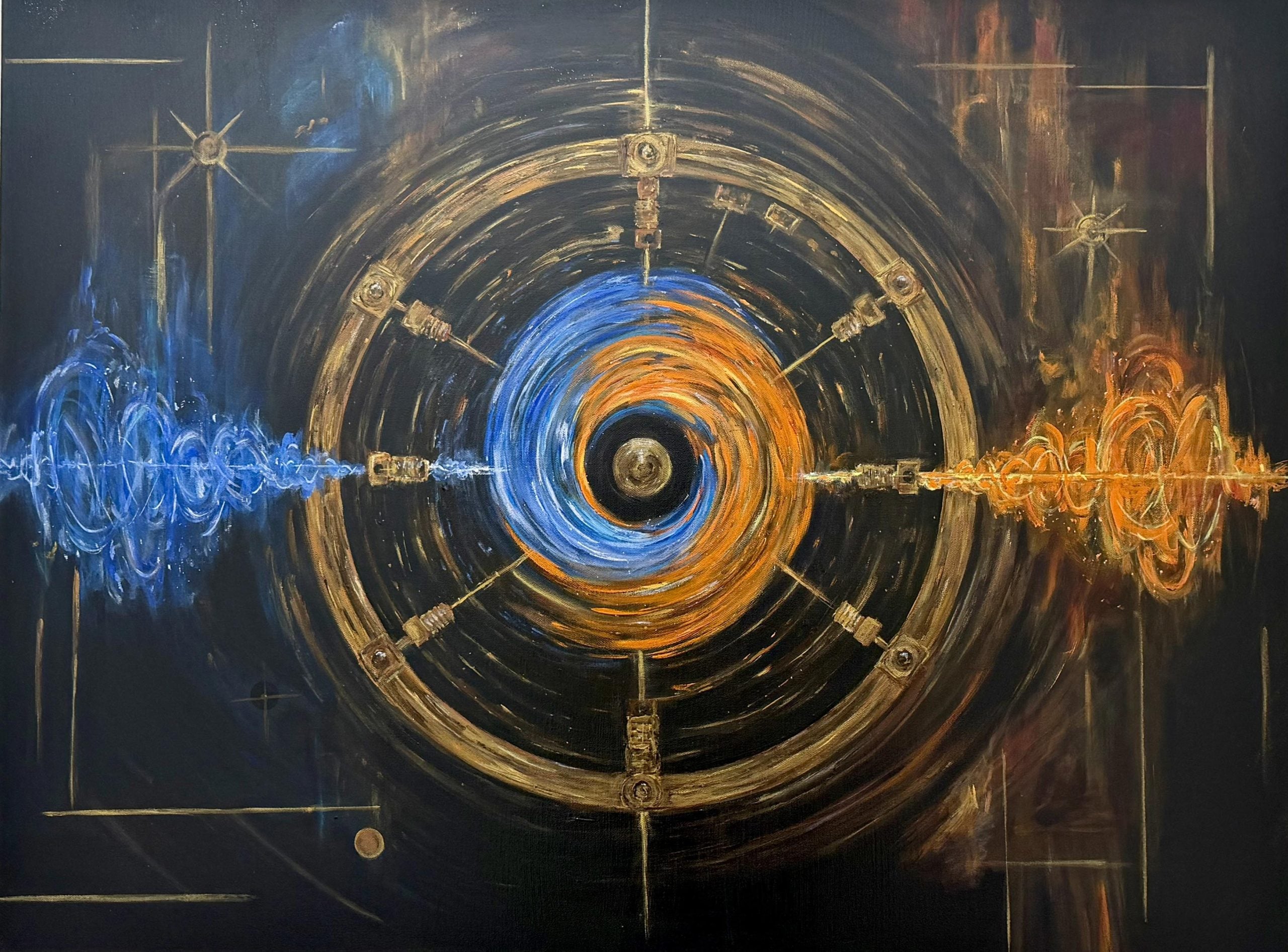
Data from the GW250114 black hole merger allows scientists to map the 'ringing' of space-time, providing a test for Einstein’s general relativity. This analysis also confirms predictions such as Hawking’s area theorem.
Black hole spectroscopy is transitioning from a theoretical pursuit into a cornerstone of experimental astrophysics. As gravitational-wave detectors grow more sensitive, scientists are increasingly able to isolate the characteristic "ringing" emitted by newly formed black holes, allowing for unprecedented tests of Albert Einstein’s theory of general relativity.
The most recent leap in this field centers on an event designated GW250114. Detected on 14 January 2025 by the international LIGO-Virgo-KAGRA collaboration, this signal originated from the merger of two black holes approximately 1.3 billion light-years away. While the event is described as nearly identical to the historic 2015 detection that first confirmed the existence of gravitational waves, the clarity of the current data is significantly higher. According to Keefe Mitman of the Cornell Center for Astrophysics and Planetary Science, the signal-to-noise ratio has improved dramatically over the past decade, allowing researchers to capture details that were previously lost in background interference.
Related media


The Physics of the Ringdown
When two black holes merge, the resulting object is initially in a distorted state. It stabilizes by emitting gravitational waves — a process known as the "ringdown" phase. This ringing is composed of specific quasinormal modes
, which are characteristic tones analogous to the harmonics of a musical instrument. Each black hole’s fingerprint is determined by two primary physical properties: its mass and its spin. This concept, often called the "no-hair" theorem, suggests that these two variables are sufficient to fully define a black hole, a prediction stemming from the Kerr solution developed in 1963.
By measuring multiple vibration modes, researchers can perform independent tests of general relativity. If multiple tones yield the same mass and spin, the theory is verified. In the case of GW250114, the signal was strong enough for researchers to measure two distinct tones and place constraints on a third. All observations were consistent with Einstein’s equations.
"By listening to the ringing of newly formed black holes, we are turning gravitational waves into a tool for exploring some of the deepest questions in physics, from the nature of gravity itself to the possibility of discovering entirely new forms of matter and energy."
Dr. Gregorio Carullo, University of Birmingham, via Brightsurf
Confirming Historical Predictions
The analysis of GW250114 has provided robust confirmation of Stephen Hawking’s area theorem, which states that the surface area of a black hole's event horizon cannot decrease over time. Following the merger, the total surface area of the event horizon increased from roughly 240,000 square kilometers to 400,000 square kilometers. Max Isi of Columbia University noted that observing such processes — long treated as mathematical abstractions, is an astounding development in modern science.
Researchers are also utilizing new statistical methods to process these signals. A team at the University of Cambridge has developed a technique using Bayesian analysis to more accurately identify faint overtones that fade rapidly after a collision.
Future Outlook
While current observations align with general relativity, many physicists suspect the theory is incomplete, particularly as it fails to account for dark energy, dark matter, and the requirements of quantum mechanics. Scientists look toward the next generation of observatories, including the Einstein Telescope, Cosmic Explorer, and the space-based LISA mission, to detect even fainter nonlinear modes
and potential signatures of quantum gravity.
Recent Gravitational Wave Catalog Highlights
- GWTC-5.0: The latest catalog includes 161 new events, bringing the total number of detected gravitational-wave signals to 390.
As detection rates increase, with new signals arriving roughly three to four times each week during active runs, the field is evolving from the discovery of individual events to an era of statistical precision. Whether these future measurements continue to support Einstein's predictions or reveal the first cracks in the current understanding of gravity remains the primary question for the years ahead.
Archypedia is dedicated to independent, evidence-backed reporting. This briefing was synthesized from primary source reporting, corroborated across independent newsrooms, and verified against our Editorial Standards.
Transparency record
Evidence behind this report
This report synthesizes 12 distinct sources. Open the source ledger below to compare the underlying coverage.
- brightsurf.com
- miragenews.com
- uk.news.yahoo.com
- knowridge.com
- scitechdaily.com
- news.cornell.edu
- mpg.de
- sciencenews.org
- space.com
- riken.jp
- simonsfoundation.org
- caltech.edu
Prepared under the Archypedia Editorial Policy by the Niko Vale editorial desk profile. AI-assisted tools may support drafting and verification; public accountability remains with Archypedia. Report an error.