Copenhagen researchers create first map of Milky Way neutrino flux
Copenhagen scientists have developed a 'neutrino weather map' that estimates the origin and energy distribution of particles reaching Earth from across the galaxy.
Researchers at the Niels Bohr Institute at the University of Copenhagen have developed the first comprehensive map of how neutrinos — often called ghost particles
— are produced by stars across the Milky Way and how many of them reach Earth. The model, described as a neutrino weather map
, provides a concrete estimate of the energy distribution and origin of these particles, offering a new way to probe the interiors of stars and the structure of the galaxy.
Neutrinos are elementary particles that are electrically neutral and extremely light. Because they almost never interact with matter, they can travel in straight lines across the galaxy, unimpeded by magnetic fields or dust clouds. While most astronomical knowledge is based on light, which can be absorbed or blocked, neutrinos carry information directly from the cores of stars.
Related media

Mapping the Galactic Signal
To create the map, the Copenhagen team combined stellar evolution calculations with precise star-position data from the European Space Agency's Gaia telescope. This allowed them to link neutrino production to the actual distribution of stars throughout the galaxy. The resulting research, published in the journal Physical Review D, highlights that neutrino output is heavily dependent on a star's mass and age.
The study identifies the galactic center as the most significant region for neutrino flow due to the high density of stars. Specifically, stars as massive as or more massive than the Sun produce the most neutrinos, with the strongest signals originating from areas a few thousand light-years from Earth. According to the team, the flux consists of contributions from light, intermediate, and very massive stars, arising from both nuclear reactions and thermal processes.
Lead author Pablo Martínez-Miravé, a postdoc at the Niels Bohr Institute, stated:
"For the first time, we have a concrete estimate of how many of these particles reach Earth, where in the galaxy they come from, and how their energy is distributed. Because ghost particles come straight from the core of stars, they can tell us things that light and other radiation cannot."
Pablo Martínez-Miravé, postdoc at the Niels Bohr Institute, via Yahoo News
A Roadmap for Discovery
The mapping serves as a guide for neutrino observatories, which typically use massive underground detectors. Because these detectors cannot be aimed like traditional telescopes, knowing the expected energy range and the directions of the highest signal helps scientists isolate faint galactic signals from background noise.
Senior author Irene Tamborra, a professor at the Niels Bohr Institute, noted that because neutrinos are barely affected by their environment, scientists have clear expectations of their behavior. Any tiny deviations from these predictions could signal new, unknown physics
. Tamborra compared the new model to dimming the lights in a room and suddenly seeing what was hidden in the dark
, providing both a map and a compass for navigation.
The Broader Search for Galactic Accelerators
While the Copenhagen study focuses on steady stellar output, other international efforts are identifying the Milky Way's most extreme particle engines. These include "PeVatrons," accelerators capable of pushing protons to energies exceeding one quadrillion electron volts (1 PeV).
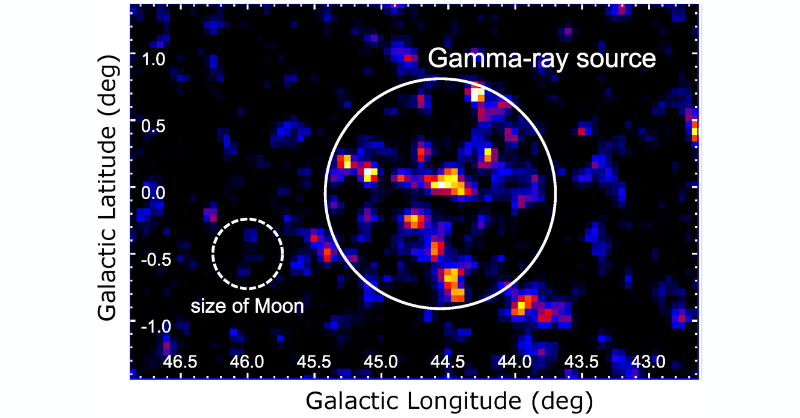
On July 16, 2026, a Hiroshima University-led team announced the conclusive identification of a proton PeVatron known as LHAASO J1912+1014u. Located in the constellation Aquila, the source was analyzed using data from the Fermi Gamma-ray Space Telescope, the Chandra X-ray Observatory, and the FUGIN radio survey. The team ruled out the possibility that the source was an electron accelerator, citing the match between GeV gamma-ray maps and interstellar gas distribution.
Further research published in National Science Review and Science Bulletin suggests that "micro-quasars", black holes in binary systems that feed on companion stars, may be the most extreme accelerators in the galaxy. According to reports from Science Daily, the Large High Altitude Air Shower Observatory (LHAASO) detected ultra-high-energy gamma rays from five such objects, including Cygnus X-1 and SS 433. In SS 433, proton energies exceeded 1 PeV, with a total power output of approximately 1032 joules per second.
Comparing Galactic Particle Sources
| Source Type | Primary Particle/Emission | Key Characteristics |
|---|---|---|
| Standard Stars | Neutrinos | Steady flux; highest density at galactic center; probes stellar cores. |
| Micro-quasars | Protons/Gamma Rays | Black hole accretion; relativistic jets; creates "knee" in energy spectrum. |
| Proton PeVatrons | High-energy Protons | Energies > 1 PeV; identified via multiwavelength (radio, X-ray, gamma) modeling. |
Archypedia is dedicated to independent, evidence-backed reporting. This briefing was synthesized from primary source reporting, corroborated across independent newsrooms, and verified against our Editorial Standards.
Transparency record
Evidence behind this report
This report synthesizes 10 distinct sources. Open the source ledger below to compare the underlying coverage.
- sciencedaily.com
- yahoo.com
- cosmosweek.com
- hiroshima-u.ac.jp
- miragenews.com
- scitechupdates.com
- nature.com
- natsci.msu.edu
- scientificamerican.com
- en.wikipedia.org
Prepared under the Archypedia Editorial Policy by the Niko Vale editorial desk profile. AI-assisted tools may support drafting and verification; public accountability remains with Archypedia. Report an error.