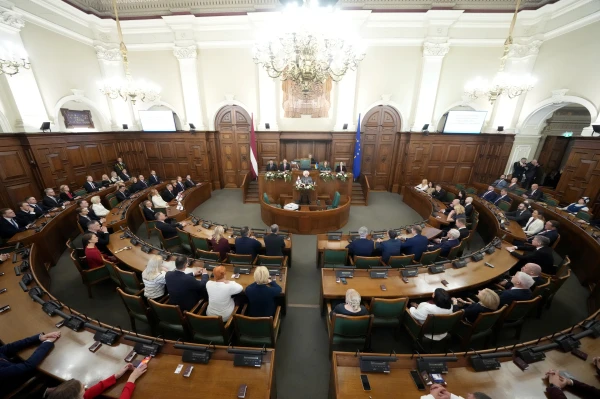
Latvia’s Political Crisis Deepens: How Drone Strikes, Language Laws, and Soft Mandates Are Reshaping the Saeima’s Agenda
Riga, June 2, 2026 — Latvia’s parliament, the Saeima, is set to convene for a series of high-stakes sessions this week, with lawmakers grappling with three interlocking crises: the escalating threat of drone attacks from Russian territory, the contentious implementation of language policies, and the fallout from a coalition government collapse. The political turbulence—triggered by a recent military incident and deep divisions over national security—has left the country at a crossroads, with analysts warning of potential long-term instability if key reforms stall.
At the heart of the debate is whether Latvia can maintain its delicate balance between NATO solidarity, domestic political cohesion, and the practical realities of a war unfolding on its borders. The Saeima’s agenda reflects a nation caught between the urgency of defense and the slow burn of cultural and linguistic tensions—issues that have repeatedly derailed governance in recent years.
This is not the first time these themes have dominated Latvian politics. But the convergence of drone strikes, language mandates, and a fractured government creates a uniquely volatile mix. What emerges from the upcoming sessions could redefine Latvia’s approach to security, identity, and governance for years to come.
— ###
The Drone Threat: A New Front in the Ukraine War
Latvia’s immediate crisis was triggered by a series of drone incursions over its airspace, widely attributed to Russian forces operating from Belarus. While the attacks have not yet caused casualties, they have exposed critical vulnerabilities in the country’s defense posture and reignited debates over military spending, NATO commitments, and the feasibility of “soft mandates” in deterring aggression.
Key developments in the drone crisis:
- Recent incidents: At least three drone sightings have been reported in Latvian airspace since May 15, with two incidents involving armed reconnaissance drones. Authorities have confirmed that none crossed into sovereign Latvian territory but acknowledged that the proximity of the flights constituted a “direct threat to national security.”
- Russian denials and Ukrainian context: While Moscow has not officially claimed responsibility, Western intelligence sources suggest the drones are part of a broader Russian campaign to test NATO’s eastern flank defenses. Ukraine has also reported a surge in drone attacks along its southern front, raising questions about whether Latvia is becoming an indirect battleground.
- Military response: Latvia has accelerated its air defense modernization program, with plans to deploy additional Patriot missile systems by late 2026. However, lawmakers remain divided over whether the current budget allocations—already strained by inflation and post-pandemic recovery costs—are sufficient.
Why this matters: The drone incidents have forced a reckoning with Latvia’s reliance on “soft mandates”—non-binding pledges to increase defense spending to 2% of GDP by 2027. With the Saeima now under pressure to approve a revised defense budget, the debate has shifted from theoretical commitments to concrete action. Failure to act could undermine Latvia’s standing within NATO and embolden further Russian provocations.
Analysts note that the drone threat is not just a military issue but a political one. The ruling coalition’s collapse in late May was directly tied to disagreements over how to respond to the incursions. The center-right New Unity party, led by Arturs Kulbergs, accused the center-left Harmony party of downplaying the severity of the threat, while Harmony countered that New Unity’s proposed defense spending increases would destabilize the economy.
— ###
Language Laws: The Cultural Fault Line
Simultaneously, the Saeima is preparing to revisit one of Latvia’s most divisive social policies: the Language Law, which governs the use of Latvian in public administration, education, and media. First enacted in 2021, the law has been both a symbol of national identity and a lightning rod for criticism from Latvia’s Russian-speaking minority, who argue it marginalizes their community.
The law’s key provisions—and the current debate:
- Mandatory Latvian in government: Public officials must now conduct business primarily in Latvian, with exceptions for bilingual regions. Critics argue this excludes non-Latvian speakers from civic participation.
- Education requirements: Schools must teach core subjects in Latvian, though minority-language instruction is permitted for up to 40% of the curriculum. The law has led to a decline in Russian-language schools, particularly in Riga.
- Media regulations: Broadcast stations must air a minimum of 60% content in Latvian, a rule that has led to legal challenges from Russian-language outlets.
The law’s implementation has been uneven, with some regions enforcing stricter compliance than others. The Saeima is now considering amendments that would clarify enforcement mechanisms and address concerns about discrimination. However, any changes risk reigniting tensions between nationalists, who view the law as essential for preserving Latvian culture, and integrationists, who argue for a more inclusive approach.
The political stakes: The language debate is deeply personal in Latvia, where memories of Soviet-era Russification remain raw. For the ruling parties, the law is a non-negotiable part of their identity platform. For opposition groups, it represents a step backward in building a unified society. The upcoming sessions will test whether the Saeima can find a compromise—or if the issue will further polarize an already divided parliament.
— ###
How Language and Security Collide
The intersection of these two crises—drone threats and language policies—highlights a broader challenge for Latvia: balancing its Western alignment with its internal social dynamics. The country’s Russian-speaking minority, which makes up roughly 25% of the population, has historically been wary of both NATO integration and Latvian nationalist policies. The current government collapse risks exacerbating these divisions at a time when unity is critical.
Three scenarios emerging from the Saeima debates:
- The hardline approach: A majority of lawmakers could push for stricter enforcement of the Language Law while approving significant defense increases. This would appeal to nationalist voters but could alienate minority communities and strain relations with Russia’s ally base.
- The pragmatic compromise: Amendments to the Language Law could be paired with targeted defense investments, aiming to address both identity and security concerns without deepening divisions. This path would require bipartisan cooperation, which has been elusive.
- Gridlock and stalemate: If no consensus emerges, Latvia could face prolonged political instability, with repeated government collapses and delayed reforms on both fronts. This would weaken the country’s position in NATO and leave it vulnerable to further Russian pressure.
Expert opinions vary sharply. Dr. Inese Līdaka, a political scientist at the University of Latvia, warns that “the Saeima’s inability to act decisively on either front will send a message to both Moscow and Brussels that Latvia is not a reliable partner.” Meanwhile, Jānis Bērziņš, a former defense minister, argues that “the focus should be on defense first—language can wait until after we’ve secured our borders.”
— ###
Who Holds the Power Now?
The collapse of the previous coalition government in late May left Latvia without a functioning executive for nearly two weeks. The Saeima’s rapid confirmation of a new cabinet—led by a technocratic coalition of New Unity, Harmony, and the Greens and Farmers Union—was a rare display of unity. However, the new government’s mandate is fragile, with key portfolios still under negotiation.
The new government’s challenges:
- Defense and security: The Ministry of Defense will be tasked with accelerating drone defense procurement and negotiating with NATO allies for additional air support. Delays could leave Latvia exposed during the summer months, when drone activity typically increases.
- Language and integration: The Ministry of Education will lead efforts to revise the Language Law, while the Ministry of Culture must address concerns about media pluralism. Any missteps risk triggering protests from both nationalist and minority groups.
- Economic stability: With inflation still above 5%, the government must balance defense spending with social welfare programs. The European Commission has signaled it will monitor Latvia’s budget closely, given its reliance on EU recovery funds.
Key figures to watch:
- Arturs Kulbergs (New Unity): The new prime minister has pledged to hold “as many meetings as necessary” to stabilize the government. His ability to broker deals between hardline nationalists and pragmatic centrists will determine whether the Saeima can pass critical legislation.
- Dainis Kravts (Harmony): As speaker of the Saeima, Kravts holds significant influence over the legislative agenda. His willingness to compromise on language reforms will be tested in the coming weeks.
- NATO Secretary General Jens Stoltenberg: While not a Latvian official, Stoltenberg’s public statements on Latvia’s defense posture will shape domestic political calculations. His recent calls for “unified action” against drone threats have added pressure on Riga to act.
— ###
Why This Matters Beyond Latvia’s Borders
Latvia’s struggles offer a microcosm of the broader challenges facing NATO’s eastern members. As Russia escalates its use of drones and hybrid warfare, smaller allies like Latvia, Estonia, and Lithuania are forced to confront hard choices: how much to spend on defense, how to manage internal divisions, and whether their Western partners will provide sufficient support.
Three broader implications:
- Testing NATO’s resolve: Latvia’s ability to deter drone attacks will be closely watched by other Baltic states. If Riga’s defenses prove inadequate, it could trigger a domino effect of increased Russian aggression across the region.
- The limits of soft power: The failure of “soft mandates” (non-binding defense pledges) to deter Russia raises questions about whether NATO’s current strategy is sufficient. Some analysts argue that harder commitments—such as pre-positioned troops or joint air patrols—may be necessary.
- The future of minority rights in Europe: Latvia’s Language Law debate reflects a broader tension in post-Soviet Europe between national identity and minority inclusion. The outcome could influence similar discussions in Lithuania and Estonia, where Russian-speaking communities also face integration challenges.
For Latvia, the stakes could not be higher. The country’s membership in both the EU and NATO is its greatest asset—but also its greatest vulnerability. If the Saeima fails to act decisively, it risks undermining decades of progress toward stability and security.
— ###
What to Watch in the Coming Weeks
The Saeima’s sessions this week will set the tone for Latvia’s political trajectory in the second half of 2026. Here are the critical questions to follow:
- Will the new government survive? The coalition’s slim majority means that any major legislation will require careful negotiation. A single defection could derail key reforms.
- How will Russia respond? If Latvia accelerates its defense upgrades, Moscow may escalate drone attacks or other hybrid tactics. Conversely, a perceived weakness could embolden further aggression.
- Can the Language Law be reformed without backlash? Any amendments must thread the needle between nationalist demands and minority rights. Missteps could trigger protests or legal challenges.
- What support will Latvia receive from NATO? The alliance’s willingness to provide advanced air defense systems or intelligence-sharing could be a game-changer for Riga.
One thing is clear: Latvia’s path forward will be defined not by grand gestures, but by the ability of its leaders to navigate these crises with pragmatism and unity. The coming weeks will reveal whether that balance is possible—or if the country is headed for deeper turmoil.
— ###
Key Questions and Answers
Q: Are the drone attacks in Latvia directly tied to the war in Ukraine?
A: While Latvia has not been directly involved in the Ukraine conflict, the drone incursions are widely seen as part of Russia’s broader campaign to test NATO’s eastern defenses. Ukrainian officials have confirmed that Russia is using drones to probe vulnerabilities along NATO’s borders, including in the Baltics.
Q: How does Latvia’s Language Law compare to similar policies in other EU countries?
A: Latvia’s approach is stricter than most EU members, which typically focus on integration rather than mandatory language use. Estonia’s language policy is similar but less enforcement-heavy, while Lithuania has taken a more gradualist approach. The Latvian model is unique in its emphasis on public administration and media regulations.
Q: Could Latvia’s political instability trigger a NATO intervention?
A: Unlikely in the short term, but prolonged instability could prompt NATO to offer technical assistance or accelerated defense support. The alliance has already signaled concern, with Secretary General Stoltenberg calling for “unified action” against drone threats.
Q: What are the economic consequences of increased defense spending?
A: Latvia’s defense budget is projected to rise by 15–20% in 2026, funded partly by EU recovery funds and domestic reallocations. While this could strain social spending, economists argue that the long-term cost of inaction—such as economic damage from drone attacks—would be far greater.
Q: How do Latvia’s Russian-speaking citizens view the Language Law?
A: Opinions vary widely. Some see the law as necessary to preserve Latvian identity, while others view it as discriminatory. Polls suggest that around 40% of Russian speakers feel excluded from public life, though many also support stronger defense measures against Russia.
Q: What happens if the Saeima fails to pass reforms?
A: Without action on defense or language policies, Latvia risks prolonged political deadlock, weakened NATO credibility, and potential economic consequences. The European Commission has warned that delays in defense spending could jeopardize EU funding for other projects.
—
