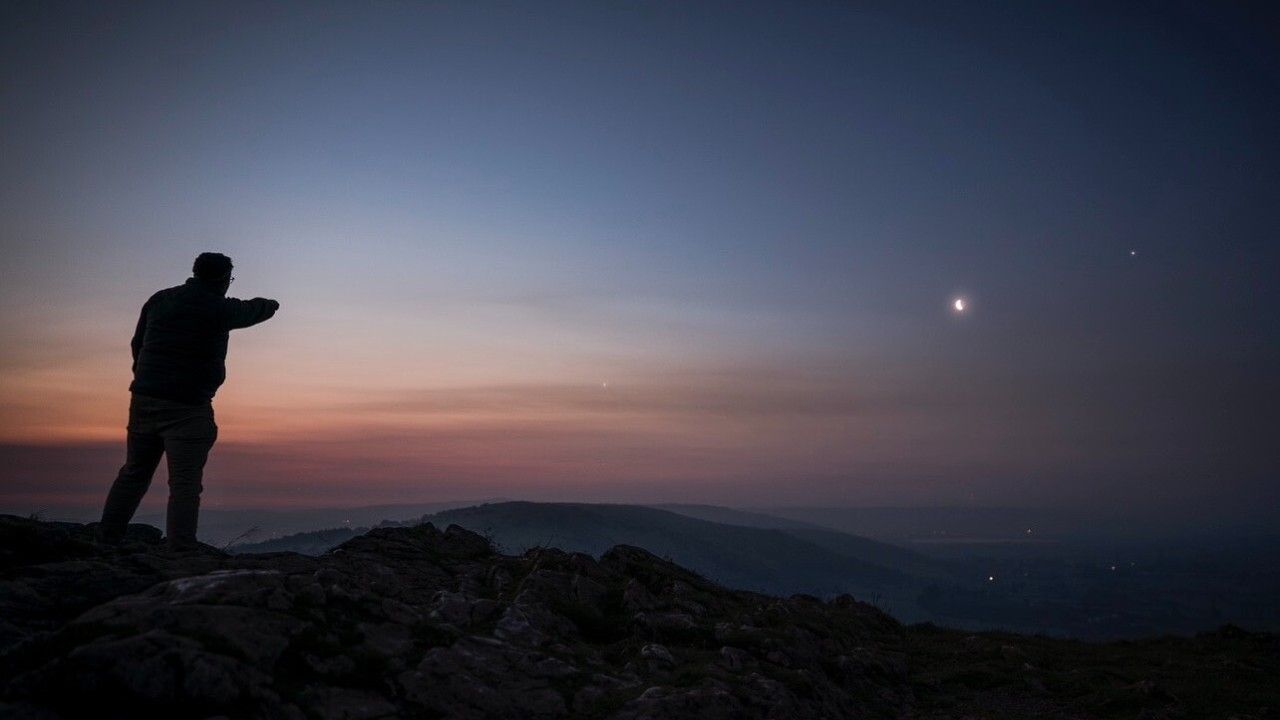
Don’t miss this beautiful 3-planet parade after sunset on June 12 — it won’t last long – Space
Venus, Jupiter, and a third planetary companion will align in a visible “parade” in the western sky after sunset on June 12, according to reports from Space and other astronomical outlets. The event features a close conjunction where the planets appear to nearly touch, a phenomenon visible to the naked eye without the need for specialized equipment.
How to see the June 12 planetary parade
Observers can find the planetary alignment by looking toward the western horizon immediately following sunset on June 12. According to BBC Sky at Night Magazine, Venus and Jupiter will be prominently bright in the west, creating a visual encounter where the two planets appear to “kiss.”
The window for viewing is narrow because the planets will be positioned low in the sky. As the sun dips below the horizon, the brightness of Venus and Jupiter becomes apparent against the darkening blue of the dusk sky. Because these objects are among the brightest in the night sky, they are easily distinguishable from distant stars.
The Hill reports that no telescope is required to witness this event. The proximity of the planets is an apparent visual alignment rather than a physical convergence in space, making it accessible to any observer with a clear view of the western horizon.
- Direction: West
- Timing: Immediately after sunset
- Equipment: Naked eye (no telescope needed)
- Primary Targets: Venus and Jupiter
Why Venus and Jupiter are converging in the June sky
The event is described as a conjunction, a term used by astronomers when two or more celestial bodies appear close to each other from the perspective of Earth. Sky & Telescope notes that Venus and Jupiter will converge in a “dusk conjunction” starting around June 9, leading up to the peak visibility on June 12.
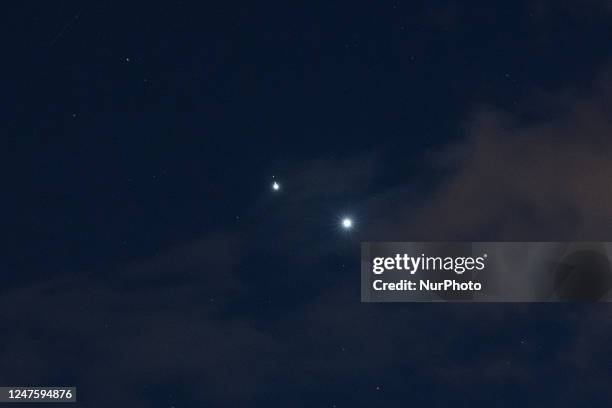
This alignment occurs because the planets orbit the sun at different speeds and distances. When Earth, Venus, and Jupiter align in a specific way relative to our line of sight, they appear to merge into a single area of the sky. While they look close together, they remain millions of miles apart in their respective orbits.
Jupiter and Venus will appear to nearly touch in one of 2026’s best skywatching events, according to Live Science.
The “parade” aspect of the event refers to the grouping of these planets along the ecliptic—the apparent path the sun follows across the sky. When multiple planets occupy this narrow band simultaneously, they form a planetary parade, creating a linear arrangement that is visually striking during the transition from day to night.
Comparison of astronomical reporting on the event
Different astronomical sources emphasize different aspects of the June 12 alignment. While all agree on the visibility and timing, the framing of the event varies across outlets.
| Source | Key Description | Primary Focus |
|---|---|---|
| BBC Sky at Night | “Planets kiss” | Visual intimacy of the pairing |
| Sky & Telescope | “Dusk conjunction” | The timing of the convergence |
| Live Science | “Best skywatching events of 2026” | Long-term astronomical significance |
| The Hill | “No telescope needed” | Accessibility for the general public |
The science of apparent proximity vs. actual distance
A common misconception regarding planetary parades is that the planets are physically moving toward one another. In reality, the “nearly touch” description used by Live Science refers to angular separation. This is the angle between two objects as seen by an observer on Earth.
Venus, the second planet from the sun, and Jupiter, the fifth, are separated by the asteroid belt and the orbit of Mars. The visual “kiss” described by BBC Sky at Night is a projection of their positions onto the celestial sphere. Because Venus is closer to Earth and reflects a high amount of sunlight due to its thick cloud cover, it often appears as the brightest object in the parade.
Jupiter, while much larger, is significantly further away. However, its massive size allows it to remain highly visible. The combination of Venus’s reflective brightness and Jupiter’s sheer scale makes this specific pairing one of the most luminous events in the annual calendar.
Factors affecting visibility
Several variables can impact the quality of the viewing experience on June 12:
- Light Pollution: While these planets are bright, reducing city lights improves the contrast.
- Horizon Obstructions: Since the parade is in the west after sunset, buildings or mountains can block the view.
- Atmospheric Conditions: Cloud cover or heavy smog can obscure the planets.
Why this event is considered a significant skywatching highlight
The significance of the June 12 event stems from the rarity of such close visual approximations between the two brightest planets in the solar system. According to Live Science, this is positioned as one of the premier events for 2026, suggesting that few other conjunctions in that year will offer the same level of brilliance and proximity.
For amateur astronomers, these events serve as a gateway to deeper study. While no telescope is needed for the basic view, those with binoculars may notice the difference in color: Venus typically appears as a brilliant, steady white, while Jupiter may show a slightly creamier or yellowish hue.
The limited duration of the event—noted by Space as something that “won’t last long”—is due to the differing orbital velocities of the planets. Venus moves more quickly across the sky relative to the distant Jupiter, meaning the window where they appear to “touch” is brief.
For more information on celestial alignments, readers may find a related explainer on planetary conjunctions useful for understanding the mathematics of orbital paths.
Common questions about the June 12 planetary parade
What time should I look for the planets on June 12?
The best time to view the parade is immediately after sunset. Because the planets are located in the west and will sink toward the horizon shortly after the sun does, timing is critical.
Do I need a telescope or binoculars to see Venus and Jupiter?
No. According to The Hill, these planets are bright enough to be seen with the naked eye. However, binoculars can provide a clearer view of the two distinct points of light as they converge.
Why is it called a “3-planet parade” if only Venus and Jupiter are highlighted?
A planetary parade occurs when multiple planets align in the same region of the sky. While the conjunction of Venus and Jupiter is the most visually striking “headliner” of the event, other planets are positioned along the same ecliptic path, contributing to the overall “parade” effect.

Will the planets be visible during the day?
No. The brightness of the sun overpowers the light of the planets. They only become visible once the sun has set and the western sky begins to darken.
How long will this alignment last?
The peak proximity occurs around June 12, but the planets begin their approach around June 9, as reported by Sky & Telescope. The window of maximum closeness is short because the planets move at different speeds in their orbits.
Observers interested in tracking the planets over the coming months can use star-mapping software or mobile apps to see how Venus and Jupiter diverge following the June 12 peak. This movement demonstrates the dynamic nature of our solar system, where the “parade” is a momentary snapshot of a constant, orbiting dance.
