Global ocean temperatures hit record high of 21.1C
Global ocean surface temperatures reached a record 21.1C on August 22, 2026. This peak occurred in a window where sea temperatures are not typically expected to reach their annual maximum.
Global ocean surface temperatures reached a record 21.1C on August 22, 2026, breaking a previous high of 21.09C set in March 2024. According to the European Copernicus climate change service, this new peak occurred in a window where sea temperatures are not typically expected to reach their annual maximum.
Because the southern hemisphere contains more ocean surface than the northern hemisphere, worldwide sea temperatures usually peak in March or April. Scientists warn that hitting a record in August—while a natural El Niño event is still months away from its projected peak—signals an ocean under extreme stress. The current warming is the result of a "supersized" El Niño acting upon decades of human-driven warming caused by the burning of fossil fuels, which Samantha Burgess, strategic climate lead for Copernicus, says has already warmed the waters by 0.8C.
Related YouTube video
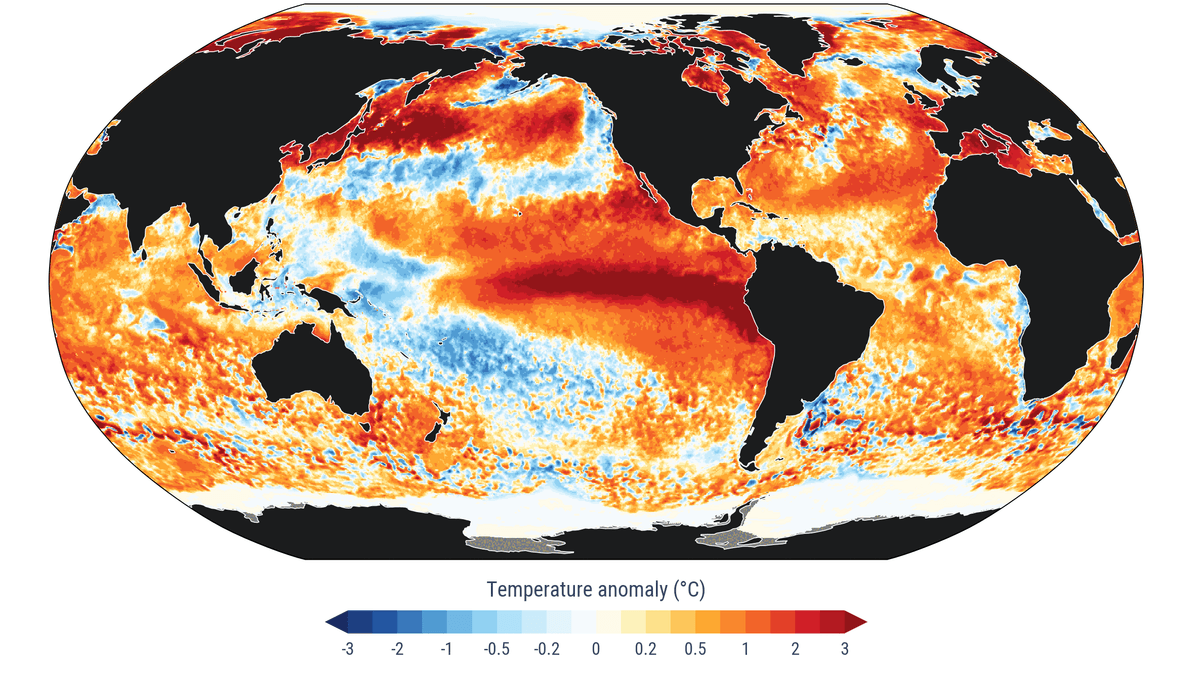

This combination creates a "staircase" effect. While natural El Niño cycles temporarily boost surface temperatures by releasing accumulated ocean heat into the atmosphere, they are now pushing the global baseline onto successively higher steps. Ocean heat content reached record levels every year from 2017 to 2025, meaning each new natural cycle begins from a higher starting point.
The consequences extend from the deep ocean to terrestrial urban centers. Warmer oceans provide storms with increased energy and moisture, resulting in rainier conditions and larger storm surges. On land, these temperatures neutralize the natural cooling mechanisms of coastal regions; when the ocean is excessively warm, the sea breezes that typically lower nighttime temperatures are diminished, amplifying the impact of heatwaves for coastal populations.
The biological toll is most acute in the eastern Pacific, where the warming disrupts the upwelling of cold, nutrient-rich water. This mechanism is critical for the Peruvian anchovy fishery, the largest in the world. Boris Worm, a biology professor at Dalhousie University, notes that while larger marine creatures can migrate to cooler waters, anchovies cannot. They either starve or fail to reproduce, creating a ripple effect throughout the food web that threatens the seabirds, marine mammals, and humans that rely on them.
This disruption is part of a wider threat to global food security. The UN World Food Programme estimates that El Niño could leave nearly 50 million more people facing acute hunger by the end of the year, largely due to crop disruptions in Central America and Southeast Asia.
Shift in Marine Ecosystems
As the oceans warm, the composition of marine life is shifting toward opportunistic species. This transition is visible in several ways:
- Coral Adaptation: Marine ecologist John Bruno notes that heat-sensitive coral populations are now about one-fifth of their 1990s levels. However, "weedy" coral species are adapting to hotter waters, unlike the long-lived iconic species such as staghorn coral.
- Jellyfish Expansion: In the waters off Europe and potentially the U.S. East Coast, there is an increase in jellyfish, which thrive in warmer conditions.
- Water Chemistry: Burgess reports that warming oceans become more acidic and carry less oxygen, further straining food industries.
The instability is not limited to the tropics. In the western English Channel, Prof Tim Smyth of the Plymouth Marine Laboratory reports almost continuous marine heatwave conditions for over three years, peaking at 7C above normal in July.
The current record of 21.1C is considered a preliminary indicator. Because the El Niño event is expected to continue strengthening through the end of the year, reaching unprecedented levels, scientists expect the record to be broken again. The next critical trigger for ocean temperatures is expected between November and January, when the current El Niño is projected to reach its peak.
Systemic Climate Instability
The current warming trend is not a isolated spike but part of a longitudinal shift. According to data from the European Union’s Copernicus Climate Change Service, the record of 21.1C is the highest recorded since the agency began tracking sea-surface temperatures in 1979. This peak follows a period of constant escalation, with global ocean heat content reaching record levels every single year from 2017 to 2025.
The scale of the current El Niño event is described by the Met Office as potentially the strongest in living memory
. This phenomenon is expected to continue strengthening through December, with sea-surface temperatures in key tropical Pacific regions projected to reach more than 3C above average. The Bbc reports that the event is on course to be the strongest seen in centuries.
The physical expansion of the warming water carries direct risks for coastal infrastructure. Zachary Labe, a climate scientist at Climate Central, notes that warmer water occupies more space, which exacerbates sea-level rise and increases the risk of coastal flooding. Jane Lubchenco, a former chief of the U.S. National Oceanic and Atmospheric Administration, describes the situation as very troubling
, stating that such temperatures destabilize weather patterns and threaten global economic prosperity.
While the August record is a preliminary indicator, scientists anticipate further breaks in the data. Dr Jeremy Grist of the National Oceanography Centre in Southampton suggests that, all things being equal, the record could be broken again in March or April 2027. For the current cycle, the next step will be the period between November and January, when the El Niño is expected to reach its peak.
How significant is this development?
Contribute your assessment to the aggregated reader intelligence ledger.
Archypedia is dedicated to independent, evidence-backed reporting. This briefing was synthesized from primary source reporting, corroborated across independent newsrooms, and verified against our Editorial Standards.
Transparency record
Evidence behind this report
This report synthesizes 4 distinct sources. Open the source ledger below to compare the underlying coverage.
Prepared under the Archypedia Editorial Policy by the Samir Haddad editorial desk profile. AI-assisted tools may support drafting and verification; public accountability remains with Archypedia. Report an error.