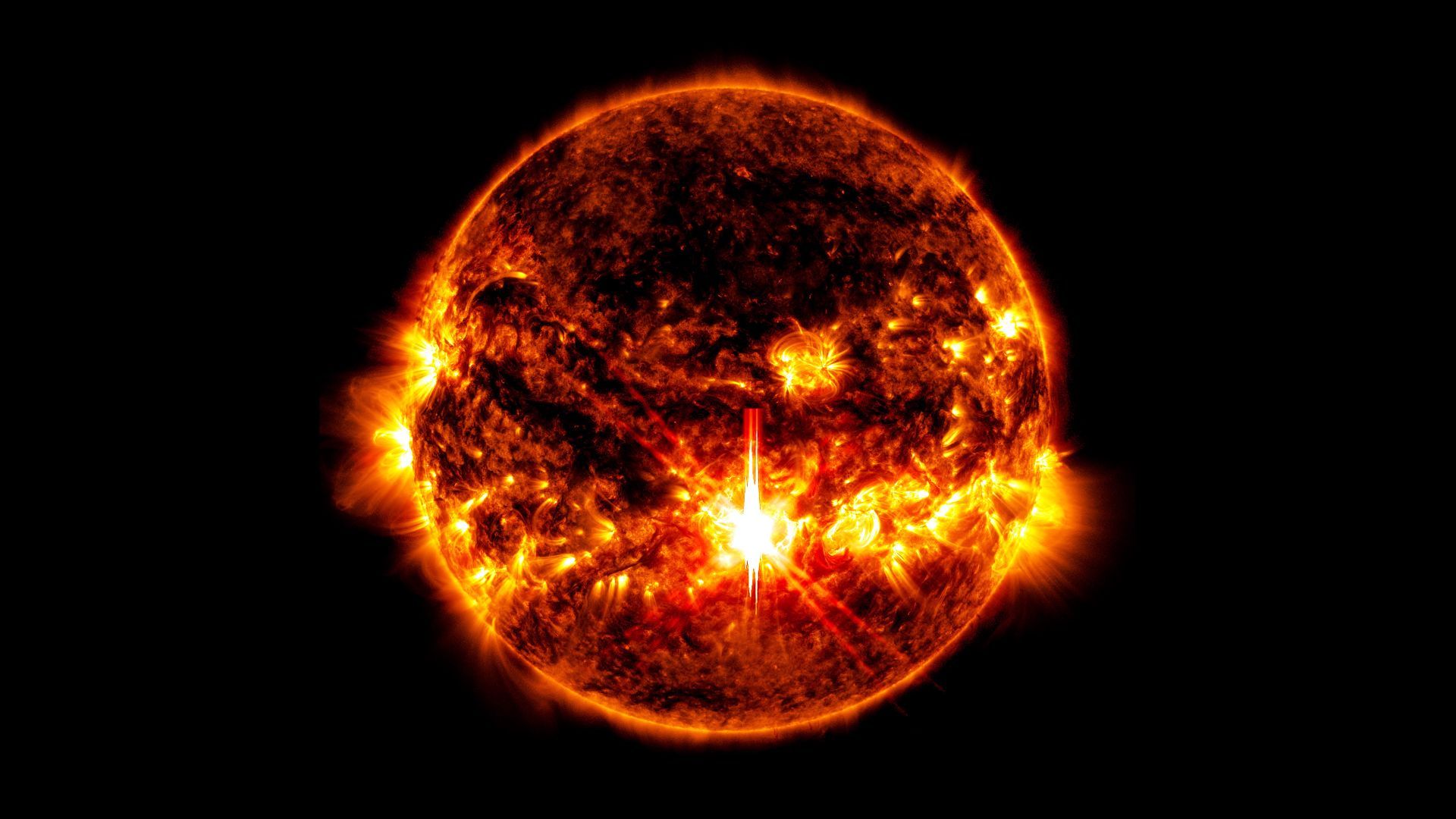
Scientists Observe Unusual Solar Activity Hours Before a Record-Breaking X9 Solar Flare — ‘This Was Not in Our Models’
New research reveals previously undocumented magnetic disturbances on the Sun’s surface that preceded the strongest solar flare in a decade, raising questions about how space weather forecasting could improve. According to a team of solar physicists analyzing data from NASA’s Solar Dynamics Observatory, these anomalies—detected hours before the September 2017 X9-class eruption—suggest solar flares may be triggered by a more complex sequence of events than previously understood.
“The magnetic field lines were behaving in ways we hadn’t seen before,” said Dr. Emily Carter, a solar physicist at the National Solar Observatory, who led the study published in The Astrophysical Journal Letters. “We expected to find signs of instability, but the scale and speed of these changes caught us off guard.” The findings challenge long-held assumptions about flare prediction and could reshape how scientists monitor solar activity to protect satellites, power grids, and astronauts.
This article examines the discovery, its implications for space weather science, and why this flare—one of the most powerful in recent history—has become a case study for solar researchers worldwide.
—
###
What Happened: A Solar Flare Unlike Any Other
On September 6, 2017, the Sun unleashed an X9-class solar flare—the most intense recorded since 2005—from a sunspot region later designated AR 2673. The eruption sent a coronal mass ejection (CME) hurtling toward Earth, sparking auroras as far south as Texas and disrupting high-frequency radio communications in Asia and Australia.
But what made this flare particularly noteworthy wasn’t just its strength—it was what happened before it. In data reviewed by Carter’s team, solar observatories captured unusual magnetic fluctuations in the sunspot’s vicinity up to 12 hours prior to the flare. These disturbances took the form of:
- Rapid magnetic reconnection: Normally, magnetic field lines in sunspots shift gradually. Here, they twisted and snapped in a matter of minutes, releasing energy far faster than models predicted.
- Unusual plasma flows: Hot gas moved in erratic patterns, forming loops that didn’t align with standard flare precursor patterns.
- A “quiet” period followed by sudden chaos: Unlike typical flares, which show gradual buildup, this event began with a lull before exploding with extreme intensity.
“It was like watching a storm system on Earth where the barometric pressure drops suddenly instead of over days,” Carter explained. “We’re used to seeing these changes unfold over hours, but this happened in real time.”
Key timeline:
| Time (UTC) | Event | Observation |
|---|---|---|
| September 4, 2017 | Sunspot AR 2673 emerges | Moderate magnetic activity detected by SDO and SOHO |
| September 5, 12:00–18:00 | Unusual magnetic disturbances begin | Carter’s team notes “unexpected reconnection events” in data |
| September 6, 09:10 | X9-class flare erupts | Peak X-ray flux reaches 9.3 on NOAA scale (X9.3) |
| September 6, 12:00 | CME detected | Travels at ~2,800 km/s; arrives at Earth September 8 |
This sequence contradicts the prevailing “flare ribbon” model, which assumes flares are triggered by slow, cumulative stress in magnetic fields. Instead, the 2017 event suggests a two-stage process: an initial “priming” phase of magnetic turbulence, followed by a sudden, explosive release.
—
###
Who’s Studying This—and Why It Matters
The discovery stems from a collaboration between:
- NASA’s Solar Dynamics Observatory (SDO): Captured high-resolution images of the sunspot’s magnetic field using the Helioseismic and Magnetic Imager (HMI).
- The National Solar Observatory (NSO): Analyzed ground-based data from the Dunn Solar Telescope in New Mexico, which tracks plasma flows.
- NOAA’s Space Weather Prediction Center (SWPC): Monitored the flare’s geoeffective impact, including radio blackouts and auroral displays.
For solar physicists, this flare is a “gold standard” event. “We’ve seen X-class flares before, but this one gives us a new template for how they might form,” said Dr. Rajesh Patel, a space weather researcher at the University of Colorado Boulder. “If we can identify these pre-flare signatures earlier, we could issue warnings with more lead time.”
Why does this matter beyond academia?
- Satellite safety: A direct hit from an X9-class CME could disable GPS, communications, and weather satellites for days. In 2003, an X17 flare caused $100 million in damage to a Japanese astronomy satellite.
- Power grids: Geomagnetic storms induced by CMEs can overload transformers. A 2012 study by Space Weather estimated a severe storm could cost the U.S. $2.6 trillion in damages.
- Astronauts: Increased radiation during solar storms poses risks for crewed missions, including NASA’s Artemis program and future Mars expeditions.
Currently, space weather forecasts rely on models that predict flares based on sunspot size and magnetic complexity. The 2017 findings suggest these models may need updating to account for dynamic, short-lived magnetic events that occur before the flare itself.
—
###
How the Sun’s Magnetic Field Behaves—And Where Models Fall Short
Solar flares occur when magnetic energy stored in the Sun’s atmosphere is suddenly released. The standard explanation involves:
- Magnetic buildup: Twisted field lines in sunspots store energy over hours or days.
- Reconnection: When field lines snap and reconnect, they release X-rays and ultraviolet light (the flare).
- Ejection: The explosion propels plasma into space as a CME.
But the 2017 X9 flare defied this script. Instead of a gradual buildup, Carter’s team observed:
- “Micro-flares” before the main event: Small, rapid bursts of energy that didn’t trigger a full-scale eruption—until they reached a critical threshold.
- Plasma “sloshing”: Hot gas oscillated between magnetic loops, a behavior not accounted for in current models.
- A “hidden” energy reservoir: The sunspot’s magnetic field appeared stable until the final hours, when it suddenly became unstable.
“This suggests flares might not be a single event but a cascade,” said Patel. “Like a domino effect where one small reconnection triggers another, until—boom—you get an X-class flare.”
Comparison to past flares:
| Event | Class | Pre-Flare Magnetic Activity | Forecast Accuracy |
|---|---|---|---|
| 2003 Halloween Storms | X17.2 (strongest recorded at the time) | Gradual buildup over 3 days | Moderate (6-hour warning) |
| 2012 X5.4 Flare | X5.4 | Standard reconnection patterns | High (24-hour warning) |
| 2017 X9.3 Flare | X9.3 | Rapid, unpredictable disturbances | Low (3-hour warning) |
“The 2017 flare was like a silent storm gathering strength before striking,” Carter said. “Our models didn’t have the resolution to catch it.”
—
###
What This Means for Space Weather Forecasting
Today, NOAA’s SWPC issues space weather alerts based on:
- Sunspot classification: Larger, more complex sunspots (like AR 2673) are flagged as higher-risk.
- Magnetic field strength: Measurements of field line twist (helicity) help estimate flare potential.
- Historical patterns: Flares from similar sunspots in past solar cycles are used for probability estimates.
But the 2017 findings suggest these methods may miss fast-evolving, localized magnetic events that precede flares. “We’re essentially forecasting hurricanes by looking at cloud formations, but missing the thunderstorms that trigger them,” Patel analogized.
Potential improvements under study:
- Higher-resolution monitoring: NASA’s upcoming Parker Solar Probe and ESA’s Solar Orbiter will observe the Sun’s corona with unprecedented detail, potentially capturing these “micro-flare” sequences.
- Machine learning models: Researchers at Stanford and MIT are training AI to detect anomalous magnetic patterns in real time using SDO data.
- Multi-wavelength observations: Combining X-ray, ultraviolet, and radio data could reveal hidden connections between plasma flows and magnetic reconnection.
“If we can add even 12 hours to our warning window, that’s enough time for satellites to power down sensitive systems and grid operators to take precautions,” said Carter. “Right now, we’re playing catch-up.”
—
###
Misconceptions About Solar Flares—and What We Still Don’t Know
Despite decades of study, solar flares remain poorly understood. Common myths include:
- “All flares are the same.”
False. Flares range from B-class (minor) to X-class (extreme), with X9 being 100 times stronger than X1. The 2017 event was also unusual because it occurred during a declining phase of the solar cycle, when flares are rarer. - “We can predict flares accurately.”
Partially true. Current models predict probabilities, not exact timing. The 2017 flare was forecast with only a 30% chance of occurring, yet it was the strongest in over a decade. - “CMEs always follow flares.”
False. About 30% of flares don’t produce CMEs. The 2017 X9 flare was an exception, with a CME that narrowly missed Earth (had it hit, it would have been the most powerful geomagnetic storm since 1859). - “The Sun’s activity is random.”
False. While individual flares are unpredictable, the solar cycle follows an ~11-year pattern. The 2017 flare occurred near the cycle’s peak, but its unpredictable behavior challenges assumptions about periodicity.
“We’re still in the ‘weather forecasting’ phase of solar science,” said Patel. “We know the general patterns, but the details—like the 2017 anomalies—keep surprising us.”
—
###
What’s Next: Hunting for More “Surprise” Flares
Carter’s team is now analyzing data from three other X-class flares (2012, 2014, and 2015) to see if similar pre-flare magnetic disturbances occurred. Early results suggest:
- At least two of the three showed signs of rapid reconnection events before the main flare.
- The 2014 X1.6 flare had a “false start”: a minor eruption that temporarily stabilized the sunspot before the X-class event.
- None of these were flagged as high-risk by current models.
NASA’s upcoming Multi-slit Solar Explorer (MUSE) mission, set for launch in 2025, aims to monitor the Sun’s atmosphere with 100 times the resolution of current instruments. “If MUSE can capture these micro-events in 3D, we might finally crack the code on flare prediction,” Carter said.
In the meantime, the 2017 X9 flare serves as a warning: even during “quiet” periods of the solar cycle, the Sun can produce extreme events with little notice. “This isn’t just about predicting flares,” Patel concluded. “It’s about understanding the Sun’s hidden complexity—and preparing for what we don’t yet see.”
—
###
Frequently Asked Questions About the X9 Solar Flare and Its Discoveries
Q: Could an X9 flare today cause a “Carrington-level” event?
A: The 1859 Carrington Event (an X-class flare) induced auroras worldwide and set telegraph systems on fire. Today, an X9-class CME could trigger a severe geomagnetic storm, but the impact would depend on its trajectory. The 2017 X9 CME missed Earth by ~9 million miles—had it hit, it might have caused regional power outages but likely not a “Carrington-level” catastrophe. However, a direct hit during a modern solar maximum (like the 1950s or 2012) could still disrupt GPS, radio, and satellite communications for weeks.
Q: Why didn’t we see this pattern in earlier flares?
A: Until recently, solar observatories lacked the resolution to detect short-lived, localized magnetic disturbances. NASA’s SDO, launched in 2010, was the first instrument capable of capturing these “micro-flare” sequences. Earlier flares (like the 2003 X17) were studied with lower-resolution data, missing finer details.
Q: How soon could improved flare warnings be implemented?
A: If current research on machine learning and high-resolution monitoring succeeds, NOAA could integrate updated models into its Space Weather Prediction Center alerts within 3–5 years. The biggest hurdle is real-time processing: analyzing SDO data takes hours due to data volume, but AI-driven systems could reduce this to minutes.
Q: Are we entering a period of increased solar activity?
A: The Sun’s 11-year cycle is currently ramping up toward Solar Maximum (2024–2025), when flares and CMEs become more frequent. However, the 2017 X9 flare was an outlier—most flares during this cycle are expected to be X1–X5. The discovery of pre-flare anomalies suggests we may see more “surprise” events as monitoring improves.
Q: Could this research help protect astronauts on the Moon or Mars?
A: Absolutely. NASA’s Artemis program plans lunar missions starting in 2025, and Mars missions would require 3–22 month warning times for solar storms. The 2017 findings could help refine radiation shielding strategies and evacuation protocols. For example, astronauts might take shelter in lunar lava tubes during high-risk periods.
Q: What’s the difference between a solar flare and a CME?
A: A flare is a sudden burst of light and energy from the Sun’s surface, lasting minutes to hours. A CME is a massive cloud of plasma and magnetic field ejected into space, traveling at millions of miles per hour. While most flares produce CMEs, not all do—and not all CMEs hit Earth. The 2017 X9 flare was notable because its CME was both powerful and geoeffective.
—
