Spiral arms form as dynamic density patterns that move through galaxies
A study of 22 galaxies shows that molecular cloud lifecycles remain consistent regardless of their location, suggesting spiral arms organize gas.
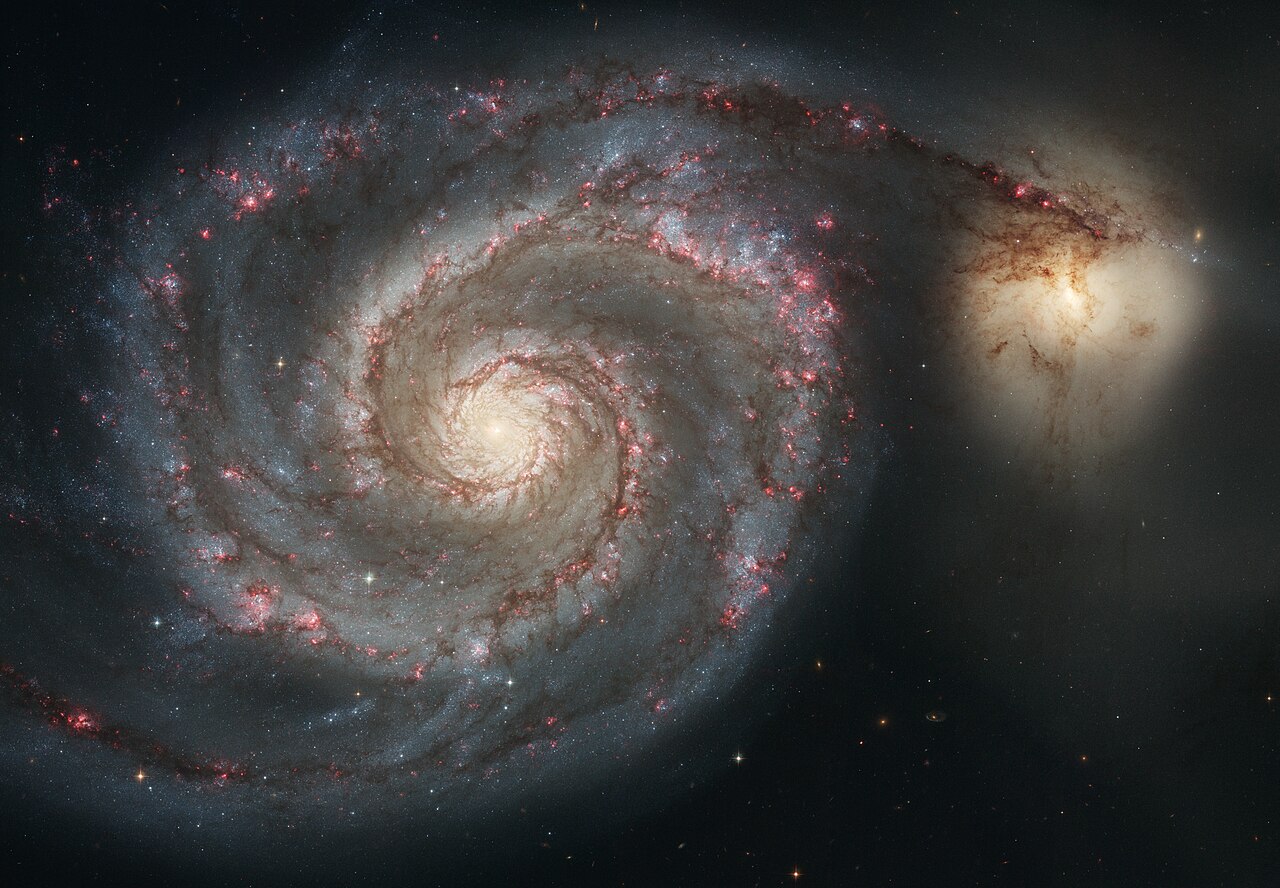
Spiral arms represent one of the most recognizable features in the universe, yet they are not permanent, solid structures. Rather than rotating as rigid components of a galaxy, spiral arms function as dynamic density patterns — often likened to traffic congestion on a highway — that move through the galactic disk. As galactic disks experience differential rotation, where matter orbits the center at varying speeds, gas and stars are organized into these visually distinct patterns. Over time, these configurations serve as essential organizers of galactic structure, collecting diffuse material into concentrated regions.
The origin of these structures has long been a subject of scientific inquiry, with two primary, non-exclusive theories predominating. The density wave theory posits that spiral arms emerge when mechanical oscillations create waves of high density, which move independently of the stellar disk to compress gas and trigger star formation. Conversely, the stochastic self-propagating star formation model suggests that arms arise from localized starburst activity, where stellar feedback, such as supernova shockwaves, triggers further star formation in adjacent regions. In interacting systems, such as the Whirlpool Galaxy, tidal forces from companion galaxies can also distort disks to create pronounced spiral patterns.
Related media


Evaluating the Star Formation Trigger
While spiral arms are host to significant starburst activity and concentrations of bright, young stars, recent research challenges the long-held hypothesis that they act as the primary engines for creating stars. A study led by Romanelli et al., published in June 2025, utilized data from the PHANGS-ALMA survey to analyze the evolutionary lifecycles of giant molecular clouds across 22 nearby spiral galaxies. By applying the "Uncertainty Principle for Star Formation," the researchers compared cloud lifecycles, feedback timescales, and star formation efficiency in both spiral arms and quieter inter-arm regions.
The findings indicate that the lifecycle of a star-forming cloud is largely independent of its specific location within a galaxy. Molecular clouds typically persist for approximately 10 to 50 million years, regardless of whether they are situated within a dense spiral arm or in the regions between them. Furthermore, the feedback from newborn stars, the process by which energy and momentum from massive stars eventually disperse parent clouds, occurs over similar timescales in both environments. These results suggest that while spiral arms gather gas, they do not necessarily accelerate the fundamental process of cloud collapse into stars.
Dynamics and Gas Transport
Despite their role in transporting gas, the efficiency of star formation, the fraction of gas converted into stars, shows interesting variations. Romanelli et al. Found that star formation efficiency is actually slightly higher in inter-arm regions compared to spiral arms. This observation aligns with hypotheses suggesting that intense shear and differential gas flows within spiral arms may provide support against gravitational collapse, effectively suppressing star formation efficiency rather than enhancing it. Other theories suggest that tidal forces from nearby clouds in dense environments might tear clouds apart, further limiting their ability to form stars.
Future Research Directions
The role of galactic morphology continues to be a central focus for astronomical research. Upcoming investigations aim to address several outstanding questions:
- Refinement of numerical simulations to better model the complex interactions between magnetic fields, stellar feedback, and galactic spiral patterns.
- Continued analysis of the PHANGS-ALMA survey data to further clarify the specific role of galactic bars in long-term gas transport and galaxy evolution.
- Exploration of how varied environments, such as galaxy clusters where ram pressure may strip gas, influence the long-term stability and appearance of spiral arms.
How significant is this development?
Contribute your assessment to the aggregated reader intelligence ledger.
Archypedia is dedicated to independent, evidence-backed reporting. This briefing was synthesized from primary source reporting, corroborated across independent newsrooms, and verified against our Editorial Standards.
Transparency record
Evidence behind this report
This report synthesizes 6 distinct sources. Open the source ledger below to compare the underlying coverage.
Prepared under the Archypedia Editorial Policy by the Niko Vale editorial desk profile. AI-assisted tools may support drafting and verification; public accountability remains with Archypedia. Report an error.