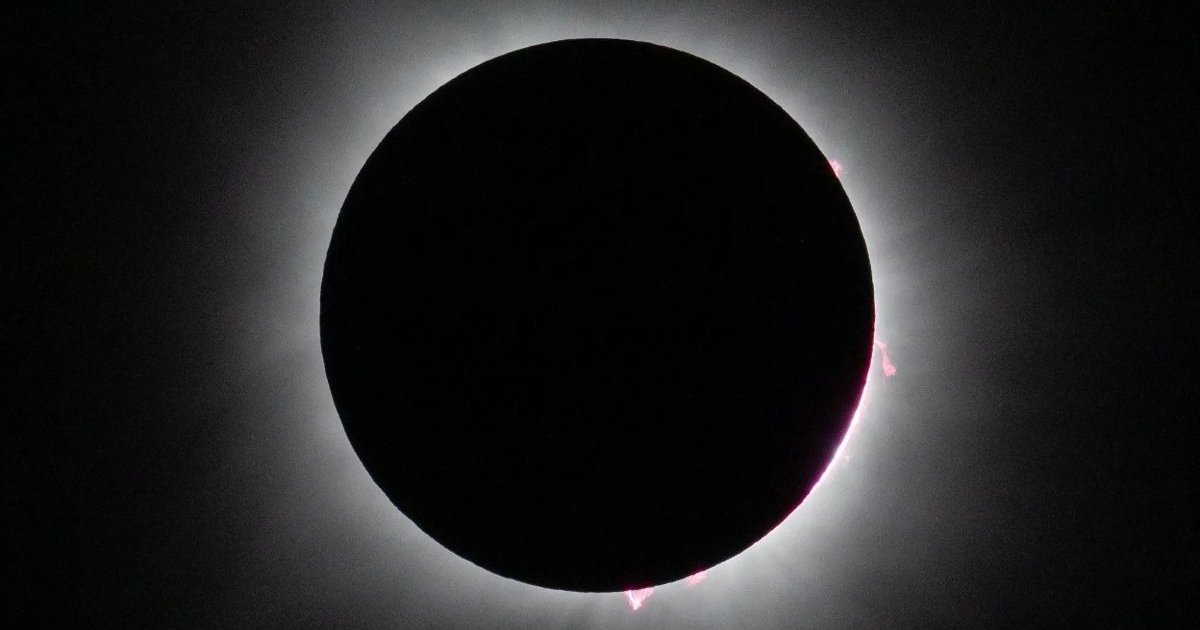
Rare solar eclipse wows millions across Europe and UK
The region's most significant celestial event since August 1999 brought total darkness to parts of Iceland and Spain while drawing millions outdoors across the UK.

As the frantic scramble for certified protective eyewear left pharmacies, opticians, and museum gift shops sold out across Europe, a sudden, communal hush fell over crowds gathered from Land's End to Greenwich Park. Millions of people across the United Kingdom and continental Europe turned their eyes upward on Wednesday for a rare, once-in-a-generation solar eclipse that blocked over 90% of the Sun in Britain and brought total darkness to parts of Iceland and Spain, marking the region's most significant celestial event since August 1999.
The astronomical phenomenon began as a small nibble on the edge of the solar disk shortly after 6:00 PM BST, growing steadily until more than 90% of the Sun was obscured according to Yahoo News. Weather conditions proved to be a critical divider of experiences. While much of southern England, Oxfordshire, Berkshire, Hampshire, Dorset, the Isle of Wight, and wide swaths of Spain enjoyed perfect clear skies, thick cloud cover threatened and occasionally spoiled the view for skywatchers in Scotland as reported by Livemint. At the Whitelee Windfarm Visitor Centre in Eaglesham, operators warned that visibility entirely depended on cloud thickness.
Related YouTube video


With commercial stocks of specialized solar glasses exhausted days in advance — such as at a shop in Land's End where the final pairs vanished in hours noted by The Mirror — resourceful spectators deployed household alternatives. Across parks and public squares in Britain and Germany, onlookers projected light through kitchen colanders, cereal boxes, blank sheets of paper, and welding helmets, while physics students shared telescopes with passing pedestrians according to GB News.
The event triggered varied atmospheric and human reactions. In Cornwall, where the Moon covered up to 98.5% of the Sun, spectators on cliff tops experienced sudden, eerie temperature drops shifting from hot to refreshing and cold. Observers in London popped champagne corks in parks, and one couple in Alpheton, Suffolk, deliberately timed their wedding celebration to coincide with the spectacle. Meanwhile, in Spain, millions of foreign tourists and astrotourists flooded inland rural villages along the path of totality, such as Miranda de Ebro, to escape crowded Mediterranean beaches, generating hundreds of millions of euros in economic activity noted Livemint. Spanish authorities concurrently issued strict warnings to avoid heatwave-parched rural zones where the gathering crowds could spark wildfires.
Medical professionals issued urgent warnings regarding the invisible dangers of unprotected viewing. Nkosi Yearwood, an optometrist and council member for Wales with The College of Optometrists, cautioned that because the retina lacks pain receptors, individuals who looked directly at the Sun without certified protection could suffer solar retinopathy without realizing it immediately stated The Mirror. Symptoms including blurred vision, distortion, dark spots, or altered color perception can take hours or a couple of days to manifest.
As the peak phase subsided, the Moon continued its trajectory across the solar disk. The final stages of the celestial event played out across the UK and Europe just before evening sunset, with the Sun fully emerging from behind the Moon and returning to its complete visibility shortly before 8:05 PM BST reported The Mirror.
Regional Variations and Future Sights
The geographical reach of the celestial alignment produced stark contrasts in viewing experiences across the British Isles. According to GB News, the Moon began to dawn over the sun from 6:08 PM in Edinburgh, moving westward across the country, with Devon, Cornwall, and the westernmost reaches of Pembrokeshire enjoying the most dramatic views as between 94 per cent and 96 per cent of the solar disk was obscured. Meanwhile, Yahoo News noted that southern locations such as Oxfordshire, Berkshire, Hampshire, Dorset, and the Isle of Wight experienced perfect clear skies as the eclipse peaked shortly after 19:00 BST.
- Edinburgh: Moon began dawning over the sun starting at 6:08 PM, as reported by GB News.
- Devon, Cornwall, and Pembrokeshire: Recorded the most dramatic views in the UK with 94 to 96 percent of the sun blocked, according to GB News.
- Southern England: Oxfordshire, Berkshire, Hampshire, Dorset, and the Isle of Wight enjoyed clear skies with the eclipse peaking shortly after 19:00 BST, per Yahoo News.
- Scotland: Visibility was threatened and occasionally spoiled by thick cloud cover, with operators at the Whitelee Windfarm Visitor Centre in Eaglesham warning that viewing depended entirely on cloud thickness, as reported by Livemint.
As skywatchers return to normal routines following the fading sunset, the next step for anyone who directly viewed the Sun without certified protection is to monitor for symptoms such as blurred vision, distortion, dark spots, or altered color perception and immediately seek advice from an optometrist at a local optician.
How significant is this development?
Contribute your assessment to the aggregated reader intelligence ledger.
Archypedia is dedicated to independent, evidence-backed reporting. This briefing was synthesized from primary source reporting, corroborated across independent newsrooms, and verified against our Editorial Standards.
Transparency record
Evidence behind this report
This report synthesizes 4 distinct sources. Open the source ledger below to compare the underlying coverage.
Prepared under the Archypedia Editorial Policy by the Niko Vale editorial desk profile. AI-assisted tools may support drafting and verification; public accountability remains with Archypedia. Report an error.