Bolyai Researchers Use Floquet Formalism to Model Driven Spin Systems
Researchers have introduced a full Floquet-space formalism to improve the control and modelling of driven spin systems. This approach explicitly accounts for complex interactions, such as the Dzyaloshinskii-Moriya interaction, to assist in developing spin-based quantum technologies.

Researchers at Bolyai University and the National Institute for Research and Development of Isotopic and Molecular Technologies have introduced a new modelling framework designed to improve the control of driven spin systems. By applying a full Floquet-space formalism, the team aims to overcome limitations found in traditional simulations, which often rely on approximations that fail to account for complex, non-rotational spin dynamics. This advancement is considered a meaningful step toward the development of sophisticated spin-based quantum technologies, including new approaches to data storage and processing.
The research, led by Andrea Simion and colleagues, adapts mathematical methodologies from Nuclear Magnetic Resonance (NMR) to analyze electron spins subjected to both static magnetic fields and transverse oscillating fields. According to the team, the new approach achieves a five-fold increase in modelling accuracy by capturing multi-frequency, strongly correlated, and chiral dynamic regimes that previous perturbative models — often used in spintronics — frequently misrepresent. The study highlights that the common Magnus expansion or rotating-wave approximations are insufficient when the strength of the driving field becomes comparable to intrinsic material interactions.
Related media

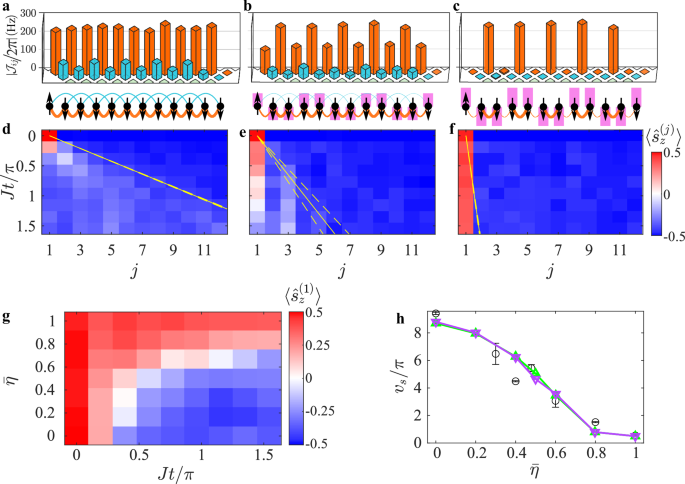
A central focus of the work is the explicit inclusion of the chiral Dzyaloshinskii-Moriya interaction (DMI), an antisymmetric exchange interaction arising from spin-orbit coupling and asymmetric atomic arrangements. Simulations reveal that the interplay between this interaction and isotropic Heisenberg exchange coupling leads to distinctive behaviors, such as the emergence of tilted, elliptical Bloch-sphere trajectories. These results deviate from the simpler circular paths predicted by models that neglect these specific interactions. The researchers observed that the DMI generates a measurable spin component along the y-axis while simultaneously reducing the component along the z-axis, effectively reorienting the spin away from the static magnetic field.
The study also emphasizes the critical role of boundary conditions in determining how these spins behave. The research shows that effects induced by the DMI are significantly more pronounced in systems with open boundaries, where spins at the edges interact with their environment, compared to systems with periodic boundaries, where translational invariance partially suppresses the symmetry-breaking effects.
Comparison of Modelling Approaches
| Feature | Approximate Floquet Engineering | Full Floquet-Space Formalism |
|---|---|---|
| Computational Basis | Perturbative/Effective-Hamiltonian | Operator-based Hilbert-Floquet |
| Frequency Handling | Single-frequency/High-frequency | Multi-frequency/Coupled modes |
| DMI Interaction | Often neglected or approximated | Explicitly accounted for |
| Accuracy | Limited in strong-driving regimes | Validated via Fourier truncation |
As the scientific community continues to explore the control of interacting spin systems, the full Floquet-space formalism provides a robust tool for designing pulse sequences and gate operations. By mapping the Schrödinger equation into an extended Sambe space, the team established a time-independent eigenproblem that allows for the stable calculation of quasienergies and expectation values. According to the research, this methodology remains valid for arbitrary ratios of driving, exchange, and DMI strengths, distinguishing it from standard reduction techniques.
The transition from approximate models to a full operator-based Hilbert-Floquet representation allows the researchers to treat the time-periodic Hamiltonian through an expansion in a Fourier basis. This mapping creates a framework where the system’s evolution is analyzed by iteratively including higher Floquet modes, only truncating the space once physically relevant dynamical features, such as quasienergies and Bloch-sphere trajectories, stabilize. This approach ensures that resonance-enhanced effects, which are typically ignored by high-frequency expansions, are captured with high fidelity.
Beyond its theoretical utility, the work serves as a practical guide for experimentalists. By analyzing the control landscape, mapping the longitudinal spin response over the driving-parameter space, the researchers demonstrated that arbitrary target rotations remain feasible even in nonintegrable, interacting systems. This suggests that the formalism can assist in the precise calibration of pulse sequences and the optimization of quantum gates.
Looking ahead, the researchers suggest that the next phase of this work will involve incorporating a deeper understanding of material imperfections and their impact on spin interactions. Because the DMI is highly sensitive to the symmetry of the atomic lattice, future efforts will likely focus on advanced characterization techniques to map structural variations at the nanoscale. These efforts are expected to support the design of more robust quantum logic and magnetic architectures, addressing critical concerns regarding decoherence in topological qubits, where edge-induced symmetry breaking remains a challenge for coherent control.
Archypedia is dedicated to independent, evidence-backed reporting. This briefing was synthesized from primary source reporting, corroborated across independent newsrooms, and verified against our Editorial Standards.
Transparency record
Evidence behind this report
This report synthesizes 4 distinct sources. Open the source ledger below to compare the underlying coverage.
Prepared under the Archypedia Editorial Policy by the Niko Vale editorial desk profile. AI-assisted tools may support drafting and verification; public accountability remains with Archypedia. Report an error.