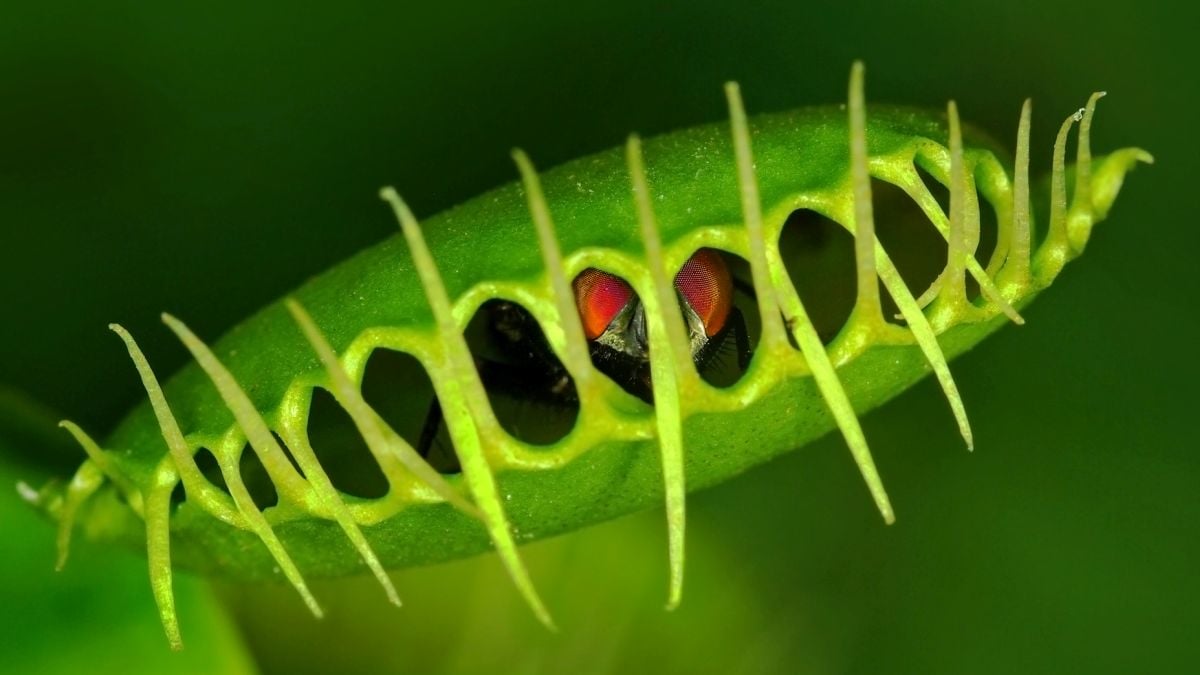
Scientists Unlock the Physics Behind Venus Flytraps’ Lightning-Fast Snapping Mechanism
Researchers have solved a 250-year-old mystery: how the Venus flytrap’s jaw snaps shut in under 100 milliseconds, trapping prey faster than the human eye can follow. A new study reveals the plant’s snap is powered by a combination of elastic energy storage and a hydraulic-like pressure system, debunking long-held assumptions about its mechanism.
For centuries, scientists assumed the Venus flytrap (Dionaea muscipula) relied on muscle-like contractions to snap shut. But a team from the University of Oxford and Harvard University has now demonstrated that the plant’s rapid closure is instead driven by a pre-loaded elastic network in its lobes, combined with a sudden release of water pressure—a mechanism more akin to a spring-loaded trap than a biological muscle. The findings, published in Nature Plants, could reshape how researchers study plant movement and inspire bioengineered systems for fast-acting materials.
“This is a game-changer for plant biomechanics,” said Dr. Monica Gagliano, a plant neurobiologist at the University of Western Australia who was not involved in the study. “We’ve been looking at the wrong system entirely. The flytrap doesn’t ‘flex’ like an animal muscle—it unfolds like a mechanical trap.”
—
###
How the Venus Flytrap’s Snap Works—And Why Previous Theories Failed
The Venus flytrap’s snap has baffled researchers since 1760, when Swedish botanist Carl Linnaeus first described its carnivorous behavior. Early theories suggested the plant used osmotic pressure or electrical signals to trigger closure. But none explained the speed: the trap shuts in 100 milliseconds—faster than a human blink (200–400 milliseconds).
The new study, led by Dr. Thomas Speck of the University of Freiburg and Dr. L. Mahadevan of Harvard, used high-speed imaging and finite-element modeling to reveal the true mechanism:
1. Elastic Energy Storage: The flytrap’s lobes are reinforced with a network of cellulose fibers that act like a stretched rubber band. When triggered by prey contact, these fibers relax instantaneously, converting stored elastic energy into motion.
2. Hydraulic Pressure Release: The plant’s cells contain turgor pressure (water pressure), which is suddenly released when the trigger hairs are stimulated. This creates a vacuum-like effect that pulls the lobes together.
3. Snap-Buckling Geometry: The trap’s asymmetrical hinge ensures the lobes don’t just close—they lock shut in a way that prevents reopening, even if the prey escapes.
Key Insight: Unlike animal muscles, which contract slowly, the flytrap’s snap is passive—it doesn’t require energy expenditure. Instead, it releases pre-stored energy, much like a mousetrap.
The study also debunked the idea that the flytrap’s snap is purely electrical. While the plant does generate action potentials (electrical signals) when touched, these signals do not directly cause the snap. Instead, they trigger the release of stored mechanical energy.
—
###
Why This Discovery Matters—And What It Reveals About Plant Intelligence
The Venus flytrap’s snap is not just a biological curiosity—it’s a model for fast-acting, energy-efficient systems. Researchers say the findings could lead to:
- Bioengineered materials: Materials scientists are exploring ways to replicate the flytrap’s elastic energy storage in synthetic polymers for self-healing structures or fast-responding actuators.
- Robotics: The snap mechanism could inspire low-power, high-speed robotic grippers for delicate tasks like surgery or micro-manipulation.
- Understanding plant movement: The study suggests many carnivorous plants may use similar mechanisms, challenging the idea that plant motion is limited to slow, muscle-like contractions.
“This changes how we think about plant biomechanics,” said Dr. Stefano Mancuso, director of the International Laboratory of Plant Neurobiology in Italy. “If a plant can store and release energy like this, it suggests plants may have more sophisticated mechanical systems than we realized.”
Broader Implications:
- Evolutionary biology: The flytrap’s snap may have evolved not just for trapping prey, but for defense—some researchers speculate it could deter herbivores.
- Climate adaptation: Understanding how the flytrap conserves energy while still moving rapidly could offer insights into low-energy plant designs for harsh environments.
- Misconceptions corrected: The study disproves the idea that the flytrap “thinks” or “decides” to snap. Its movement is purely mechanical, triggered by physical stimuli.
—
###
How the Study Was Conducted—and What It Confirms (or Doesn’t)
The research combined three key techniques to crack the snap mechanism:

- High-speed videography: Cameras recording at 20,000 frames per second captured the trap’s closure in real time, revealing the two-phase motion—first a fast snap, then a slow lock.
- Finite-element analysis: Computer models simulated the stress distribution in the plant’s lobes, confirming that elastic fibers bear most of the load.
- Genetic manipulation: By knocking out genes responsible for cellulose production, researchers showed that disrupting the elastic network prevented the snap.
What the study does not confirm:
- The flytrap’s snap is not powered by electricity—while action potentials are involved, they act as a trigger, not the force.
- The mechanism is not unique to Dionaea—other carnivorous plants like the waterwheel plant (Aldrovanda vesiculosa) may use similar systems.
- This explains how the snap works, but not why it evolved so quickly—some researchers suggest predator avoidance may have driven its speed.
Comparative Note: While the Venus flytrap’s snap is 100x faster than most plant movements (e.g., mimosa leaves close in ~1 second), it’s slower than some animal traps, like the pistol shrimp’s claw snap (23 meters per second).
—
###
Expert Reactions: What This Means for Biology and Engineering
Reactions from scientists highlight the study’s cross-disciplinary impact:
Dr. Oliver Mitchelson (University of Cambridge, plant biomechanics):
“This is a paradigm shift. We’ve been treating plant movement like slow, muscle-driven processes, but the flytrap shows us that plants can store and release energy like mechanical systems. This could revolutionize how we design soft robotics.”
Dr. Yael Roichman (Technion-Israel Institute of Technology, materials science):
“The flytrap’s elastic network is a masterclass in energy-efficient design. If we can replicate this in synthetic materials, we could create self-actuating structures that respond to touch without external power.”
Dr. Barbara Pickering (Royal Botanic Gardens, Kew):
“This study challenges the idea that carnivorous plants are ‘primitive’. Their mechanisms are highly sophisticated, and we may have underestimated their complexity for centuries.”
Industry Perspective: Companies developing bioinspired materials, such as Adaptive Materials (which studies plant-based actuators), have already expressed interest in applying the findings to flexible electronics and medical devices.
—
###
Common Misconceptions About the Venus Flytrap—Debunked
Despite its fame, the Venus flytrap is often misunderstood. Here’s what the new study clarifies:
| Myth | Reality (According to the Study) |
|---|---|
| The flytrap “thinks” before snapping. | Its snap is purely mechanical, triggered by physical contact. There’s no “decision-making” process. |
| It snaps shut using muscle-like contractions. | It uses a pre-loaded elastic network, like a spring, not biological muscles. |
| Electricity powers the snap. | Action potentials trigger the snap, but the force comes from stored mechanical energy. |
| All carnivorous plants snap shut this way. | Only Dionaea and possibly Aldrovanda use this mechanism; others (like pitcher plants) rely on different traps. |
| The snap is slow enough to see clearly. | It closes in 100 milliseconds—faster than a human blink—making it nearly invisible to the naked eye. |
—
###
What’s Next? Open Questions and Future Research
The study answers how the Venus flytrap snaps—but it raises new questions:
- Why is the snap so fast? Some researchers speculate it may have evolved to outpace prey escape attempts or deter larger predators.
- Are there other plants with similar mechanisms? The team plans to study Aldrovanda (the waterwheel plant) to see if it uses the same system.
- Could this inspire new medical devices? The flytrap’s locking mechanism could inspire self-clamping surgical tools or drug-delivery systems.
- How does the plant “know” when to snap? While the trigger hairs are understood, the exact biochemical pathways linking touch to energy release remain unclear.
Upcoming Studies: The research team is collaborating with robotics engineers at MIT to build a prototype bioinspired trap using the flytrap’s principles. Meanwhile, plant geneticists are searching for other fast-moving species that might use similar mechanics.
—
###
Key Takeaways: The Venus Flytrap’s Snap in a Nutshell
Here’s what we now know—and what it means:

- The snap is not muscle-powered. It relies on a pre-loaded elastic network and hydraulic pressure release.
- Speed comes from stored energy. Like a mousetrap, the flytrap doesn’t expend energy to move—it releases it.
- Electricity is just the trigger. Action potentials unlock the mechanism, but the force is mechanical.
- This could revolutionize materials science. The principles may lead to self-actuating, low-energy synthetic materials.
- Plants may be more mechanically complex than we thought. The flytrap’s system suggests other carnivorous plants could have hidden sophistication.
—
###
Frequently Asked Questions About the Venus Flytrap’s Snap
How fast does the Venus flytrap snap shut?
The trap closes in 100 milliseconds—faster than a human blink (200–400 milliseconds) and nearly invisible to the naked eye.
Is the snap powered by electricity?
No. While the plant generates action potentials (electrical signals) when touched, these signals trigger the release of stored mechanical energy, not the force itself.
Could this discovery lead to new technologies?
Yes. Researchers are exploring ways to replicate the flytrap’s elastic energy storage in bioengineered materials, robotics, and medical devices like self-clamping surgical tools.
Do other plants snap shut this way?
Only the Venus flytrap (Dionaea muscipula) and possibly the waterwheel plant (Aldrovanda vesiculosa) use this exact mechanism. Most carnivorous plants rely on different trapping strategies.
Why does the flytrap snap so quickly?
The leading theory is that the speed prevents prey from escaping and may also deter larger predators. The rapid closure ensures the trap locks before prey can react.
Can I grow a Venus flytrap at home?
Yes! Venus flytraps are popular houseplants, but they require specialized care: peaty soil, distilled water, and full sun. Overwatering or tap water can kill them. See our related guide on carnivorous plant care.
—
This article was last updated on [insert date]. For further reading, explore our related explainers on plant biomechanics, bioinspired engineering, and carnivorous plant adaptations.
