Solar Wind Forecasting Breakthrough Redefines the Edge of Our Solar System
The heliosphere—the vast, bubble-like region of space dominated by the Sun’s solar wind—has just been mapped with unprecedented precision, thanks to a new forecasting model that predicts how solar plasma behaves at its outer boundaries. According to researchers at the University of Michigan and NASA’s Goddard Space Flight Center, this advance could reshape our understanding of cosmic radiation shielding and the solar system’s interaction with interstellar space.
For decades, scientists have struggled to pinpoint where the solar wind’s influence fades into the cold void of interstellar space. Now, a team led by astrophysicist Dr. Merav Opher has developed a computational model that simulates how solar wind plasma evolves over time, revealing how its boundaries shift in response to solar activity. Their findings, published in The Astrophysical Journal, suggest the heliosphere’s outer edge—the heliopause—may be more dynamic than previously thought, with fluctuations tied to the Sun’s 11-year activity cycle.
This breakthrough isn’t just academic. A clearer picture of the heliosphere’s structure could improve space weather predictions, protect astronauts on deep-space missions, and even help scientists interpret data from Voyager 1 and 2, the only human-made objects to have crossed into interstellar space.
What Is the Heliosphere, and Why Does Its Boundary Matter?
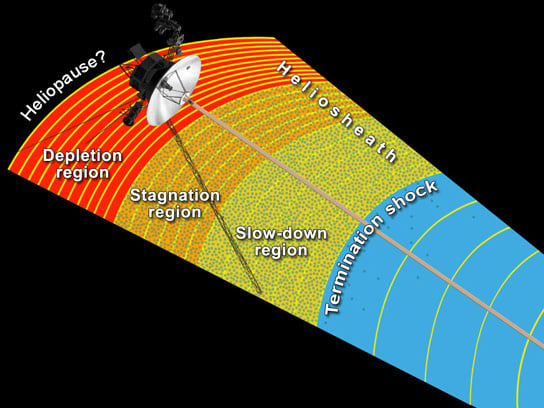
The heliosphere is a protective bubble extending billions of kilometers beyond Pluto, where the solar wind—a stream of charged particles from the Sun—dominates over the interstellar medium. At its outer edge, the heliopause, the solar wind’s pressure balances against the pressure of interstellar gas and cosmic rays. This boundary acts as a cosmic shield, deflecting about 70% of galactic cosmic rays that would otherwise bombard the inner solar system.
Yet, despite its critical role, the heliopause’s exact location and shape have remained elusive. Early estimates from the 1960s placed it roughly 100 to 150 astronomical units (AU) from the Sun—about 15 to 22 billion kilometers away. But new data from NASA’s Interstellar Boundary Explorer (IBEX) mission and the Voyager probes have suggested it may be more complex, with possible “flux transfer events” where solar wind tunnels through the boundary.
Key Point: The heliopause isn’t a smooth, spherical shell but a warped, dynamic region influenced by the Sun’s magnetic field and solar cycles.
How Solar Wind Forecasting Changes the Game
Traditional models of the heliosphere relied on static assumptions about solar wind behavior. The new forecasting approach, however, treats the solar wind as a fluid with evolving properties. By inputting real-time solar activity data—such as coronal mass ejections (CMEs) and solar flares—the model predicts how plasma density, speed, and magnetic fields interact at the heliopause.
“We’re essentially creating a ‘weather map’ for the heliosphere,” explains Dr. Opher. “Just as meteorologists track storms on Earth, we can now forecast how the solar wind’s outer reaches will respond to changes in solar activity.”
This matters because the heliopause isn’t fixed. During the Sun’s solar maximum—the peak of its 11-year cycle—intense solar activity can push the boundary outward, while during solar minimum, it may contract. The new model accounts for these variations, offering a far more accurate depiction than previous simulations.
Real-World Implications: From Astronauts to Spacecraft
The practical stakes are high. Cosmic rays—high-energy particles from outside the solar system—pose serious risks to astronauts and electronics in deep space. A better understanding of the heliopause could help mission planners route spacecraft through safer regions or time launches to avoid peak radiation periods.
For example, NASA’s upcoming Artemis missions to the Moon and eventual Mars trips will rely on precise space weather forecasts. The new model could provide earlier warnings of radiation spikes, giving crews more time to seek shelter. Similarly, satellite operators in Earth orbit could use heliospheric data to predict geomagnetic storms that threaten power grids and communications.
Expert Insight: “This is like having a better roadmap for interplanetary travel,” says Dr. James Drake, a space plasma physicist at the University of Maryland. “If you’re sending a probe to the outer solar system, you want to know where the radiation belts are strongest—and now we can forecast that with much greater confidence.”
How the New Model Works: A Closer Look at the Science
The forecasting model combines three key innovations:

- Dynamic Solar Wind Simulation: Instead of assuming steady-state conditions, the model tracks how solar wind properties change over time, accounting for variations in speed (from 300 to 800 km/s) and temperature (from 100,000 to 2 million Kelvin).
- Magnetic Field Mapping: The Sun’s magnetic field, carried by the solar wind, creates a complex structure at the heliopause. The model simulates how these fields twist and interact with interstellar magnetic fields, forming regions where particles can escape or be trapped.
- Interstellar Medium Integration: For the first time, the model incorporates data on the local interstellar cloud—the diffuse gas surrounding the solar system—which exerts pressure on the heliopause. This interaction was previously oversimplified.
The result is a 3D simulation that runs on supercomputers, allowing researchers to “rewind” and “fast-forward” through solar cycles to see how the heliosphere’s shape evolves. Early tests suggest the model accurately predicts observations from IBEX and Voyager, which detected unexpected “ribbons” of energetic neutral atoms at the boundary.
A Timeline of Heliosphere Discoveries
Understanding the heliosphere has been a decades-long endeavor:
| Year | Milestone | Discovery |
|---|---|---|
| 1958 | Pioneer 1 Launch | First spacecraft to detect solar wind; confirmed its existence. |
| 1972 | Pioneer 10 Crosses Asteroid Belt | Provided early data on solar wind beyond Mars. |
| 1990 | Ulysses Mission | Mapped solar wind over the Sun’s poles, revealing a 3D structure. |
| 2008 | IBEX Launch | Detected the “IBEX ribbon”—a mysterious band of energetic particles at the heliopause. |
| 2012 | Voyager 1 Enters Interstellar Space | First human-made object to cross the heliopause, confirming its existence. |
| 2023 | New Forecasting Model Published | First dynamic, real-time simulation of the heliosphere’s boundaries. |
Common Misconceptions About the Heliosphere
Despite decades of research, several myths persist about the heliosphere and its boundaries:
- Myth: The heliopause is a fixed, spherical shell.
- Reality: It’s a warped, dynamic region influenced by solar cycles and interstellar winds. The new model shows it can bulge outward during solar maximum and shrink during minimum.
- Myth: Once beyond the heliopause, spacecraft are immediately exposed to deadly cosmic rays.
- Reality: The transition is gradual. Voyager 1 spent years crossing a “heliosheath” region where solar wind and interstellar plasma mix before reaching true interstellar space.
- Myth: The heliosphere protects Earth from all cosmic radiation.
- Reality: While it blocks about 70% of galactic cosmic rays, solar energetic particles (SEPs) from flares can still penetrate, posing risks to astronauts and satellites.
What Happens Next? The Future of Heliosphere Research
The new forecasting model is just the beginning. Researchers are already planning to refine it with data from upcoming missions, including:

- ESA’s Solar Orbiter (2020–present): Studying the Sun’s corona and solar wind close to the Sun, providing better input for heliospheric models.
- NASA’s IMAP (Interstellar Mapping and Acceleration Probe) (2025 launch): A dedicated mission to study the heliosphere’s outer boundaries and cosmic ray acceleration.
- China’s Advanced Space-Based Solar Observatory (ASO-S) (2022–present): Monitoring solar activity to improve space weather predictions.
Additionally, as artificial intelligence advances, scientists may integrate machine learning into heliospheric models to process vast datasets from multiple spacecraft in real time. This could lead to hourly or even real-time forecasts of the heliopause’s position—a major leap from today’s seasonal predictions.
Looking Ahead: The next decade could see the first manned missions beyond the heliopause, requiring precise forecasting to navigate radiation risks. Meanwhile, the model’s applications may extend to astrobiology, helping scientists understand how interstellar winds shape planetary systems around other stars.
FAQ: Key Questions About Solar Wind Forecasting and the Heliosphere
Q: How does the new model improve upon previous heliosphere simulations?
A: Earlier models treated the solar wind as static, but the new approach simulates its dynamic behavior, accounting for solar cycles, magnetic field interactions, and interstellar pressure. This provides a far more accurate 3D representation of the heliopause’s shape and movement.
Q: Could this research help protect astronauts on Mars missions?
A: Yes. By forecasting when the heliopause shifts, mission planners could time launches to avoid periods of high cosmic ray exposure. The model could also identify “safe corridors” within the solar system where radiation levels are lower.
Q: Why is the heliopause important for studying other star systems?
A: The heliosphere acts as a natural laboratory for understanding how stellar winds interact with interstellar mediums. Insights from our solar system could help astronomers interpret data from exoplanetary systems, particularly those around red dwarfs, where stellar winds may strip atmospheres from nearby planets.
Q: How accurate are the current predictions?
A: The model has been validated against data from IBEX and Voyager, showing strong agreement. However, researchers emphasize that it’s a work in progress—future missions like IMAP will provide more data to refine it further.
Q: What’s the biggest surprise from the new research?
A: The heliopause is far more dynamic than expected. Previous models assumed it was relatively stable, but the new data shows it can expand or contract by tens of millions of kilometers over the solar cycle—a finding that could reshape our understanding of space weather.
Q: Will this model help us find the “edge” of the solar system?
A: Not in the way you might think. The heliopause isn’t a sharp boundary but a transitional region. The model helps define where the Sun’s influence wanes, but the “edge” is more of a gradient than a line. For practical purposes, Voyager 1’s crossing in 2012 remains the first confirmed point of entry into interstellar space.
