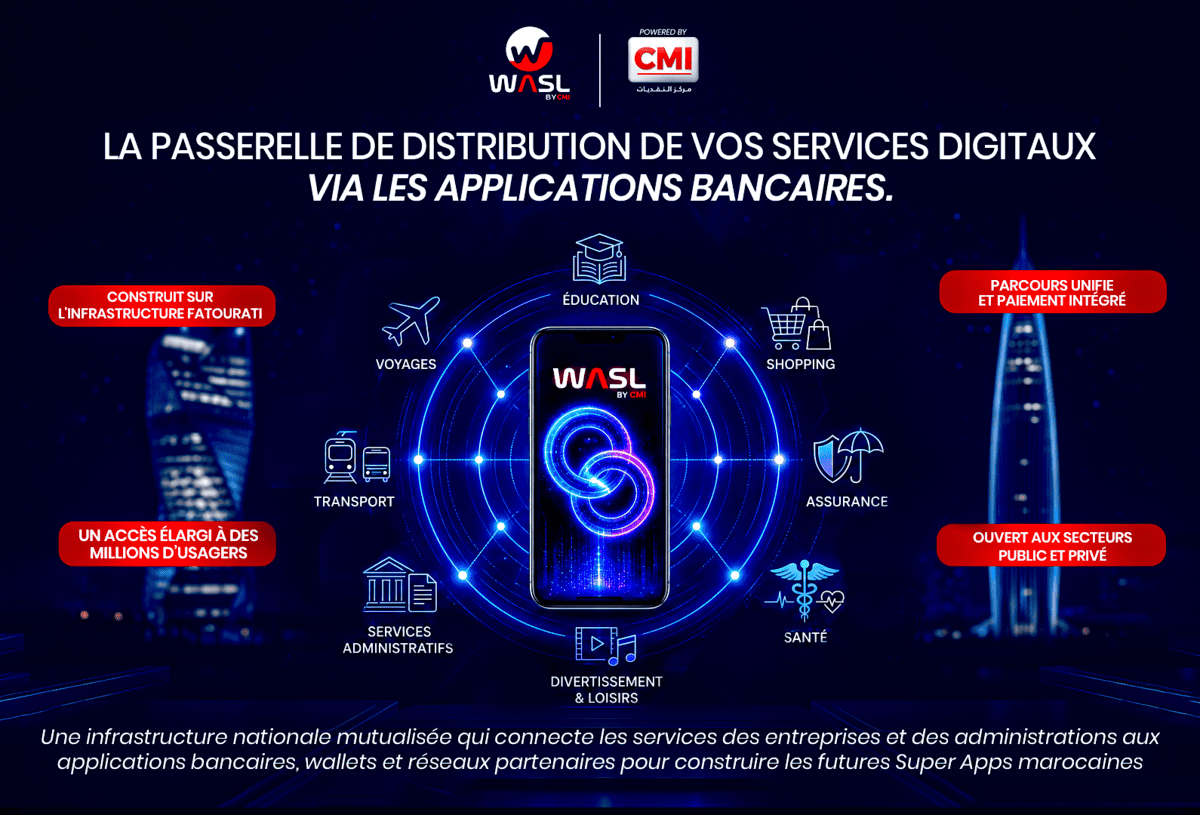
Morocco’s financial and digital infrastructure is about to get a major upgrade with WaSL, a new platform from CMI designed to consolidate payments, reservations, and service access into a single app—paving the way for the country’s first super apps. The move positions Morocco to follow in the footsteps of Southeast Asia’s Grab and India’s Paytm, where all-in-one platforms have reshaped daily transactions for hundreds of millions of users.
The platform, unveiled by CMI (Casablanca Management Institute), integrates banking, e-commerce, and government services into one interface, according to local media reports. Unlike traditional fintech apps that focus on a single function—such as payments or ride-hailing—WaSL is built to handle multiple use cases, from bill payments and ticket bookings to digital identity verification. The company did not disclose a launch timeline but confirmed it is in active development.
Why Morocco Needs a Super App—and What Sets WaSL Apart
Morocco’s digital economy has grown rapidly in recent years, with mobile penetration exceeding 130% and fintech adoption rising. Yet fragmentation remains a hurdle: users juggle separate apps for banking (CIH, Attijariwafa Bank), transportation (Careem), and government services (Madani portal). WaSL aims to bridge that gap by offering a unified experience, similar to how WeChat in China or Gojek in Indonesia serve as the primary digital hub for their users.
What distinguishes WaSL from existing players is its focus on interoperability. The platform is designed to work with Morocco’s existing financial infrastructure, including the country’s central bank (Bank Al-Maghrib) and mobile money operators like Inwi and Orange Money. This avoids the pitfalls of standalone ecosystems, where users must switch between apps—a common pain point in markets like Africa, where M-Pesa and MTN Mobile Money dominate but lack integration.
Key Features of WaSL
- Unified Payments: Seamless transactions across banks, mobile wallets, and e-commerce.
- Service Reservations: Booking flights, hotels, and government appointments in one place.
- Digital Identity: Integration with Morocco’s national ID system for secure authentication.
- Local Partnerships: Planned collaborations with transport providers, retailers, and public services.
How WaSL Compares to Morocco’s Existing Digital Players
Morocco already has strong contenders in the fintech space, but none have achieved the scale or breadth of a super app. Here’s how WaSL stacks up against the current landscape:
| Platform | Primary Function | Super App Potential | Key Limitation |
|---|---|---|---|
| CIH Mobile | Banking & payments | Limited to financial services | No reservations or third-party integrations |
| Careem | Ride-hailing & food delivery | Expanding to payments in some markets | Not a full-service app in Morocco yet |
| Madani Portal | Government services | No commercial or financial features | Fragmented user experience |
| WaSL (CMI) | Payments, reservations, identity | Designed as a full super app | Launch timeline and adoption remain untested |
The table above highlights a critical gap: no single platform in Morocco today offers the depth of services a super app requires. WaSL’s ambition to combine financial transactions, reservations, and government interactions could fill this void—if it gains traction among users and businesses.
What This Means for Users, Businesses, and Regulators
For consumers, WaSL could simplify daily life by reducing the need to switch between apps. A user booking a train ticket via ONCF could pay directly through WaSL, then use the same app to order groceries from a local retailer—all without leaving the platform. This mirrors the convenience of Alipay in China, where 1.4 billion users handle everything from utility bills to stock trading in one place.

For businesses, the platform presents both an opportunity and a challenge. Retailers and service providers would gain access to a wider customer base, but they’d also need to adapt to WaSL’s ecosystem—potentially requiring new integrations or compliance adjustments. The success of similar models in India (Paytm) and Southeast Asia (Grab) shows that super apps can drive significant merchant adoption, but only if they offer clear value beyond basic transactions.
Regulators will watch closely, particularly around data privacy and financial security. Morocco’s Personal Data Protection Law, enacted in 2018, sets strict rules for handling user data. WaSL’s integration with banking and government systems will require compliance with these regulations, as well as potential oversight from Bank Al-Maghrib to ensure financial stability. The platform’s developers have not yet detailed how they plan to address these concerns, but past incidents—such as the 2022 data breach at CIH Bank—highlight the risks of consolidating sensitive services in a single app.
What Happens Next: Timeline and Competition
CMI has not announced a firm launch date for WaSL, but the platform is expected to enter a beta testing phase within the next 6–12 months, according to company statements. The rollout will likely start with Casablanca and Rabat, Morocco’s two largest cities, before expanding nationwide.
The biggest question is whether WaSL can outpace existing players. Careem, for example, already has a strong foothold in Morocco’s ride-hailing market and is expanding into payments. If Careem or another major player integrates super app features first, it could steal WaSL’s momentum. Meanwhile, global tech giants like Google and Apple are also eyeing Africa’s digital market, with Google Pay and Apple Pay already active in the region. WaSL’s success will depend on its ability to differentiate itself—not just as another payment tool, but as the default digital hub for Moroccans.
One thing is clear: if WaSL delivers on its promise, it could redefine how millions of users interact with financial and government services. For now, the platform remains a work in progress—but its potential to reshape Morocco’s digital economy is undeniable.
