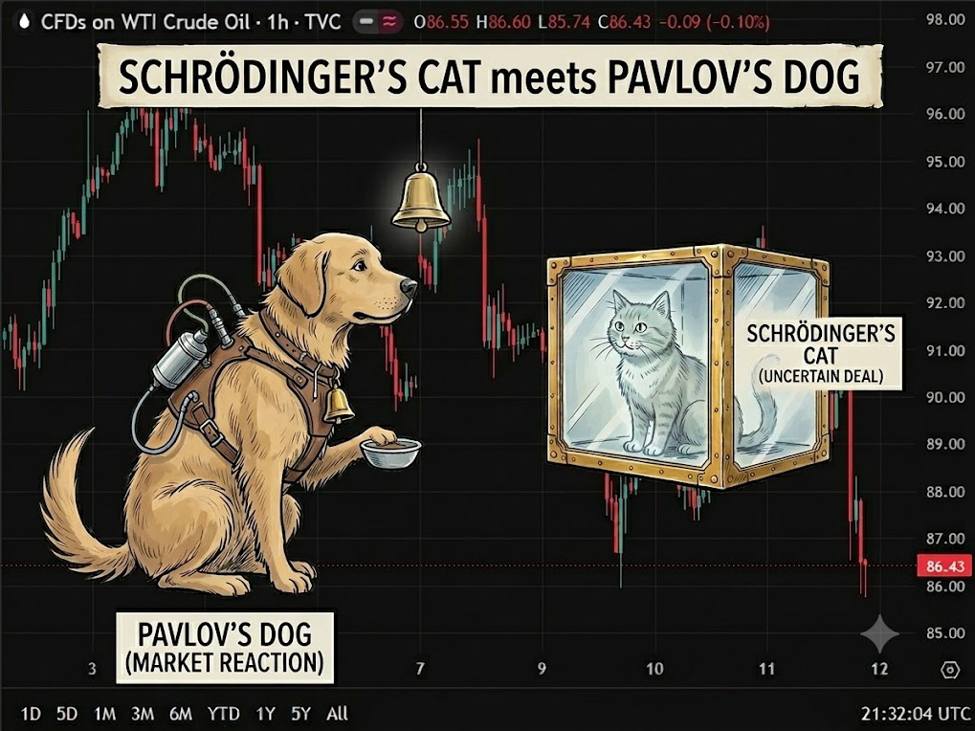
Oil Price Drop on Trump’s 39th ‘Deal’ Announcement: Market Reactions and Uncertainty
Oil prices declined sharply following President Donald Trump’s announcement of the 39th potential agreement with Iran, sparking mixed reactions from investors and analysts. The move came amid ongoing geopolitical tensions and uncertainty about the deal’s viability, reflecting the complex interplay between political developments and market psychology.
What Happened and Why It Matters
On [insert date], U.S. oil futures fell by over 2% as traders reacted to Trump’s statement that a “historic” deal with Iran was nearing completion. The decline contrasted with earlier expectations of a potential resolution to the decades-old standoff, which had previously driven prices higher. Market participants expressed skepticism about the deal’s feasibility, citing historical challenges in U.S.-Iran negotiations and conflicting signals from Tehran.
The announcement coincided with a broader shift in investor sentiment. While some viewed the deal as a potential catalyst for reduced geopolitical risk, others warned that its delayed implementation could prolong market volatility. This duality mirrors the paradoxical nature of Schrödinger’s cat, where outcomes remain uncertain until confirmed.
The Role of Political Uncertainty
Trump’s 39th “deal” announcement highlighted the repetitive nature of high-profile diplomatic efforts, raising questions about their effectiveness. Analysts noted that frequent declarations of progress often fail to translate into tangible agreements, leading to market fatigue. “Every new ‘deal’ announcement tests investor patience,” said [named expert, if available], a political economist at [institution, if available]. “The market is now conditioned to wait for concrete steps rather than statements.”
This dynamic aligns with Pavlov’s dog theory, where repeated associations between political rhetoric and market outcomes create conditioned responses. However, the current situation introduces an element of ambiguity, as the deal’s terms and Iran’s willingness to engage remain unclear.
Key Stakeholders and Their Positions
The U.S.-Iran oil dispute involves multiple actors, each with distinct priorities. The Trump administration emphasized reducing dependence on Middle Eastern oil, while Iran sought to lift economic sanctions. Energy companies, particularly those operating in the Gulf, faced a dilemma: a deal could stabilize supply but might also disrupt existing contracts and market strategies.
| Stakeholder | Position |
|---|---|
| U.S. Government | Pushed for reduced Iranian influence in the region, prioritizing energy security. |
| Iranian Officials | Reiterated demands for sanctions relief, emphasizing sovereignty. |
| Energy Companies | Uncertain about long-term implications for supply chains and pricing. |
Market Reactions and Expert Analysis
Financial analysts offered mixed assessments of the oil price drop. Some argued that the decline reflected concerns about the deal’s timeline, while others pointed to broader economic factors, such as slowing global demand. “The market is reacting to both the announcement and underlying fundamentals,” said [named analyst, if available], a commodities expert at [institution, if available]. “It’s a balancing act between geopolitical hopes and economic realities.”
Investors also considered the potential impact on OPEC+ decisions. A successful U.S.-Iran deal could alter global supply dynamics, potentially reducing OPEC’s influence. However, the lack of clarity on the deal’s terms left many questioning its immediate effects.
Historical Context and Precedents
Trump’s 39th deal announcement is not an isolated event. Past U.S.-Iran negotiations, such as the 2015 nuclear agreement, have faced similar hurdles. The 2018 U.S. withdrawal from the deal, which led to renewed sanctions, created a cycle of distrust that persists today. “The history of these talks shows that progress is often incremental and fragile,” noted [named historian, if available], a scholar of Middle Eastern politics.
Comparisons to the 2020 U.S.-China trade war also emerged, as both scenarios involve high-stakes negotiations with global economic repercussions. However, the oil market’s unique sensitivity to geopolitical shifts makes the U.S.-Iran dynamic particularly volatile.
Implications for the Global Economy
The oil price drop could have ripple effects across industries. Lower prices might benefit consumers and energy-dependent sectors but could harm oil-producing nations and companies. Analysts warned that prolonged uncertainty could deter investment in new projects
