Nepal rescuers pull two survivors alive 10 days after devastating floods
Four survivors, including two Nepali hydropower workers, a Chinese national, and a 64-year-old civilian, were extracted from tunnels and debris following a massive glacier collapse.
The survival of mechanical foreman Sanjay Sah, mechanical supervisor Kabir Maharjan, Chinese national Luhaitao, and 64-year-old civilian Chandika Shrestha defies the grim statistical reality of the Aug. 26 disaster. While NBC News and plant associations report that approximately 900 workers remain missing across 12 crippled hydropower projects—with roughly 500 believed trapped in subterranean tunnels—the weekend breakthroughs have galvanized rescue coordinators waiting atop sludge-filled shafts for further signs of life.
Chronology of the Weekend Extractions
The sequence of survivals began on Friday, Sept. 4, 2026, when search teams first detected human voices echoing from inside a blocked underground passage at the Trishuli 3A plant in Nepal's Rasuwa district, according to statements from Nepalese lawmaker Shri Ram Neupane reported by Pbs. Searchers located mechanical foreman Sanjay Sah and mechanical supervisor Kabir Maharjan after nine days of subterranean entrapment.
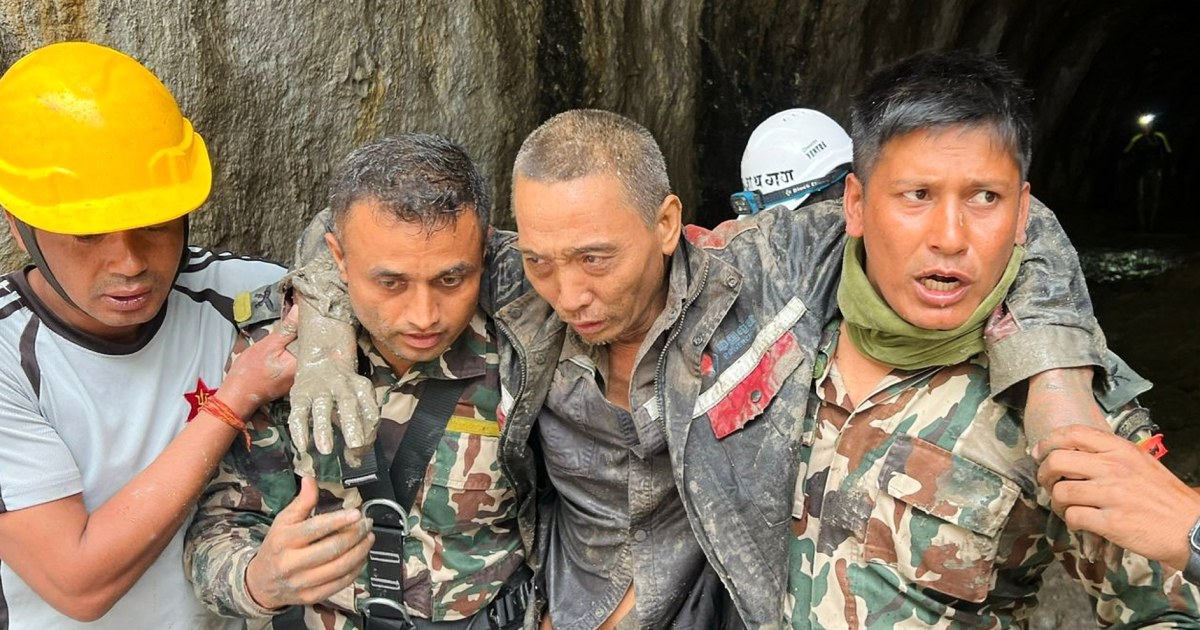
Images documented by the Newsday coverage pack showed rescuers carrying one of the mud-covered workers on a soldier's back. Both men were immediately airlifted to a Kathmandu hospital, where the prime minister's office noted one survivor remained in critical condition. Amir Maharjan, brother to one of the rescued men, told the Boston Globe that his family was rushing to the hospital, expressing overwhelming relief.
Operations expanded on Saturday, Sept. 5, 2026, when a joint rescue contingent of Nepali military personnel and foreign experts extracted a Chinese national, identified as Luhaitao, from 225 meters (about 738 feet) inside a tunnel at the Upper Trishuli-1 Hydroelectric Project, as detailed by TRT World. Concurrently, in Betrawati, Nuwakot, a nine-member Nepal Armed Police Force team led by Inspector Suman BK rescued 64-year-old Chandika Shrestha from the fourth floor of her husband Anand Shrestha's debris-buried house, according to The New Indian Express.
Scale of Destruction and International Response
The backdrop to these rare rescues is a regional catastrophe triggered when a glacier on Mount Langtang Lirung fractured at an altitude of about 5,200 meters (17,060 feet). The resulting ice-and-rock avalanche transformed into a massive debris flow that scoured valleys along the border, ravaging Rasuwa, Nuwakot, Dhading, Kavre, and the Kathmandu Valley.
| Disaster Metric | Reported Figure |
|---|---|
| Confirmed Fatalities (Nepal) | At least 1,287 |
| Missing Persons (Nepal Total) | More than 5,000 |
| Missing Hydropower Workers | About 900 across 12 projects (~500 believed trapped in tunnels) |
| Missing Foreign Workers | About 850 (combined Nepal and China figures) |
| Cross-Border Casualties (Tibet, China) | 31 killed, 531 missing |
| Estimated Economic Damage | At least 387.5 billion Nepalese rupees ($2.5 billion) |
The sheer magnitude of the crisis has drawn specialized response units from India, China, South Korea, and the United States to assist local military personnel. These teams face daunting physical barriers, cutting through collapsed concrete, deep sludge, and tangled rebar using heavy machinery.
The Human Toll and Economic Fallout
The concentration of missing personnel highlights the vulnerability of Nepal's rapid hydropower expansion. Official figures indicate that roughly 850 of the missing workers are foreign nationals. Across the border in Tibet, Chinese state media reported 31 deaths and 531 missing persons.
Financial assessments released by Nepal's disaster management agency quantify the devastation at 387.5 billion Nepalese rupees, equivalent to $2.5 billion. This immense loss spans wiped-out roads, bridges, settlements, and power generation facilities that formed the backbone of regional development.
Brig. Gen. Raja Ram Basnet, the army spokesperson, noted that one of the initial survivors reported other individuals remaining alive within the flooded tunnel network. Amplifying this sentiment, Nepal’s Communication Minister Bikram Timilsina stated via social media that authorities are waiting for the rescue of more and more people,
as specialized teams sustain their underground search efforts.
Archypedia is dedicated to independent, evidence-backed reporting. This briefing was synthesized from primary source reporting, corroborated across independent newsrooms, and verified against our Editorial Standards.
Transparency record
Evidence behind this report
This report synthesizes 6 distinct sources. Open the source ledger below to compare the underlying coverage.
Prepared under the Archypedia Editorial Policy by the Samir Haddad editorial desk profile. AI-assisted tools may support drafting and verification; public accountability remains with Archypedia. Report an error.