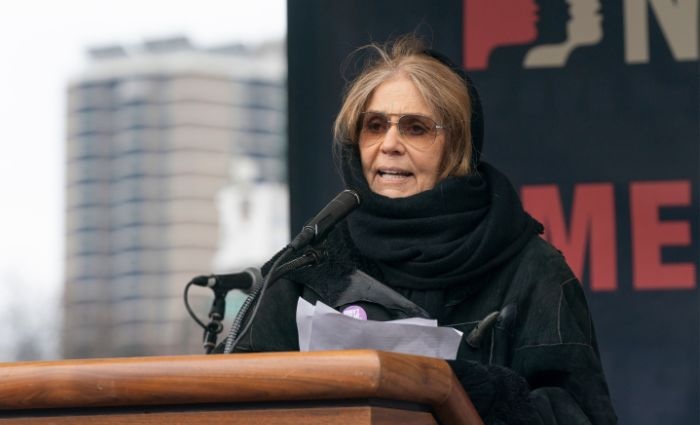
Gloria Steinem, feminist movement leader and activist, dies at 92
The pioneering feminist writer and civil rights advocate passed away peacefully at her New York City home at the age of 92, her foundation announced.

Her death was announced through a statement posted to her verified Instagram account by her foundation, noting that she passed away peacefully on a Tuesday at her home in New York City, surrounded by some of the many who loved her. The announcement emphasized that Steinem continued working for equality until the very end of her near-century of life, maintaining an independent spirit marked by curiosity and humor, as reported by Nbcsandiego.
Steinem's path to global activism was rooted in an Ohio childhood and spent partly in a trailer home. Her formative years were shaped by the struggles of her mother, whose severe mental illness left her in and out of sanatoriums and battling to hold down jobs. When her parents separated when she was ten, Steinem grew up in a rundown Toledo home alongside her mother, where she directly observed the systemic hostility directed at working women, as detailed by Irishtimes.
Related video and Instagram post


After graduating from a women’s liberal arts college in 1956, Steinem spent two years in India working as a legal clerk in the country’s supreme court before returning to the United States. In a chapter of her early career, she served as director of the Independent Research Service — a CIA front organization that recruited American students to disrupt Soviet-controlled World Youth Festivals in Vienna and Helsinki. Steinem later acknowledged that she had been aware of who bankrolled the operation, stating that if she had a choice she would do it again.
Her trajectory shifted decisively toward journalism and advocacy in the 1960s. In 1962, Esquire magazine editor Clay Felker gave her a serious assignment: a feature on contraception titled The Moral Disarmament of Betty Coed, which detailed the impossible choices women faced between careers and family. The following year, she went undercover for 11 days as a Playboy Bunny to expose the treatment of glamour models in Hugh Hefner's Playboy Club. Forced into tight costumes and high heels, Steinem lost 10lbs — half of them in a single night, during her stint, and her manager celebrated by making her costume two inches tighter. Following the article, she was unable to get work because she had become a Bunny, and it did not matter why.
By 1968, Felker hired her at New York magazine, where an abortion speak-out in Greenwich Village catalyzed her life as an active feminist. Reporting on the event, she coined the term reproductive freedom. Having undergone an abortion in London at age 22, Steinem described the protest as a moment of profound personal clarity, noting that it was the first time she had taken responsibility for her own life. She later remarked that if men could get pregnant, abortion would be a sacrament. Working alongside Dorothy Pitman Hughes, she co-founded Ms. magazine in 1971, utilizing essays such as If Men Could Menstruate and a first issue featuring Wonder Woman on the cover to thrust feminist perspectives into the mainstream media.
Steinem acknowledged that her effectiveness as a public figure relied heavily on the platform afforded to her as a young, white, educated woman. She used that visibility to amplify grassroots organizers and marginalized voices, including Black feminists such as Florynce Kennedy, Evelyn Cunningham, Shirley Chisholm, and Fannie Lou Hamer, whom she credited with teaching her the importance of activism and finding a family. She argued persistently that sex and race were inextricably intertwined as tools used to organize human societies into hierarchies of cheap labor. Her activism extended across decades and causes, campaigning against domestic violence, female genital mutilation, and the pornography industry, while supporting LGBTQ rights, the Times Up movement, Black Lives Matter, the Vietnam and Gulf wars, and the reunification of Korea. In 1984, she was arrested protesting against apartheid outside the South African embassy in Washington, D.C., and in 2017, she co-chaired and spoke at the Women's March on Washington following the inauguration of Donald Trump, having supported Hillary Clinton's presidential campaign.
Polarizing moments dotted her career. Some feminists felt her position as a public leader had been decided not by merit but by media bias favoring young, white, and attractive women. She faced fierce criticism for a 1998 opinion piece defending President Bill Clinton against sexual harassment allegations, stating he was not guilty of sexual harassment but had made a gross, dumb, and reckless pass, a stance she later reevaluated with the observation that women must be believed. She also faced historical criticism over a 1977 writing regarding transgender people, a view she explicitly clarified in 2013 to affirm that transgender lives are authentic and should be celebrated.
Steinem's later years were marked by personal endurance through health challenges, including a 1986 breast cancer diagnosis and a battle with the chronic pain condition trigeminal neuralgia in 1994. After decades of dismissing marriage, she wed environmental activist David Bale in 2000, remaining close to her stepson, actor Christian Bale, following David Bale's death in 2003. As reported by The Irish Times, she reflected on her longevity and mission in a 2011 interview with the Observer, expressing her hope to live to 100 because there was so much to do, even as her foundation noted she continued working for equality until the very end.
- Passed away at age 92 on a Tuesday at her home in New York City, surrounded by loved ones.
- Authored nine books and co-founded Ms. magazine in 1971.
- Co-chaired and spoke at the Women's March on Washington in January 2017.
Supporters wishing to honor her memory have been asked by her foundation to make a donation to Gloria's Foundation in lieu of flowers.
Archypedia is dedicated to independent, evidence-backed reporting. This briefing was synthesized from primary source reporting, corroborated across independent newsrooms, and verified against our Editorial Standards.
Transparency record
Evidence behind this report
This report synthesizes 4 distinct sources. Open the source ledger below to compare the underlying coverage.
Prepared under the Archypedia Editorial Policy by the Samir Haddad editorial desk profile. AI-assisted tools may support drafting and verification; public accountability remains with Archypedia. Report an error.