Germany's far-right AfD seeks landmark state victory as Saxony-Anhalt votes
Roughly 1.7 million voters in Saxony-Anhalt cast ballots as the populist AfD seeks its first state government in post-war Germany, testing the mainstream firewall.

As the clock ticked toward 6 p.m. Local time on Sunday, 6 September 2026, roughly 1.7 million eligible voters across Saxony-Anhalt finished casting their ballots in an election that could force Germany to cross a historic post-war threshold, according to reporting from Aol and CNBC. The populist, anti-immigration Alternative for Germany, or AfD, entered election day leading final polls with 40% to 41% of support, positioning the party to potentially capture its first state government since World War II.
The regional ballot marks a major test for the federal administration of Chancellor Friedrich Merz, whose center-right Christian Democratic Union has governed the state for two decades alongside coalition partners. As detailed by Yahoo News Singapore and Cnbc, Merz has struggled against sluggish economic performance and persistent voter discontent, creating an environment where the AfD views regional success as a direct stepping stone toward the 2029 federal election.
Related YouTube video


The Campaign and the Stakes of an Absolute Majority
Led by 35-year-old Ulrich Siegmund, a former fragrance salesman with a prominent TikTok following, the AfD campaign leveraged a populist style and deep-seated regional grievances. Siegmund arrived at his local polling station in Tangermünde riding an East German-era moped, accompanied by his wife, as noted by Associated Press. He has insisted he will only assume power if the party secures an absolute majority, rejecting coalition deals with other parties.
| Party | Final Polling / Support Range | Key Status |
|---|---|---|
| Alternative for Germany (AfD) | 40% — 41% | Led by Ulrich Siegmund; classified as extremist by domestic intelligence |
| Christian Democratic Union (CDU) | 23% | Led by incumbent state premier Sven Schulze |
| The Left (Die Linke) | 11.5% | Potential passive tolerance partner for minority governance |
| Social Democratic Party (SPD) | 8.5% | Struggling near the parliamentary threshold |
| The Greens | 6% | Facing risk of missing parliamentary representation |
Siegmund has promised a sweeping agenda if elected, including a remigration and deportation offensive, a ban on rainbow flags in schools, halting new wind farms, and altering the state slogan from Think modern
to Think German.
Conversely, Chancellor Merz warned during a joint campaign stop in Leuna that an AfD victory would serve as an economic own-goal, deterring international investors from committing capital to an aging and dwindling regional population dependent on foreign labor, according to Aol and Associated Press.
Electoral Mechanics and the Mainstream Firewall
Germany's proportional representation system is engineered to foster coalition governance and make single-party rule difficult, relying on a strict 5% hurdle for smaller parties to enter parliament. If smaller formations such as the Greens, the FDP, or the Sahra Wagenknecht Alliance fail to cross this threshold, the mathematical path toward an absolute majority for the AfD becomes narrower yet more achievable due to the redistribution of seats, as reported by Yahoo News Singapore and CNBC.
To prevent the far-right from taking office, all mainstream parties adhere to a strict Brandmauer
or firewall, refusing to enter coalition agreements with the AfD. Saxony-Anhalt's domestic intelligence agency classifies the state's AfD chapter as a proven right-wing extremist group with ties to ethno-nationalist networks, though the party has strongly rejected such characterizations.
Civil Resistance and Fallback Scenarios
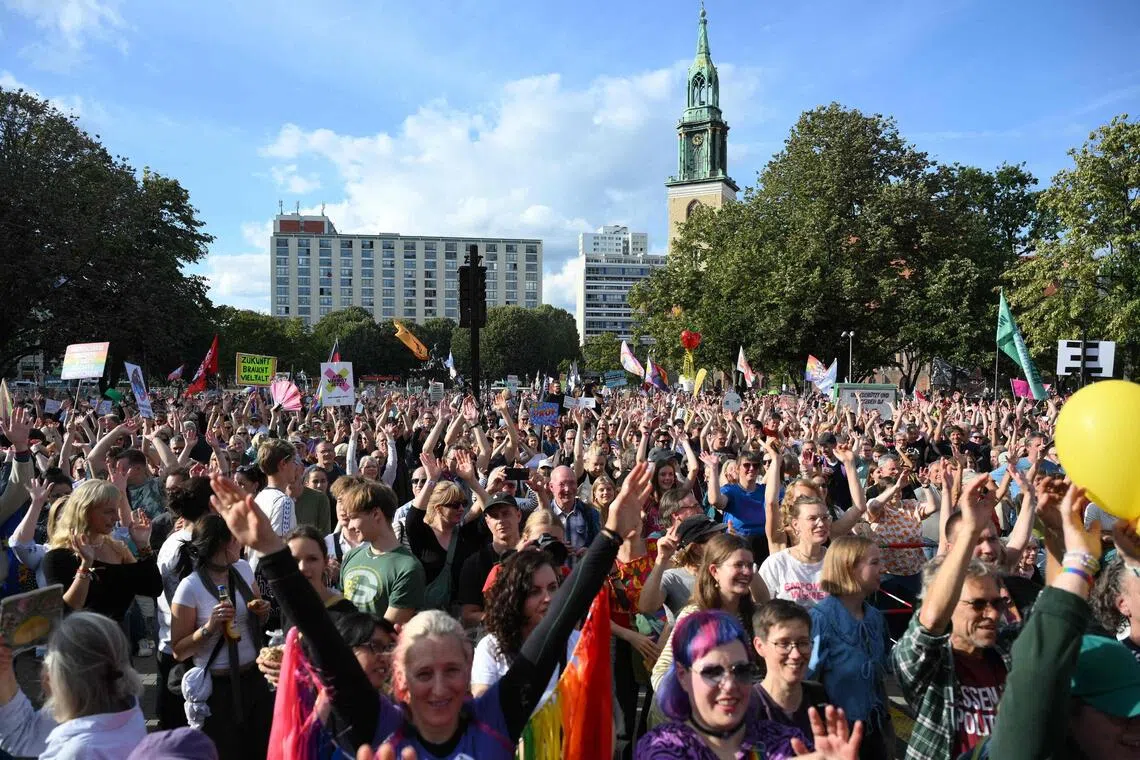
Public opposition to the AfD's rise manifested vividly on the eve of the vote, when thousands of demonstrators gathered in the state capital, Magdeburg, for a democracy festival. Projections beamed onto Magdeburg Cathedral declared that true love of the homeland rejects the AfD, while Magdeburg Bishop Gerhard Feige warned churchgoers against forces sowing discord and reminded citizens that democracies possess the potential to abolish themselves.
Independent election observers monitored polling booths amid unsubstantiated postal voting fraud claims raised by the AfD, which state authorities formally denied. Should the AfD fall short of an absolute majority despite finishing first, incumbent CDU premier Sven Schulze faces difficult fallback scenarios. Similar to governance models in neighboring Thuringia, Schulze could attempt to form a minority administration dependent on the passive tolerance of the hard-left Die Linke, as traditional coalition math grows increasingly fractured.
Election Aftermath and Potential Coalition Scenarios
As the votes are being counted, the potential coalition scenarios are becoming clearer. According to CNBC, if the AfD falls short of an absolute majority, a CDU-led administration under incumbent state premier Sven Schulze is the most likely outcome. However, the exact shape of any coalition would depend on which parties enter parliament. The CDU has ruled out a coalition with the far-left Left Party, which could help it reach a majority.
- The Free Democratic Party is likely to fall short of the 5% threshold, making it difficult for the CDU to form a coalition with its current partner.
- The Social Democratic Party is under 10%, which could make it challenging for the CDU to form a stable government with the SPD and the Greens.
- The small far-left Sahra Wagenknecht Alliance is also likely to miss out, which could limit the options for the AfD to form a coalition.
The situation is further complicated by the fact that the AfD has been classified as a right-wing extremist group by Germany's domestic intelligence agency, as reported by Associated Press and AOL. This classification has reinforced the firewall of mainstream parties refusing to work with the AfD, making it difficult for the party to form a coalition even if it finishes first.
Archypedia is dedicated to independent, evidence-backed reporting. This briefing was synthesized from primary source reporting, corroborated across independent newsrooms, and verified against our Editorial Standards.
Transparency record
Evidence behind this report
This report synthesizes 5 distinct sources. Open the source ledger below to compare the underlying coverage.
Prepared under the Archypedia Editorial Policy by the Samir Haddad editorial desk profile. AI-assisted tools may support drafting and verification; public accountability remains with Archypedia. Report an error.