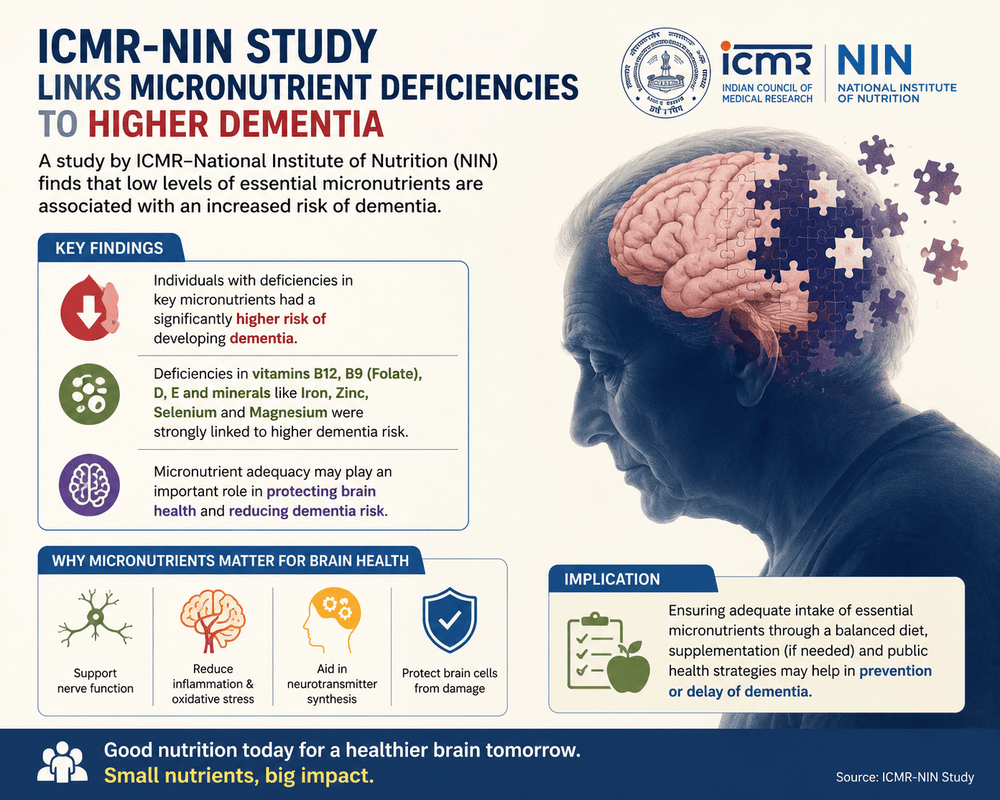
ICMR-NIN Study Links Micronutrient Deficiencies to Higher Dementia Risk in Indian Adults
A recent study by the ICMR-National Institute of Nutrition (ICMR-NIN) has established a strong correlation between micronutrient deficiencies and an increased risk of dementia among Indian adults. Examining 570 participants in Telangana, researchers found that nearly 40% of the group faced a higher predicted risk of dementia, a trend that consistently aligned with poorer nutritional status.
What did the ICMR-NIN study find regarding dementia risk?
The research conducted by the Hyderabad-based ICMR-National Institute of Nutrition (ICMR-NIN) indicates that nutrition is a critical, modifiable factor in maintaining cognitive health. The study focused on adults aged 40 to 80 years, drawing from both urban and rural areas of Telangana. The most striking finding was that approximately 40% of these participants exhibited a higher predicted risk of developing dementia.
According to the study, there was a consistent pattern where individuals in this high-risk category also suffered from poorer nutritional status. This suggests that the lack of essential vitamins and minerals—micronutrients—may play a significant role in how the brain ages and its susceptibility to cognitive decline.
| Study Parameter | Details |
|---|---|
| Institution | ICMR-National Institute of Nutrition (ICMR-NIN) |
| Sample Size | 570 adults |
| Age Range | 40 to 80 years |
| Location | Rural and urban Telangana, India |
| Key Finding | Nearly 40% showed higher predicted dementia risk |
| Primary Correlation | Poorer nutritional status linked to higher risk |
How was the dementia risk measured and analyzed?
To ensure scientific rigor, the ICMR-NIN team employed a combination of global standardized tools and advanced laboratory analysis. The researchers did not rely on a single metric but instead used a multi-pronged approach to assess cognitive health and nutritional levels.
The CAIDE Score
The study utilized a culturally adapted version of the Cardiovascular Risk Factors, Ageing and Incidence of Dementia (CAIDE) score. The CAIDE score is a globally recognized tool used to predict the risk of dementia by looking at a variety of mid-life risk factors. By adapting this tool for the Indian context, researchers could more accurately predict risk based on local demographic and health profiles.
Cognitive and Biological Testing
Beyond risk scoring, the researchers assessed actual cognitive performance using the Montreal Cognitive Assessment. This provided a real-time snapshot of the participants’ mental functioning. To connect these cognitive results with nutrition, the team analyzed blood samples using advanced laboratory methods to determine precise vitamin and mineral levels.
Additionally, the study evaluated dietary intake and diversity. This allowed researchers to see not just what was missing in the blood, but what was missing from the daily diet of the participants.
Why are micronutrients essential for brain health?
Micronutrients, which include essential vitamins and minerals, act as the building blocks for neurological function. While the brain represents a small fraction of body weight, it has high metabolic demands. The ICMR-NIN study highlights that diets rich in fruits and vegetables—which are natural sources of these micronutrients—are associated with a lower burden of dementia risk factors.
When the body lacks these essential nutrients, the brain’s ability to maintain healthy neurons and manage oxidative stress may be compromised. The findings position nutrition as a “modifiable factor,” meaning that unlike genetics, dietary habits can be changed to potentially lower the risk of cognitive decline.
“Diets rich in fruits and vegetables, which are natural sources of essential micronutrients, are associated with a lower burden of dementia risk factors, underscoring the importance of balanced and diverse eating habits.”
What are the modifiable risk factors for dementia?
While genetic predisposition plays a role in the development of dementia, the ICMR-NIN research emphasizes that a significant portion of cases are driven by factors within a person’s control. Researchers estimate that nearly half of all dementia cases are driven by modifiable factors.
According to the study, the primary modifiable drivers include:
- Nutrition: Inadequate intake of essential vitamins and minerals.
- Chronic Health Conditions: Hypertension and diabetes.
- Lifestyle Choices: Physical inactivity.
- Mental and Social Health: Depression and social isolation.
By addressing these factors—particularly through improved nutrition and lifestyle changes—individuals may be able to mitigate their risk of cognitive impairment as they age. This shifts the conversation from dementia being an inevitable part of ageing to a condition that can be potentially delayed or prevented through proactive health management.
The impact of India’s demographic shift on cognitive health
The timing of this study is critical because of the current demographic trends in India. The Indian population is not only living longer but is also ageing faster than in previous generations. This shift is leading to a rise in age-related non-communicable diseases (NCDs), with dementia becoming a growing public health concern.
As the proportion of elderly citizens increases, the burden on healthcare systems to manage cognitive decline grows. The ICMR-NIN study provides a roadmap for public health interventions by identifying nutrition as a key lever. If a substantial percentage of the population—as seen in the 40% high-risk figure in Telangana—is vulnerable due to nutritional gaps, then dietary fortification and public awareness campaigns regarding “brain-healthy” diets could have a massive impact on national health outcomes.
For those interested in how these findings fit into broader health trends, a related explainer on non-communicable diseases in India may provide further context on the rise of age-related ailments.
Common misconceptions about dementia and nutrition
One common misconception is that dementia is solely a result of genetics or “old age” and cannot be influenced by external factors. The ICMR-NIN study directly challenges this by highlighting that nearly 50% of risk factors are modifiable. Nutrition is not a “cure” for dementia, but it is a critical component of risk reduction.
Another misconception is that any calorie intake is sufficient for brain health. The study emphasizes nutrient density and dietary diversity. Consuming enough calories but lacking specific micronutrients (as found in fruits and vegetables) can still leave an individual at high risk for cognitive decline. The focus must be on the quality and variety of the food consumed, rather than just the quantity.
Frequently Asked Questions
What is the main finding of the ICMR-NIN study on dementia?
The study found a strong link between micronutrient deficiencies and a higher risk of dementia among Indian adults. Specifically, in a study of 570 adults in Telangana, nearly 40% were found to have a higher predicted risk of dementia, which correlated with poorer nutritional status.
Who participated in the ICMR-NIN research?
The research involved 570 adults between the ages of 40 and 80, representing both rural and urban populations within the state of Telangana.
What tools were used to predict dementia risk?
Researchers used a culturally adapted version of the CAIDE (Cardiovascular Risk Factors, Ageing and Incidence of Dementia) score, the Montreal Cognitive Assessment for performance testing, and advanced laboratory analysis of blood samples to check vitamin levels.
Can dementia be prevented through diet?
While the study does not claim that diet can entirely prevent dementia, it identifies nutrition as a “modifiable factor.” Diets rich in fruits and vegetables, which provide essential micronutrients, are associated with a lower burden of dementia risk factors.
What other factors besides nutrition increase dementia risk?
According to the researchers, other modifiable factors include hypertension, diabetes, physical inactivity, depression, and social isolation.
As India continues to navigate its demographic transition, the findings from the ICMR-NIN underscore the necessity of integrating nutritional science into geriatric care. The link between what we eat in mid-life and how our brains function in later years suggests that dietary diversity is not just about physical health, but is a fundamental pillar of cognitive longevity.
