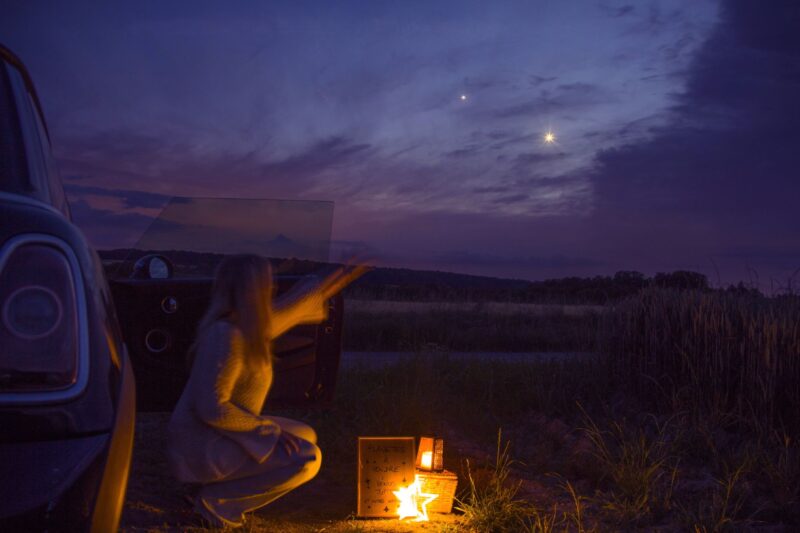
Venus-Jupiter Conjunction 2026: How to See the “Cosmic Kiss” and Best Viewing Tips
Venus and Jupiter will align in a rare celestial event in 2026, creating a visual “cosmic kiss” where the two brightest planets appear nearly touching in the night sky. According to reports from EarthSky, this conjunction offers a prime opportunity for astrophotographers and casual observers to capture high-contrast imagery of the solar system’s most luminous neighbors.
What is the Venus-Jupiter Conjunction of 2026?
A conjunction occurs when two celestial bodies appear close to each other in the sky from the perspective of an observer on Earth. While Venus and Jupiter remain millions of miles apart in space, their orbital paths align relative to Earth’s position, creating an optical illusion of proximity. EarthSky describes this specific 2026 alignment as a high-visibility event due to the inherent brightness of both planets.
Venus, often called the “Evening Star” or “Morning Star,” is the brightest planet in our solar system. Jupiter, the largest planet, is similarly brilliant, though its light is more steady and less intense than the piercing glow of Venus. When these two meet, they create a singular, brilliant point of light that can be seen even in areas with moderate light pollution.
The event is frequently characterized by media outlets as a “cosmic kiss” due to the minimal angular separation between the two spheres. This terminology, used by The Boston Globe and FOX Weather, emphasizes the visual intimacy of the alignment rather than any physical interaction between the planets.
Key Characteristics of the Participating Planets
| Planet | Visual Appearance | Primary Role in Conjunction | Relative Brightness |
|---|---|---|---|
| Venus | Bright, white-yellow glow | Primary light source | Highest |
| Jupiter | Steady, creamy-white light | Secondary light source | High |
| Mercury | Faint, fleeting shimmer | Occasional third participant | Low/Variable |
When and Where to View the 2026 Alignment
The timing of a conjunction depends on the orbital velocities of the planets involved. Venus moves quickly across the sky because of its proximity to the Sun, while Jupiter moves more slowly. According to astronomical data, the window for peak visibility is narrow, often lasting only a few nights where the planets are at their closest angular distance.
Observers should look toward the horizon shortly after sunset or before sunrise, depending on the specific phase of the 2026 orbit. Because Venus never wanders far from the Sun, it is only visible during these twilight hours. To maximize the view, observers need a clear line of sight to the western or eastern horizon, free from tall buildings or mountain ranges.
- Peak Window: The closest approach occurs over a period of several days.
- Best Time: Civil twilight, when the sky is dark enough for planets to pop but light enough to maintain some horizon detail.
- Viewing Equipment: The conjunction is visible to the naked eye, but binoculars or a small telescope will reveal the distinct discs of the planets.
The Three-Planet Alignment: Including Mercury
While the Venus-Jupiter pairing is the primary attraction, other planetary bodies often join the vicinity. Axios reports that in certain viewing windows, Mercury also becomes visible, creating a rare three-planet alignment. This addition increases the complexity of the visual arrangement and provides a more comprehensive look at the inner and outer solar system.
Mercury is significantly harder to spot than Venus or Jupiter because it remains very close to the Sun’s glare. When Mercury aligns with Venus and Jupiter, it typically appears as a smaller, dimmer point of light. This three-planet grouping allows observers to see the stark contrast between the smallest planet (Mercury), the brightest (Venus), and the largest (Jupiter).
Sky & Telescope notes that these “sky at a glance” events are essential for tracking the movement of the ecliptic—the apparent path the Sun and planets follow across the celestial sphere. The presence of three planets in one small sector of the sky highlights the flat, disc-like nature of our solar system’s planetary plane.
Capturing the Event: Technology and Photography Tips
The search for “Venus-Jupiter conjunction 2026. Wow! Best photos here – EarthSky” reflects a high demand for high-resolution imagery of the event. Capturing a “cosmic kiss” requires specific technical settings to avoid overexposing the bright planets against a darkening sky.
Equipment Recommendations
For professional results, a DSLR or mirrorless camera with a telephoto lens (at least 200mm to 600mm) is necessary to bring the planets closer in the frame. However, modern smartphones with “Night Mode” or “Pro Mode” can capture the alignment if the user stabilizes the device with a tripod.
Technical Settings for Astrophotographers
- ISO: Keep ISO low (100–400) to prevent digital noise, as the planets provide ample light.
- Aperture: Use a wider aperture (f/2.8 to f/5.6) to let in more light, though slightly stopping down can improve sharpness.
- Shutter Speed: Use a fast shutter speed to avoid “trailing” caused by the Earth’s rotation.
- Focus: Manual focus is mandatory. Use “Live View” to zoom in on Jupiter and rotate the focus ring until the planet is a sharp point rather than a blurred disc.
“The challenge of photographing a conjunction is the dynamic range; the planets are intensely bright while the background sky is rapidly fading to black.”
To achieve the “Wow” factor seen in EarthSky galleries, photographers often use a technique called “stacking.” This involves taking dozens of short-exposure images and using software to merge them, which reduces noise and enhances the detail of the planetary discs.
Comparing the “Cosmic Kiss” Across Media Reports
Different news outlets frame this astronomical event using varying degrees of scientific and emotive language. This contrast reflects the target audience of each publication, ranging from hard-science enthusiasts to general news consumers.
FOX Weather and The Boston Globe utilize evocative phrasing like “kissing planets” and “cosmic kiss.” This framing transforms a geometric alignment into a narrative event, making the science of orbital mechanics more accessible to the general public. By focusing on the visual “romance” of the alignment, these outlets encourage non-astronomers to look up and engage with the night sky.
In contrast, Sky & Telescope and EarthSky focus on the technical aspects of the event. Their reporting emphasizes the “Sky at a Glance” perspective, providing specific dates, angular separations, and viewing coordinates. While they acknowledge the visual beauty, their primary goal is to provide a utility-based guide for observers who want to know exactly where to point their telescopes.
Axios takes a more streamlined, news-bulletin approach, focusing on the fact of the visibility (“3 planets visible this week”). This reflects a search-intent optimization for users who want quick, actionable information without the deeper astronomical context.
Why This Conjunction Matters Scientifically
Beyond the visual spectacle, conjunctions serve as practical demonstrations of planetary motion. They provide a visible manifestation of Kepler’s Laws of Planetary Motion, specifically the fact that planets closer to the Sun (like Venus) orbit faster than those further away (like Jupiter).
The 2026 event allows astronomers to study the relative brightness (apparent magnitude) of these bodies. Venus’s brightness fluctuates based on its phase—much like the Moon—depending on how much of its illuminated side faces Earth. Jupiter’s brightness is more consistent, though it varies slightly as it moves closer to or further from Earth in its elliptical orbit.
Furthermore, these events are often used as calibration points for amateur astronomers. Because the positions of Venus and Jupiter are known to extreme precision, photographers and telescope users can use them to test the tracking accuracy of their mounts and the clarity of their optics.
Common Misconceptions About Conjunctions
- Collision Risk: Some users mistake the term “conjunction” or “kiss” for a physical collision. In reality, the planets are separated by millions of miles of vacuum.
- Rarity: While a “near-kiss” is rare, conjunctions between Venus and Jupiter happen periodically. The 2026 event is notable for its specific proximity and brightness.
- Visibility: Many believe a telescope is required. While a telescope shows detail (like Jupiter’s cloud belts), the event is a spectacular naked-eye experience.
Preparing for the Viewing Experience
To ensure a successful viewing of the Venus-Jupiter conjunction in 2026, preparation is key. Weather is the primary obstacle for any astronomical event. Observers are encouraged to monitor cloud cover forecasts and have a backup location with a clear horizon.
Using stargazing apps can help beginners identify the planets. These apps use the phone’s gyroscope to overlay a map of the stars and planets onto the live camera view, making it easy to locate the “cosmic kiss” even if the observer is unfamiliar with the constellations.
For those interested in deeper exploration, this event is an ideal time to look for the Galilean moons of Jupiter. Through a basic telescope, the four largest moons—Io, Europa, Ganymede, and Callisto—will be visible as tiny pinpricks of light flanking the massive planet, providing a sense of scale that the naked eye cannot perceive.
Related explainer on [planetary orbits] can provide more context on why these alignments occur at specific intervals.
Frequently Asked Questions
When exactly is the Venus-Jupiter conjunction 2026?
The exact date varies by time zone, but the peak alignment occurs when the angular distance between the two planets is at its minimum. Observers should check local astronomical calendars or EarthSky for the precise window of peak proximity in their specific region.
Do I need a telescope to see the “cosmic kiss”?
No. Venus and Jupiter are two of the brightest objects in the night sky. The conjunction is easily visible to the naked eye. However, binoculars will allow you to see them as two distinct points of light rather than a single merged glow.
Why is it called a “cosmic kiss”?
This is a descriptive term used by outlets like FOX Weather and The Boston Globe to describe how close the two planets appear to be. It is a visual description, not a scientific term, referring to the minimal gap between the two planetary discs from Earth’s perspective.
Can I take a photo of the conjunction with my phone?
Yes. Use a tripod to keep the phone steady and utilize “Night Mode” or a manual exposure setting to prevent the planets from looking like blurry white blobs. Focus on the brightest object (Venus) and slightly lower the exposure slider.
Will Mercury be visible during the 2026 conjunction?
According to Axios, there are windows where Mercury is also visible in the same region of the sky. Whether it is visible during the exact peak of the Venus-Jupiter conjunction depends on Mercury’s faster orbital position at that time.
Is this event dangerous to look at?
No. Unlike a solar eclipse, looking at planets is completely safe for the eyes. There is no harmful radiation associated with viewing Venus or Jupiter.
