Aalto University researchers build first superconducting quantum heat engine
Researchers have successfully demonstrated a cyclic quantum heat engine using a transmon qubit within a superconducting circuit. This experimental breakthrough could eventually lead to autonomous systems that replace traditional microwave cabling in quantum computers.

Researchers at Aalto University have successfully demonstrated the world's first cyclic quantum heat engine operating within a superconducting circuit. The study, published on 13 July 2026 in Nature Communications, marks a milestone in the field of quantum thermodynamics, offering a proof of concept for energy management at the nanoscale. By utilizing a flux-tunable transmon qubit as the working medium, the team has shown that heat can be converted into measurable work in a controlled, cyclic fashion near absolute zero temperatures.
The experiment, conducted at the OtaNano research infrastructure in Finland, addresses a long-standing objective for physicists: integrating the classical laws of thermodynamics with the phenomena of quantum mechanics, such as superposition and entanglement. While heat engines have driven industrial advancement since the era of James Watt, applying these principles to microscopic quantum systems presents unique challenges, particularly regarding the control of thermal reservoirs and energy levels.
Related media
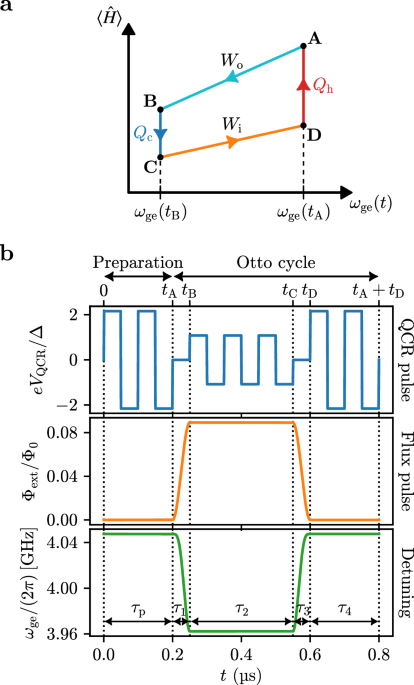

According to Aalto University, the device consists of three primary components: a transmon qubit, a resonator, and a quantum-circuit refrigerator (QCR). The QCR serves a dual purpose, functioning as a tunable thermal reservoir that can both heat and cool the qubit on demand. This versatility allows the researchers to execute an Otto cycle—a thermodynamic process typically associated with internal combustion engines—without the necessity of maintaining multiple separate physical thermal reservoirs.
Tuomas Uusnäkki, the lead author of the study, noted that the team monitored the qubit state as the engine ran, using carefully timed control pulses to drive the thermodynamic cycle. Our quantum-circuit refrigerator can be tuned to both heat and cool the qubit on demand. Using carefully timed control pulses, we drove the engine in an Otto cycle and monitored the qubit state as the engine ran,
Uusnäkki explained via Miragenews. The results confirmed that heat flowing through the qubit during these cycles generated positive work.
Implications for Quantum Computing
Beyond theoretical validation, the development of autonomous heat engines within superconducting circuits may provide a pathway toward scaling up quantum computers. Academy Professor Mikko Möttönen stated that autonomous devices could eventually replace these expensive and noise-prone cables.
Brightsurf reported that Finland's Quantum Technology Strategy aims for a computer with one thousand logical qubits by 2035, necessitating hundreds of thousands of physical qubits. Implementing autonomous engines on-chip could effectively eliminate the need for traditional microwave cabling from room temperature to the millikelvin environment.
Key Components and Functionality
The experimental setup functions by manipulating the eigenenergies of the transmon qubit through external flux pulses. The operation involves four distinct strokes of the Otto cycle:
- Adiabatic Expansion: Transition frequencies decrease as the system performs work on the driving field.
- Isochoric Cooling: The QCR acts as a cold reservoir, absorbing thermal energy.
- Adiabatic Compression: The driving field performs work on the system as frequencies increase.
- Isochoric Heating: The QCR acts as a hot reservoir, raising the effective temperature of the qubit.
The Nature report notes that these findings agree with thermodynamic simulations and offer a clear path for exploring quantum advantages in thermodynamics.
What to Watch Next
The Aalto University team is now focusing on the following developments:
- Autonomous Readout: Designing engines capable of performing qubit readouts without bringing microwave pulses from room temperature to the cryostat's millikelvin environment.
This research underscores a shift toward integrating thermodynamic management directly into the hardware of quantum processing units, moving from laboratory demonstrations to potential industrial applications in large-scale computing.
Archypedia is dedicated to independent, evidence-backed reporting. This briefing was synthesized from primary source reporting, corroborated across independent newsrooms, and verified against our Editorial Standards.
Transparency record
Evidence behind this report
This report synthesizes 7 distinct sources. Open the source ledger below to compare the underlying coverage.
Prepared under the Archypedia Editorial Policy by the Niko Vale editorial desk profile. AI-assisted tools may support drafting and verification; public accountability remains with Archypedia. Report an error.