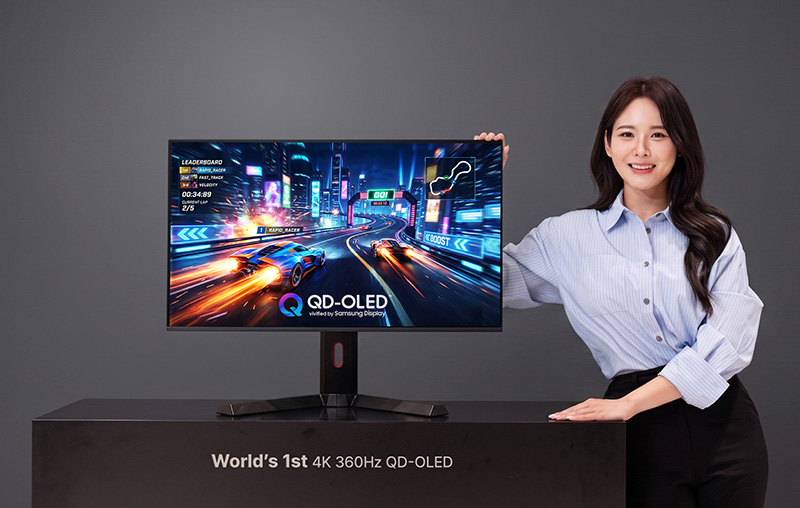
The New Standard for Gaming: Samsung Display Unveils World’s First 4K 360Hz QD-OLED Panel
The boundary between ultra-high resolution and extreme motion fluidity has long been a point of compromise for gaming enthusiasts. Traditionally, users had to choose between the crystalline detail of 4K resolution or the lightning-fast response times of high-refresh-rate panels. That compromise has officially ended. In a significant leap for display engineering, Samsung Display develops the world’s first 4K 360Hz OLED panel with a range of exciting updates – TFTCentral and other industry observers have noted this as a pivotal moment for the QD-OLED ecosystem.
This new panel doesn’t just push the limits of speed; it integrates Quantum Dot (QD) technology with OLED’s self-emissive pixels to deliver a visual experience that is simultaneously brighter and faster than its predecessors. By achieving a 360Hz refresh rate at a full 4K resolution, Samsung Display is addressing the needs of the most demanding competitive gamers and visual purists alike, effectively merging two previously distinct categories of high-end monitors.
Breaking Down the 4K 360Hz QD-OLED Breakthrough
At the heart of this development is the evolution of QD-OLED technology. Unlike traditional OLEDs, which use a white sub-pixel and color filters, QD-OLED utilizes a blue OLED layer that excites a layer of quantum dots to produce red and green light. This process is inherently more efficient and allows for higher peak brightness and more vibrant color saturation.
The achievement of 360Hz at 4K is a massive technical hurdle. To put this in perspective, a 4K image consists of approximately 8.3 million pixels. Refreshing that many pixels 360 times per second requires immense bandwidth and incredibly precise timing within the panel’s circuitry to avoid artifacts, ghosting, or input lag. Samsung Display has managed to optimize the driving electronics and the organic materials within the panel to handle this throughput without sacrificing the deep blacks and infinite contrast ratios that define the OLED experience.
The integration of 4K resolution with a 360Hz refresh rate represents a paradigm shift, removing the “resolution vs. Speed” trade-off that has defined the gaming monitor market for a decade.
Key Technical Enhancements
- Increased Luminance: The updated panels are reported to be brighter, addressing one of the primary criticisms of early OLED monitors—their struggle in brightly lit rooms.
- Reduced Motion Blur: With a 360Hz refresh rate, the interval between frames is reduced to approximately 2.78 milliseconds, creating nearly seamless motion.
- Color Accuracy: The Quantum Dot layer ensures that even at extreme speeds, color reproduction remains consistent and vivid.
MSI and the Introduction of “Triple Mode” Versatility
While Samsung Display provides the foundational technology, the implementation of this panel into consumer hardware is where the utility becomes apparent. MSI has stepped forward to debut the world’s first “triple mode” gaming monitor utilizing this QD-OLED technology. This approach acknowledges that not every game—or every gamer—needs 4K at 360Hz at all times.
The “triple mode” functionality allows the user to switch between three distinct resolution and refresh rate profiles. This represents particularly important because driving a game at 4K 360Hz requires astronomical GPU power that incredibly few current systems can maintain consistently. By offering scalable modes, MSI ensures the monitor remains useful across a variety of gaming genres, from cinematic RPGs to hyper-competitive eSports titles.
| Mode | Resolution | Refresh Rate | Primary Use Case |
|---|---|---|---|
| Ultra-High Fidelity | 4K (3840 x 2160) | 360Hz | Next-gen AAA gaming / High-end workstations |
| Competitive Edge | 1440p (2560 x 1440) | 520Hz | Fast-paced shooters / Competitive eSports |
| Extreme Fluidity | 1080p (1920 x 1080) | 680Hz | Professional reflex-based gaming |
This flexibility allows a gamer to enjoy a visually stunning 4K experience in a title like Cyberpunk 2077 and then instantly pivot to a 680Hz 1080p mode for a title like Valorant or Counter-Strike 2, where every single millisecond of frame delivery can impact the outcome of a match.
Why This Matters: The Industry Context
To understand why the news that Samsung Display develops the world’s first 4K 360Hz OLED panel with a range of exciting updates – TFTCentral is so significant, one must look at the trajectory of display technology over the last five years. For a long time, the “Gold Standard” for high-end gaming was 4K at 144Hz or 1440p at 240Hz. Moving to 360Hz at 4K is not a linear improvement; It’s an exponential jump in data handling.
The Battle of Panel Technologies
The display market is currently a battleground between three primary technologies: IPS (In-Plane Switching), WOLED (White OLED), and QD-OLED (Quantum Dot OLED). While IPS is reliable and cheap, it lacks the contrast of OLED. WOLED, popularized by LG, offers great blacks but has historically struggled with brightness and color volume compared to QD-OLED.
By pushing the QD-OLED panel to 360Hz at 4K, Samsung Display is asserting dominance in the “premium” segment. They are proving that their technology can handle the highest possible resolutions and the highest possible refresh rates simultaneously, while maintaining the brightness advantages of Quantum Dots.
The GPU Bottleneck
There is a critical caveat to this hardware: the hardware that feeds it. Even with the most powerful current-generation graphics cards, hitting a stable 360 FPS at 4K resolution in modern games is nearly impossible without heavy reliance on AI upscaling (like DLSS or FSR). However, the existence of the panel pushes GPU manufacturers to innovate further. It sets a target for the next generation of graphics processors, signaling that the demand for 4K 360Hz is now a reality.
Addressing Common Misconceptions
When new display technology emerges, several common questions and misconceptions typically arise. It is important to clarify these to understand the actual value proposition of the new Samsung Display panel.
“Is 360Hz overkill for 4K?”
For the average user, perhaps. But for the “prosumer” or the professional gamer, it is not. High refresh rates reduce input lag and motion blur, which are critical for reaction-based gaming. When combined with 4K, you no longer have to sacrifice the ability to see a distant enemy clearly (resolution) to see them move smoothly (refresh rate).
“Will this cause OLED burn-in?”
Burn-in remains a concern for all OLEDs, but QD-OLED utilizes different materials and heat management strategies. The “faster and brighter” updates mentioned in the development of these panels often include improvements in the organic layers and the way pixels are driven, which can help mitigate the risks associated with static elements in high-refresh-rate gaming.
“Do I need a special cable for this?”
Yes. To push 4K at 360Hz, the bandwidth requirements exceed the capabilities of older HDMI and DisplayPort standards. Users will likely need HDMI 2.1 or DisplayPort 2.1 to fully utilize these specs, as these standards provide the necessary throughput to avoid compressing the image or limiting the refresh rate.
Implications for the Wider Tech Ecosystem
The ripple effects of this announcement extend beyond just gaming monitors. The technology developed for a 360Hz 4K panel can be trickled down into other sectors:
- Virtual Reality (VR): High refresh rates are essential in VR to prevent motion sickness. A 4K 360Hz panel could lead to incredibly sharp, fluid VR headsets that mimic natural human vision more closely.
- Professional Video Editing: While 360Hz isn’t necessary for editing, the brightness and color accuracy improvements inherent in the new QD-OLED process are highly beneficial for color grading and HDR content creation.
- Corporate Displays: The push for higher brightness makes OLEDs more viable for office environments, where glare from overhead lighting has previously made OLEDs a tricky choice.
For those interested in how this fits into the broader evolution of screen tech, a related explainer on QD-OLED vs WOLED could provide deeper insight into the chemical differences between these two OLED variants.
Comparing the Triple Mode Capabilities
To better visualize the versatility of the MSI implementation of Samsung’s panel, consider the following comparison of how a single monitor can now serve three different personas:
| User Persona | Preferred Mode | Why? |
|---|---|---|
| The Cinematic Gamer | 4K @ 360Hz | Maximized detail for immersive worlds; smoothness for fluidity. |
| The Ranked Competitor | 1440p @ 520Hz | Optimal balance of clarity and extreme speed for eSports. |
| The Professional Athlete | 1080p @ 680Hz | Absolute minimum input lag and maximum frame delivery for reflex wins. |
Frequently Asked Questions
What exactly is a QD-OLED panel?
QD-OLED stands for Quantum Dot Organic Light Emitting Diode. It combines the self-emissive nature of OLED (where each pixel creates its own light, allowing for perfect blacks) with a layer of Quantum Dots that convert light into more precise and vibrant colors, resulting in higher brightness and better color volume than traditional OLEDs.

What is the “Triple Mode” feature in the MSI monitor?
Triple Mode is a functionality that allows the user to switch the monitor’s operating resolution and refresh rate between three presets: 4K at 360Hz, 1440p at 520Hz, and 1080p at 680Hz. This allows the monitor to adapt to the performance capabilities of the user’s PC and the specific requirements of the game being played.
Does the 4K 360Hz panel improve brightness?
Yes. According to the latest updates from Samsung Display, these new QD-OLED panels are designed to be brighter and faster than previous versions, making them more suitable for environments with ambient light.
Can any PC run games at 4K 360Hz?
Not currently. Driving 4K resolution at 360 frames per second is an immense task for any GPU. While the monitor can support it, the actual frame rate achieved in-game will depend on the hardware’s power and the use of upscaling technologies like NVIDIA DLSS or AMD FSR.
Is this panel only for gamers?
While marketed toward gamers due to the high refresh rates, the improved brightness and color accuracy make it an excellent choice for creative professionals, HDR content consumers, and anyone seeking a top-tier visual experience.
As Samsung Display continues to refine the QD-OLED process, the industry is moving toward a future where the hardware no longer limits the vision. The development of the 4K 360Hz panel is more than just a spec bump; it is a statement of intent. By removing the ceiling on both resolution and speed, Samsung Display has set a new benchmark that will challenge every other manufacturer in the display space to keep pace. For the end-user, In other words a more versatile, vivid, and responsive window into their digital worlds.
