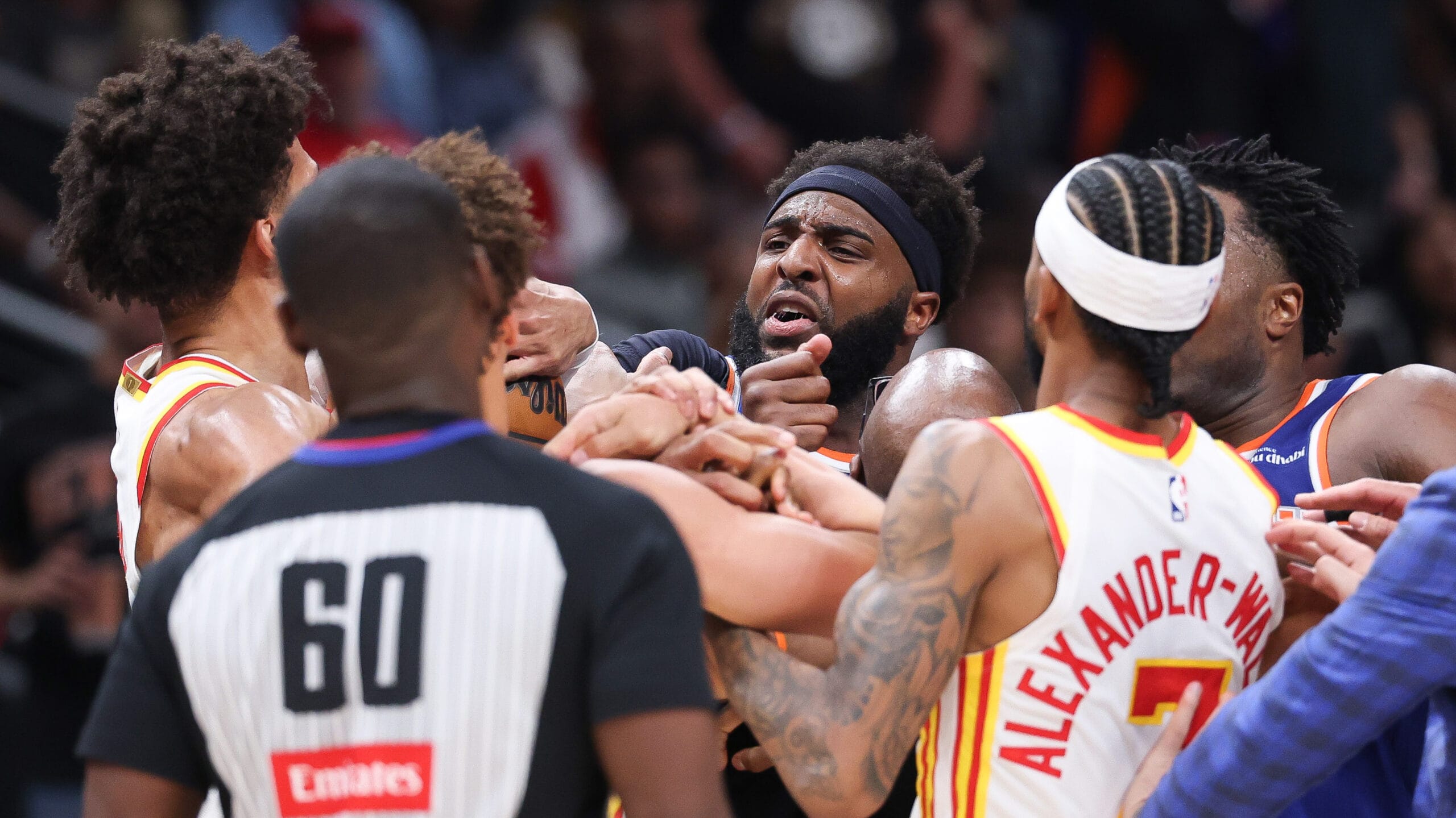
Hawks’ Dyson Daniels, Knicks’ Mitchell Robinson Fined for Altercation – NBA
The NBA has issued significant financial penalties to Mitchell Robinson of the Latest York Knicks and Dyson Daniels of the Atlanta Hawks following a volatile on-court confrontation. The league’s decision comes after a review of an incident that resulted in the ejections of both players during a high-stakes matchup, signaling a firm stance against conduct that escalates beyond the competitive boundaries of the game.
The disciplinary action reflects the NBA’s ongoing effort to maintain player decorum and game integrity, particularly in playoff-intensity atmospheres where tensions frequently peak. While the fines serve as a deterrent, the incident has sparked a broader conversation regarding the volatility of modern NBA matchups and the role of emotional regulation in high-pressure sporting environments.
Breakdown of the Disciplinary Actions
Following a comprehensive review of the game footage and official reports, the NBA league office determined that both players played a role in the escalation of the conflict. The disparity in the fine amounts suggests a difference in the perceived severity of the actions taken by each player during the altercation.
| Player | Team | Fine Amount | Game Action |
|---|---|---|---|
| Mitchell Robinson | New York Knicks | $50,000 | Ejected |
| Dyson Daniels | Atlanta Hawks | $25,000 | Ejected |
The financial penalties are designed to penalize the specific behavior that led to the ejections. In the NBA, fines are often scaled based on the player’s history of similar infractions and the specific nature of the physical or verbal provocation involved in the incident.
The Mechanics of the Altercation
The incident occurred during Game 6 of a series between the Knicks and the Hawks. What began as a standard competitive exchange quickly deteriorated into a physical confrontation. The intensity of the game—a pivotal Game 6 scenario—provided the backdrop for a moment where composure failed for both Robinson and Daniels.
- The Trigger: The altercation was sparked by a sequence of physical play that led to a heated verbal exchange.
- The Escalation: The situation moved from words to physical contact, prompting immediate intervention from teammates and coaching staffs.
- The Result: Officials acted decisively, issuing ejections to both players to prevent further escalation and ensure the game could proceed.
Analyzing the Impact on Both Franchises
For the New York Knicks, the loss of Mitchell Robinson is more than just a financial hit; This proves a tactical void. Robinson provides a specific brand of interior defense and rim protection that is difficult to replace mid-game. His ejection forced the Knicks to adjust their defensive rotations and altered the trajectory of their paint protection for the remainder of the contest.
Conversely, the Atlanta Hawks dealt with the loss of Dyson Daniels, a player whose value lies in his defensive versatility and perimeter disruption. For a team relying on a cohesive defensive shell, the sudden absence of a key defender due to an emotional lapse can create gaps that opposing offenses are quick to exploit.
Tactical Implications of Ejections
When a key rotational player is ejected, the “ripple effect” extends beyond the box score. Coaches must shift minutes to bench players who may not be mentally prepared for the intensity of a Game 6 environment. This often leads to:
- Rotation Instability: The disruption of established chemistry and timing between players.
- Defensive Vulnerability: A loss of specialized skills (e.g., Robinson’s shot-blocking or Daniels’ steals).
- Psychological Shift: The risk of a team becoming too focused on the conflict rather than the execution of the game plan.
Contextualizing the NBA’s Disciplinary Approach
The NBA’s decision to fine Robinson $50,000 and Daniels $25,000 is not an isolated event but part of a broader regulatory framework. The league utilizes a “sliding scale” of punishment, where the severity of the fine is often tied to the specific act—such as a shove, a punch, or the use of provocative language.
Historically, the league has sought to balance the “passion of the game” with the demand for professional conduct. However, in recent years, there has been a noticeable shift toward stricter penalties for altercations that threaten to spiral into full-scale brawls. By penalizing both parties, the league emphasizes that provocation and reaction are both punishable offenses.
Common Misconceptions Regarding NBA Fines
Many fans believe that fines are simply “the cost of doing business” for millionaire athletes. However, the psychological and professional impact is often greater than the monetary loss. An ejection in a critical game can lead to a loss of trust from coaching staff and can potentially affect a player’s standing in future contract negotiations if a pattern of instability is established.
there is a common belief that only the “aggressor” is fined. As seen in the Robinson-Daniels case, the NBA frequently penalizes both the initiator and the responder, reinforcing the expectation that players should walk away from conflict rather than engage.
Player Perspectives and Aftermath
In the wake of the incident, Mitchell Robinson has addressed the situation, breaking his silence regarding the ejection. While the specifics of the exchange remain a point of contention between the two camps, the acknowledgment of the event serves as a necessary step in moving past the conflict.
For Dyson Daniels, the incident serves as a steep learning curve in the physicality and mental warfare of the NBA. Young players often find the transition to high-stakes playoff basketball challenging and the emotional volatility seen in this altercation is a byproduct of that adjustment period.
The fallout of such incidents typically follows a predictable pattern: initial shock, public apologies or explanations, and finally, a refocus on the next game. However, the financial sting of a combined $75,000 in fines serves as a lingering reminder of the cost of losing composure.
Key Takeaways from the Incident
- Emotional Control: The ability to remain calm under pressure is as vital as physical skill in the playoffs.
- League Oversight: The NBA remains vigilant in monitoring player conduct, regardless of the game’s intensity.
- Team Cost: The true cost of an altercation is measured in lost minutes and disrupted strategies, not just dollar amounts.
Frequently Asked Questions
Why was Mitchell Robinson fined more than Dyson Daniels?
While the NBA does not always provide a granular breakdown of every fine, the disparity typically reflects the degree of involvement in the escalation. Robinson’s $50,000 fine suggests the league viewed his role in the altercation as more significant or severe than that of Daniels.

Does an ejection in Game 6 lead to a suspension for the next game?
Not automatically. An ejection results in the player being removed from the current game. A suspension for future games is a separate disciplinary action that occurs only if the league determines the conduct was egregious enough to warrant a ban from play.
How does the NBA determine the amount of a fine for an on-court fight?
The league reviews the official game report and video evidence. They consider the nature of the contact, whether the player has a history of similar incidents, and whether the action endangered other players or officials.
Can players appeal these fines?
Yes, players through the NBPA (National Basketball Players Association) have mechanisms to appeal fines if they believe the penalty was unjust or not supported by the evidence.
As the season progresses and the intensity of the playoffs increases, the league’s commitment to maintaining order will likely remain a priority. For the Knicks and Hawks, the focus now shifts from the financial penalties to the tactical recovery from a moment of chaos. The incident serves as a cautionary tale for players across the league: in the heat of the moment, the cost of losing your cool is both professional and financial.
