South African Telescope Detects Record-Breaking Signal from the Early Universe
A radio telescope in South Africa has detected a record-breaking signal from the early universe, offering new evidence regarding the “Cosmic Dawn.” According to research reports, the signal originates from neutral hydrogen gas during the epoch when the first stars began to form, billions of years ago, marking a significant milestone in observational cosmology.
What Was Detected in the Early Universe?
Astronomers using specialized radio equipment in South Africa have captured a signal that dates back to the period known as the Cosmic Dawn. This era represents the moment the first stars ignited, ending the “Cosmic Dark Ages.” The signal is based on the 21-centimeter line of neutral hydrogen, a specific radio frequency that allows scientists to map the distribution and temperature of gas in the infant universe.
The detection focuses on the absorption of the Cosmic Microwave Background (CMB) radiation by neutral hydrogen. As the first stars emitted ultraviolet light, they interacted with the surrounding hydrogen gas, creating a distinct dip in the radio spectrum. This “absorption feature” serves as a cosmic fingerprint, revealing when the first luminous objects appeared and how they influenced their environment.
According to the reporting, this signal is record-breaking due to its precision and the specific window of cosmic time it probes. By analyzing these frequencies, researchers can determine the timing of the first star formation and the subsequent process of reionization, where the neutral hydrogen gas was stripped of its electrons by intense radiation.
- Signal Source: Neutral hydrogen gas (HI).
- Mechanism: 21-centimeter hyperfine transition.
- Era: Cosmic Dawn / Epoch of Reionization.
- Key Indicator: Absorption of the Cosmic Microwave Background radiation.
How the South African Telescope Captured the Signal
The detection was made possible by the unique geographical and technical advantages of South Africa’s radio-quiet zones. Specifically, the Hydrogen Epoch of Reionization Array (HERA) and the precursors to the Square Kilometre Array (SKA) operate in regions with minimal human-made radio interference, which is essential for detecting signals that are incredibly faint.
The technology utilizes a vast array of dipole antennas that work together as an interferometer. Rather than acting as a single dish, the array combines signals from hundreds of antennas to simulate a much larger telescope. This increase in sensitivity is required because the signal from the early universe is buried under “foreground noise” that is thousands of times stronger than the target signal.
Researchers employ complex algorithms to perform “foreground subtraction.” This process involves identifying and removing radio emissions from our own galaxy, the Milky Way, as well as signals from distant quasars and satellite transmissions. According to the technical data, the precision of these subtraction methods is what allowed the record-breaking signal to be isolated from the cosmic noise.
“The challenge is akin to trying to hear a whisper in the middle of a hurricane,” researchers have noted regarding the difficulty of isolating the 21cm signal from galactic foregrounds.
Why the Cosmic Dawn Signal Matters for Science
The detection of this signal provides a direct look at the transition from a cold, dark universe to one filled with light. Before the first stars formed, the universe consisted mostly of hydrogen and helium gas. This period, the Dark Ages, is largely invisible to traditional optical telescopes because there were no stars to emit light.
By capturing the 21cm signal, astronomers can answer fundamental questions about the composition of the early universe. For instance, the depth and shape of the absorption signal can indicate whether the gas was colder than expected, which might suggest the presence of dark matter interacting with the hydrogen. If the signal is stronger than standard cosmological models predict, it could imply “new physics” beyond the current Standard Model of cosmology.
Furthermore, this discovery helps map the Epoch of Reionization. This is the period when the first galaxies grew large enough to ionize the surrounding gas, making the universe transparent to light. Understanding this transition is critical for understanding how the large-scale structures of the universe, including galaxy clusters, were formed.
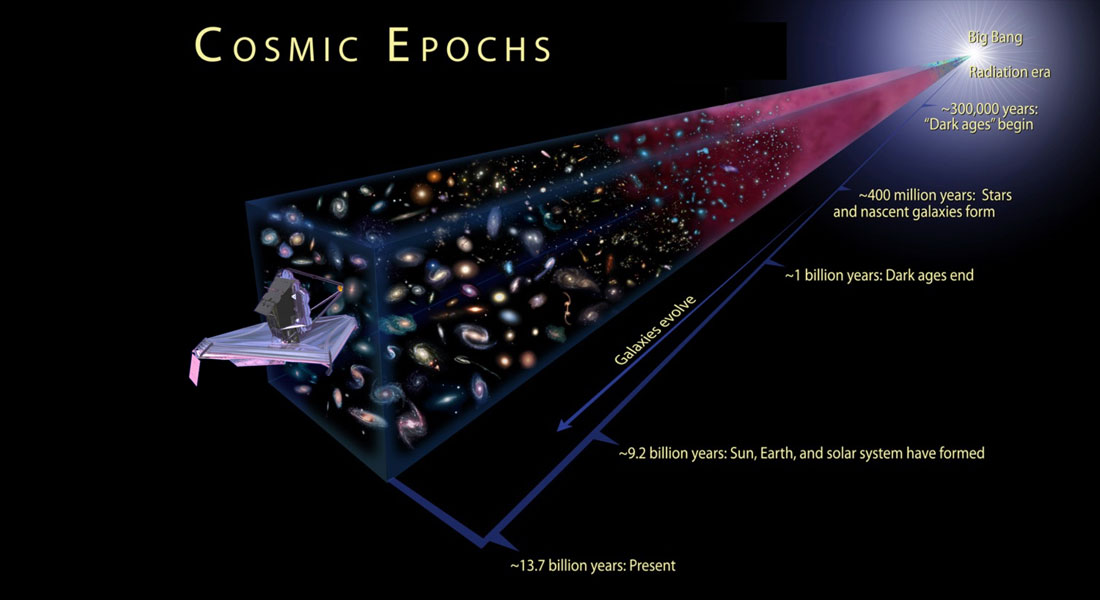
Timeline of the Early Universe
| Era | Approximate Time After Big Bang | Key Characteristic |
|---|---|---|
| The Big Bang | 0 seconds | Initial expansion and rapid cooling. |
| Recombination | ~380,000 years | Electrons and protons form neutral hydrogen; CMB emitted. |
| The Dark Ages | ~380k to ~150 million years | Universe is dark; neutral hydrogen fills space. |
| Cosmic Dawn | ~150 million to 1 billion years | First stars ignite; neutral hydrogen is heated and ionized. |
| Reionization | ~1 billion years onward | Intergalactic medium becomes fully ionized. |
Comparing Current Findings with Previous Experiments
This detection builds upon and challenges previous attempts to find the 21cm signal. A notable precedent was the 2018 report from the EDGES (Experiment to Detect the Global Epoch of Reionization Signature) collaboration, which claimed to have found a similar signal. However, the EDGES result was controversial because the signal was significantly deeper than predicted by standard models, leading some scientists to question if the result was an artifact of the instrument or an indication of unknown physics.
The South African detection differs in its approach and verification. By using a larger array of antennas and more sophisticated foreground removal techniques, the current findings provide a more robust data set. While EDGES looked for a “global” average signal, the South African arrays are designed to eventually map the signal’s fluctuations across the sky, providing a 3D image of the early universe.
The contrast between these experiments highlights the evolution of radio astronomy. Where earlier experiments relied on a single antenna to detect a general dip in frequency, the current South African infrastructure allows for cross-correlation between multiple antennas, reducing the likelihood of systematic errors and increasing the scientific validity of the record-breaking signal.
Overcoming the Challenges of Radio Interference
One of the primary obstacles in detecting signals from the early universe is the “ionosphere,” the ionized part of Earth’s upper atmosphere. The ionosphere can refract and distort low-frequency radio waves, acting like a warped lens that blurs the signal from the Cosmic Dawn.
To combat this, researchers use calibration techniques that monitor the ionosphere in real-time. According to reports, they use known, bright radio sources in the sky as “anchors” to calculate how the atmosphere is distorting the incoming data. Once the distortion is measured, it can be mathematically removed from the signal.
Beyond the atmosphere, human activity poses a constant threat. Radio Frequency Interference (RFI) from mobile phones, satellites, and digital television can easily drown out the 21cm signal. This is why the telescope is located in the Karoo region of South Africa. The government has established strict radio-quiet zones in these areas, limiting the use of electronic devices to protect the integrity of the astronomical data.
For those interested in how these zones are managed, a related explainer on radio-quiet zones provides more detail on the legal and technical protections used in astronomy.
The Role of South Africa in Global Astronomy
The detection of this signal reinforces South Africa’s position as a global hub for radio astronomy. The country hosts several critical components of the Square Kilometre Array (SKA) project, one of the largest scientific endeavors in human history. The SKA is a multi-national effort to build the world’s largest radio telescope, with half of the antennas located in South Africa and the other half in Australia.
The success of this record-breaking signal detection serves as a “proof of concept” for the full SKA. It demonstrates that the technology and the site are capable of detecting the most elusive signals in the universe. This has implications for other fields of study, such as the search for extraterrestrial intelligence (SETI) and the study of pulsars and black holes.
The investment in these facilities has also spurred local technological growth. The high-performance computing required to process the massive amounts of data from the telescope has led to advancements in data science and engineering within South Africa. This synergy between international research and local infrastructure is a key driver of the project’s success.
Common Misconceptions About the Signal
There are several common misunderstandings regarding what a “signal from the early universe” actually is. Many readers assume the telescope is “hearing” a sound or receiving a message. In reality, the “signal” is a measurement of radio intensity at a specific frequency.
Another misconception is that the telescope is seeing the Big Bang itself. The Big Bang produced the Cosmic Microwave Background (CMB), but that happened 380,000 years after the start. The signal detected in South Africa comes from after the CMB, during the period when the first stars began to change the state of the universe’s gas. It is a look at the “aftermath” of the Big Bang, not the event itself.
Finally, some believe that “record-breaking” implies a signal of immense strength. In the context of radio astronomy, “record-breaking” usually refers to the redshift (how far back in time the signal comes from) or the signal-to-noise ratio (how clearly the signal was separated from the background). The signal itself is incredibly weak; the record is in the ability to find and verify it.
Future Directions in Cosmic Dawn Research
With the initial signal detected, the next phase of research involves moving from “detection” to “mapping.” While the current discovery proves the signal exists, astronomers now want to see how it varies across different regions of the sky. This will allow them to identify the first “bubbles” of ionized gas created by the first galaxies.
As the full Square Kilometre Array comes online, the sensitivity will increase by orders of magnitude. This will enable researchers to:
- Pinpoint the exact date the first stars ignited.
- Determine the mass and temperature of the first generation of stars (Population III stars).
- Test theories about the nature of dark matter and its role in early galaxy formation.
- Observe the transition from the first stars to the first massive black holes.
The integration of data from the South African radio telescopes with optical data from the James Webb Space Telescope (JWST) will provide a complete picture. While the radio telescopes detect the gas, the JWST can see the actual stars and galaxies that were heating that gas. Together, these instruments are filling in the final missing chapters of the universe’s history.
For more on the synergy between different telescope types, see this related explainer on multi-messenger astronomy.
Frequently Asked Questions
What is the 21-centimeter line?
The 21-centimeter line is a radio spectral line produced by a “spin-flip” transition in neutral hydrogen atoms. When the electron in a hydrogen atom flips its spin relative to the proton, it emits a photon with a wavelength of approximately 21 centimeters. Because hydrogen is the most abundant element in the universe, this line is a primary tool for mapping gas in space.
Why is the signal called “record-breaking”?
The signal is considered record-breaking because of the extreme distance (and thus time) it has traveled. It originates from the very early stages of the universe’s evolution, and the precision with which it was isolated from the “noise” of the Milky Way represents a technical achievement in radio astronomy.
Does this discovery prove the Big Bang theory?
The discovery does not “prove” the Big Bang in isolation, but it provides critical supporting evidence. By confirming the existence of the Cosmic Dawn and the Epoch of Reionization, it validates the timeline predicted by the Big Bang model and helps refine our understanding of how the universe evolved from a hot, dense state into the structured cosmos we see today.
Why can’t we use normal telescopes to see this?
Normal optical telescopes detect visible light. During the Dark Ages and the early Cosmic Dawn, there were no stars to produce visible light. Furthermore, the gas in the early universe absorbed most of the radiation. Radio waves, however, can penetrate these gas clouds, making radio telescopes the only way to “see” into this era.
Who owns and operates the telescope in South Africa?
The facilities are part of international collaborations. While the land and some infrastructure are provided by the South African government, the telescopes are operated by consortia of universities and research institutions from around the world, including the SKA Observatory (SKAO), which is an intergovernmental organization.
