Success! Physicists Build The World’s First Clocks Powered by Atomic Nuclei – ScienceAlert
Physicists have successfully developed the world’s first clocks powered by atomic nuclei, according to reports from ScienceAlert and New Scientist. These nuclear clocks utilize transitions within the atomic nucleus rather than electron shells, providing a level of precision that could enable the detection of dark matter and the testing of fundamental physics.
The achievement marks a shift in timekeeping technology. While traditional atomic clocks have defined the second for decades, the transition to nuclear-powered timekeeping offers a more stable frequency. According to Phys.org, these clocks “tick” using the internal energy states of a nucleus, which are far less susceptible to external environmental interference than the electrons used in current standards.
How do nuclear clocks differ from traditional atomic clocks?
Most people use the term “atomic clock” to describe the gold standard of timekeeping. However, those devices aren’t actually “nuclear.” They rely on the movement of electrons between energy levels in an atom’s outer shell. Nuclear clocks, as detailed by ScienceAlert, move the operation inside the nucleus itself.
The difference is a matter of scale and stability. Electrons exist in a cloud around the nucleus and are easily nudged by magnetic fields, temperature shifts, or electrical interference. The nucleus is roughly 10,000 times smaller and is shielded by that very electron cloud. This makes the nuclear “tick” significantly more resilient.
According to New Scientist, this resilience allows for a degree of accuracy that exceeds current electronic atomic clocks. Because the nucleus is so tightly bound, the energy required to trigger a transition is higher, and the resulting frequency is more consistent over long periods.
- Atomic Clocks: Use electron transitions; sensitive to external electromagnetic noise.
- Nuclear Clocks: Use nuclear transitions; highly shielded and stable.
- Precision: Nuclear clocks potentially offer orders of magnitude more stability.
Why is the atomic nucleus a better “pendulum” for timekeeping?
A clock is only as good as its oscillator—the thing that swings or vibrates at a steady rate. In a grandfather clock, it’s a pendulum. In a quartz watch, it’s a vibrating crystal. In a nuclear clock, the oscillator is the nucleus of a specific atom.
According to IFLScience, the primary advantage is the frequency of the transition. The energy gaps in a nucleus are much larger than those in an electron shell. This means the “frequency” of the nuclear clock is much higher. In the world of physics, a higher frequency generally allows for finer divisions of time, which leads to greater precision.
Furthermore, the nucleus is governed by the strong nuclear force, which is vastly more powerful than the electromagnetic force that holds electrons in place. This means the nucleus doesn’t “drift” as easily. When external fields hit an atom, the electrons react immediately, causing the clock to lose a fraction of a second. The nucleus, however, remains largely indifferent to these disturbances.
“Nuclear clocks tick for the first time,” Phys.org reports, signaling a transition from theoretical physics to a working prototype that can actually be measured and utilized.
How will these clocks help scientists find dark matter?
The most immediate application for this technology isn’t about telling time more accurately for humans, but using that accuracy as a sensor. One of the most elusive mysteries in science is dark matter—the invisible substance that makes up most of the universe’s mass but doesn’t emit light or heat.
According to IFLScience, nuclear clocks are uniquely suited to detect dark matter. Some theories suggest that dark matter consists of fields that fluctuate over time. If a “clump” of dark matter passed through a nuclear clock, it might slightly alter the fundamental constants of nature for a brief moment.
Because nuclear clocks are so precise, they could detect a tiny, momentary shift in the “tick” rate. If the frequency of the nucleus changes in a way that can’t be explained by known physics, it could be the first direct evidence of dark matter interacting with normal matter. This turns a timekeeping device into a massive, ultra-sensitive dark matter detector.
Potential Dark Matter Detection Methods
- Frequency Drift: Monitoring if the nuclear transition rate fluctuates unexpectedly.
- Comparison: Running two nuclear clocks with different nuclei to see if dark matter affects them differently.
- Spatial Mapping: Using a network of clocks to track the movement of dark matter “clouds” across Earth.
What are the implications for fundamental physics and the laws of nature?
Beyond dark matter, these clocks allow physicists to test whether the “constants” of the universe are actually constant. For example, the fine-structure constant determines the strength of electromagnetic interactions. Current physics assumes this number never changes.
However, according to reports from New Scientist and ScienceAlert, a nuclear clock could prove this wrong. If the clock’s frequency changes over months or years, it would suggest that the laws of physics are evolving as the universe expands. Such a discovery would require a complete rewrite of the Standard Model of physics.
There’s also the matter of gravity. Einstein’s General Relativity predicts that time slows down closer to a massive object (gravitational time dilation). Current atomic clocks can detect this effect over a few centimeters of height. Nuclear clocks, with their increased precision, could detect gravitational changes on an even smaller scale, potentially revealing new properties of gravity or the existence of “quantum gravity.”
For those interested in how these measurements impact our understanding of the cosmos, a related explainer on general relativity provides context on how time and gravity interact.
Comparing Nuclear and Atomic Timekeeping
To understand the jump in technology, it’s helpful to see how nuclear clocks stack up against the current industry standards. The following table summarizes the key technical differences reported across the various scientific outlets.

| Feature | Traditional Atomic Clock | Nuclear Clock |
|---|---|---|
| Oscillator | Electron transitions | Nuclear transitions |
| Primary Force | Electromagnetic | Strong Nuclear Force |
| Environmental Sensitivity | High (Magnetic/Thermal) | Very Low (Shielded) |
| Frequency | Lower (GHz to THz range) | Much Higher (VUV/X-ray range) |
| Primary Use Case | GPS, Network Sync | Dark Matter, Fundamental Physics |
| Stability | High | Ultra-High |
Addressing common misconceptions about nuclear clocks
The word “nuclear” often triggers thoughts of power plants or weapons. It’s important to clarify that these clocks aren’t “nuclear” in the sense of fission or fusion. They don’t use radioactive decay to power themselves, nor do they produce dangerous radiation in the way a reactor does.
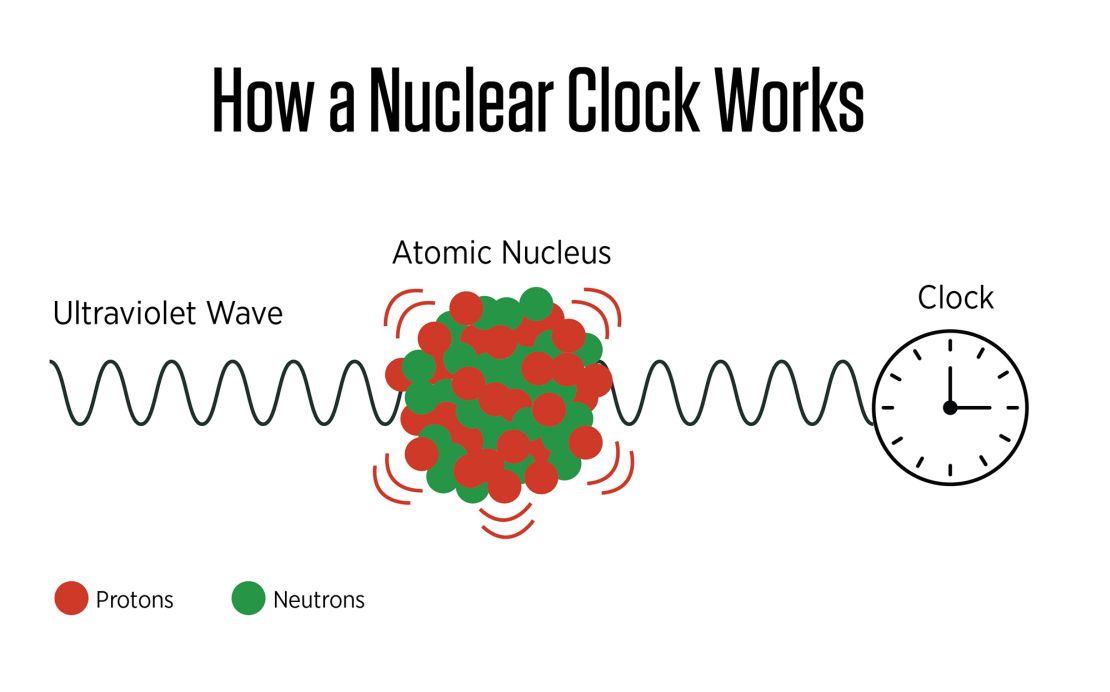
Instead, they use “nuclear transitions.” This is similar to how an electron jumps between shells, but it happens between energy levels inside the nucleus. The “power” comes from the precision of the frequency, not from a nuclear reaction. According to the technical framing in Phys.org, this is a quantum mechanical process, not a thermodynamic one.
Another misconception is that these clocks will replace the quartz watch on your wrist. They won’t. The equipment required to maintain a nuclear clock—including specialized lasers and vacuum chambers—is massive and expensive. These are laboratory instruments designed for science, not consumer electronics.
The path toward a new standard of time
The successful build of these clocks is a proof-of-concept. The next step involves refining the lasers used to “probe” the nucleus. Because nuclear transitions happen at much higher energies than electron transitions, scientists need extremely precise vacuum-ultraviolet (VUV) light to trigger the tick.
According to Inshorts, the ability to build these clocks opens the door to a new era of metrology. If the technology can be scaled or stabilized further, it could lead to a redefinition of the “second.” Currently, the second is defined by the cesium atom’s electron transition. A nuclear standard would be far more robust and universal.
As these devices become more common in high-end physics labs, they’ll likely be used in tandem. By comparing a nuclear clock to an atomic clock, scientists can isolate exactly how much environmental noise is affecting the atomic clock, effectively using the nuclear clock as a “perfect” reference point.
This development also has implications for deep-space navigation. For probes traveling to the outer edges of the solar system, timing errors of a few nanoseconds can lead to positioning errors of several meters. A nuclear clock’s stability would ensure that autonomous spacecraft remain on course without needing constant corrections from Earth.
Future Milestones to Watch
- Laser Refinement: Development of more stable VUV lasers to increase clock uptime.
- Network Integration: Linking nuclear clocks via fiber optics to create a global “quantum” time network.
- Dark Matter Detection: The first peer-reviewed report of a frequency shift attributed to non-baryonic matter.
Frequently Asked Questions
What exactly is a nuclear clock?
A nuclear clock is a timekeeping device that measures the frequency of energy transitions within an atomic nucleus. Unlike standard atomic clocks, which use the electrons orbiting the nucleus, nuclear clocks use the nucleus itself as the oscillator, making them far more stable and less sensitive to outside interference.
Why is this a “success” for physicists?
According to ScienceAlert and New Scientist, the success lies in the fact that these clocks have moved from theoretical models to working prototypes. Triggering a nuclear transition requires immense precision and specific types of light (VUV), and achieving a consistent “tick” proves the technology is viable.
Can a nuclear clock detect dark matter?
Yes, potentially. Because they are so precise, any slight change in the rate of the nuclear tick could indicate the presence of dark matter fields interacting with the nucleus. IFLScience notes that this makes nuclear clocks one of the most promising tools for detecting the “invisible” mass of the universe.
Will nuclear clocks replace GPS satellites?
Not in the immediate future. GPS relies on atomic clocks that are small and rugged enough to survive in space. Nuclear clocks currently require large laboratory setups. However, if the technology is miniaturized, it could lead to a new generation of GPS with centimeter-level accuracy.
Is there any radiation risk with these clocks?
No. These clocks do not rely on nuclear fission or fusion. They use quantum transitions between energy states in the nucleus, which is a fundamentally different process than the radioactive decay associated with nuclear power or weapons.
For further reading on how these breakthroughs fit into the broader field of quantum sensing, check out our guide to quantum metrology.
