Syrian Court Sentences Bashar Al-Assad To Death In Absentia
The Fourth Criminal Court in Damascus handed down capital punishment to the exiled former leader and his brother Maher, though both remain in Moscow.
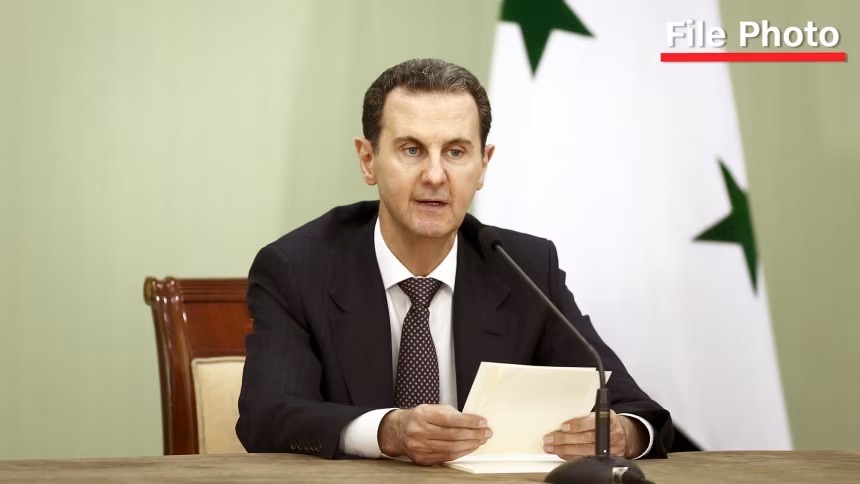
A Syrian court on Tuesday sentenced ousted former President Bashar al-Assad to death in absentia, marking a historic legal reckoning for a 14-year civil war while highlighting the deep operational limits of the country’s transitional justice system, according to Leadership.
The verdict, delivered by the Fourth Criminal Court in Damascus and broadcast live on state television by Judge Fakhareddine al-Aryan, represents the first time a court has issued capital punishment against Assad or his inner circle since the family's five-decade rule collapsed in December 2024, as reported by The Quint.
Related YouTube video



Inside the Damascus courtroom, the physical reality of the transitional government's reach stood in sharp contrast to the empty bench of the exiled Leadership. Atef Najib, a former Syrian army brigadier general and Assad’s maternal cousin, stood caged inside the courtroom wearing a prisoner’s uniform to hear his own death sentence. Najib, who served as head of the Political Security Branch in Daraa during the 2011 uprising, was convicted of murder, the intentional killing of children under 15, and torture leading to death. The court tied the convictions directly to the violent crackdown on teenage protesters in Daraa who had written anti-government graffiti on a school wall — an event widely recognized as the spark that ignited the devastating 14-year conflict.
Judge al-Aryan stated during the live broadcast that Bashar al-Assad used state agencies to commit war crimes and crimes against humanity, specifically finding the former president guilty of premeditated and intentional murder, torture, arbitrary arrest, and crimes against humanity, according to regional reporting. Maher al-Assad, the former commander of the elite 4th Armored Division — an army unit accused by opposition activists of widespread killings, torture, extortion, and operating detention facilities, was sentenced alongside his brother in absentia.
The proceedings form the centerpiece of an ongoing accountability campaign launched by Syria’s new authorities earlier this year to prosecute figures tied to the fallen regime, according to The Associated Press.
The Path to Moscow and the Extradition Challenge
Following the collapse of the five-decade Assad dynasty, Bashar al-Assad and his brother Maher fled Damascus in December 2024 after an 11-day offensive led by forces under Ahmed al-Sharaa, who is now Syria’s president, according to reporting by Leadership. Both men subsequently travelled to Moscow, where they were granted political asylum. Syria’s new authorities have called on Russia to hand the former president and his brother over for prosecution, but it remains unclear whether Damascus will be able to secure their extradition.
The latest verdict is part of efforts by Syria’s interim government to hold senior officials and security personnel linked to the former regime accountable, as noted by The Associated Press. Before his removal from power, attempts by Syrian opposition figures to pursue Assad through courts in Western countries did not result in convictions. The death sentence handed down on Tuesday is therefore a major legal development against the former Syrian leader, although its enforcement remains uncertain as Assad remains in Russia.
The legal actions unfolding in Damascus run parallel to shifting geopolitical alignments across the Middle East. According to reporting by Jewish Insider, the International Atomic Energy Agency will remove nuclear material stored at a secret site in Syria tied to the fallen Assad regime per an agreement reached between the U.S., Jerusalem and Damascus. This development comes as transitional authorities continue dismantling the remnants of the former administration's infrastructure while managing broader regional security dynamics.
Meanwhile, the collapse of the five-decade Assad dynasty has altered traditional alliances. Pro-Israel circles have viewed a new mutual defense pact between Saudi Arabia, Turkey, and Pakistan as an effort by Gulf allies to hedge against the United States and Israel, creating an alternative to the Abraham Accords. Iranian Foreign Ministry spokesman Esmaeil Baghaei stated that Tehran was not concerned about the pact inked by Saudi Arabia, Pakistan and Turkey, even as regional tensions persist across multiple active fronts.
The wider Middle East conflict continues to generate severe humanitarian and political friction. The Associated Press notes that Iranian-backed Houthi rebels in Yemen attacked the government-held port city of Mokha on the Red Sea coast and other areas of the country, deepening fears over threats to strategic shipping routes and a potential return to civil war. These strikes follow earlier violence that left dozens of troops and civilians dead, raising alarms over potential threats to strategic shipping routes and the possible reignition of Yemen's civil war after a four-year hiatus following a 2022 truce.
Energy security remains a central pressure point as the Strait of Hormuz effectively shut down by Iran. Iranian Foreign Minister Abbas Araghchi underscored Tehran's stance that the Strait of Hormuz cannot be reopened until the United States ends its blockade of Iranian ports and meets other demands. In response to Iranian demands for war reparations, U.S. President Donald Trump countered by demanding compensation from Tehran “for all of the people that they have killed and gravely wounded with their roadside bombs and many conflicts,” asserting that American naval enforcement has left the Iranian economy completely broke.
Back in Syria, the intersection of domestic accountability and international diplomacy highlights the challenges facing the interim government. As state prosecutors pursue architects of the 14-year civil war, the next step depends on whether diplomatic pressure can compel Moscow to surrender Bashar al-Assad and his brother Maher to face judgment in Damascus.
How significant is this development?
Contribute your assessment to the aggregated reader intelligence ledger.
Archypedia is dedicated to independent, evidence-backed reporting. This briefing was synthesized from primary source reporting, corroborated across independent newsrooms, and verified against our Editorial Standards.
Transparency record
Evidence behind this report
This report synthesizes 4 distinct sources. Open the source ledger below to compare the underlying coverage.
Prepared under the Archypedia Editorial Policy by the Samir Haddad editorial desk profile. AI-assisted tools may support drafting and verification; public accountability remains with Archypedia. Report an error.