USPS Postmark Change: What You Need to Know About the Date on Your Mail – AL.com
For millions of Americans, the small, ink-stamped date on a piece of mail is more than just a clerical detail—it is a legal timestamp. Whether it is a tax return, a legal response, a contract, or a critical absentee ballot, the postmark serves as the official record of when a document entered the postal system. However, as the United States Postal Service (USPS) continues to modernize its infrastructure and shift toward centralized processing, many senders are discovering that the date they drop a letter in the mailbox is not always the date that appears on the stamp.
Understanding the USPS postmark change: What you need to know about the date on your mail – AL.com and other regional reports highlight a growing disconnect between consumer expectations and the mechanical reality of modern mail sorting. As the USPS moves away from local post office cancellations toward high-speed regional distribution centers, the “postmark date” has become a point of contention and confusion for those facing strict deadlines.
The Mechanics of the Postmark: How It Actually Works
To understand why a postmark might not reflect the day you mailed your letter, it is necessary to understand the journey a piece of mail takes. In the early days of the postal service, almost every piece of mail was “cancelled” (postmarked) at the local post office where it was dropped off. The postal clerk would manually or mechanically stamp the envelope, providing an immediate and accurate record of the mailing date.
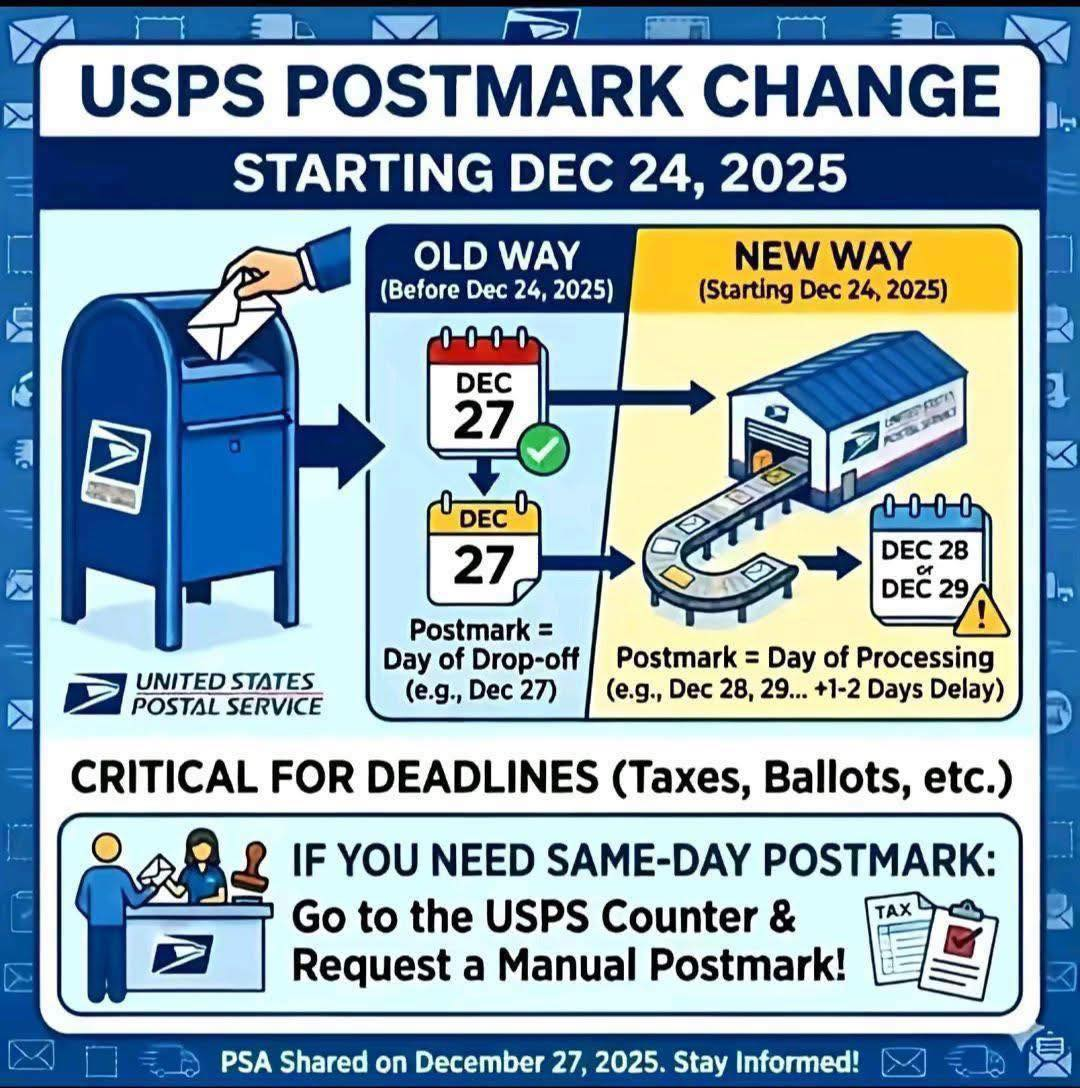
Today, the process is vastly different. Most mail is now processed through an automated system. When you drop a letter into a blue collection box or a wall slot at a local branch, that mail is collected and transported to a larger Processing and Distribution Center (P&DC). It is at these massive facilities—not the local post office—where the mail is sorted and the postmark is applied by high-speed machines.
Manual vs. Automated Postmarking
The shift toward automation has increased efficiency and lowered costs, but it has removed the “local” element from the timestamp. If you drop a letter in a box at 4:00 PM, but the collection has already occurred for the day, your mail will sit until the next morning. Even if you drop it before the collection time, the mail may not reach the regional P&DC until the following day, resulting in a postmark date that is one or more days later than the actual date of mailing.
| Feature | Local/Manual Postmarking | Automated/Regional Postmarking |
|---|---|---|
| Location of Stamp | Local Post Office | Regional Processing Center (P&DC) |
| Timing | Immediate upon acceptance | Delayed until sorting phase |
| Accuracy to Drop Date | High | Variable (depends on transit time) |
| Volume Capacity | Low | Extremely High |
Why This Change Matters: Legal and Financial Implications
The discrepancy between the “drop date” and the “postmark date” is not merely a matter of curiosity; it can have severe real-world consequences. In many legal and administrative frameworks, the postmark is the only evidence accepted to prove a deadline was met.
Tax Filings and Government Deadlines
The Internal Revenue Service (IRS) and various state taxing authorities often use the “timely mailed, timely filed” rule. If a tax return is postmarked by the deadline, it is generally considered on time, even if it arrives at the IRS office days later. If the automated sorting process delays the postmark by 24 to 48 hours, a taxpayer could face late filing penalties despite having physically mailed the document on time.
Legal Proceedings and Court Filings
In civil and criminal law, “proof of service” or the timely filing of an appeal is critical. A missed deadline by a single day can result in a case being dismissed or a right to appeal being waived. While some courts are becoming more lenient regarding postal delays, the burden of proof typically rests on the sender to show that the document was mailed in a timely manner.
Election Integrity and Absentee Ballots
Perhaps the most sensitive area affected by postmark variations is the electoral process. Many states require absentee ballots to be postmarked by Election Day to be counted. When ballots are routed to regional centers, a ballot dropped off on the afternoon of Election Day might not be stamped until the following morning, potentially disenfranchising the voter.
“The postmark is the legal heartbeat of a document. When the gap between the act of mailing and the act of stamping grows, the risk to the consumer increases.”
The Broader Context: USPS Modernization and “Delivering for America”
The confusion surrounding the USPS postmark change: What you need to know about the date on your mail – AL.com is a symptom of a larger organizational shift. Under the “Delivering for America” 10-year plan, the USPS is restructuring its entire network to improve financial sustainability and delivery speed. This includes the creation of Sorting and Delivery Centers (S&DCs).
The goal of this modernization is to reduce the number of “touches” a piece of mail receives, moving it more quickly from the sender to the recipient. However, by further centralizing the cancellation process, the USPS is effectively decoupling the postmark from the local community. The postmark no longer tells you where the mail started, but rather where it was processed.
Key Pillars of the Modernization Effort:
- Centralization: Moving sorting tasks from thousands of small offices to a few hundred regional hubs.
- Automation: Utilizing Advanced Facer Canceler Systems (AFCS) to process thousands of envelopes per hour.
- Route Optimization: Changing how mail is delivered to the “last mile” to reduce fuel and labor costs.
Common Misconceptions About Postmarks
There are several widespread myths regarding how the USPS handles dating and stamping. Clearing these up is essential for anyone relying on strict deadlines.
Myth 1: “The postmark is always the date I mailed it.”
Reality: As established, the postmark is the date the mail was processed through a cancellation machine. This may be several days after you dropped it in a mailbox, especially during peak seasons or in rural areas.

Myth 2: “If I hand it to a clerk, it gets postmarked immediately.”
Reality: In most modern post offices, clerks no longer hand-stamp every envelope. They simply accept the mail and place it in a bin to be sent to the regional center. Unless you specifically request a “round stamp” (a manual date stamp), your mail will follow the same automated path as mail dropped in a blue box.
Myth 3: “The USPS is intentionally delaying postmarks.”
Reality: Delays are typically a result of logistics and volume, not intent. The shift to regional hubs is a systemic change designed for efficiency, though it creates a “blind spot” for the individual sender regarding the exact moment of cancellation.
How to Protect Yourself: Ensuring Your Deadlines are Met
If you are sending a document where the date is non-negotiable, relying on standard First-Class mail is a risk. To ensure a guaranteed timestamp, Consider employ specific USPS services designed for accountability.
1. Use Certified Mail
Certified Mail is the gold standard for deadline-sensitive documents. When you send a piece of mail via Certified Mail, the clerk provides you with a receipt that includes the date and time the item was accepted. While the postmark on the envelope might still be delayed, the Certified Mail receipt serves as legal proof of the mailing date in almost every court and government agency.
2. Request a Manual Hand-Stamp
If you are at a post office counter, you can politely ask the clerk to “round stamp” or hand-cancel your envelope. While some offices are discouraged from doing this due to the time it takes, many will still do it for critical documents. This ensures the date on the envelope matches the date you are standing at the counter.
3. Registered Mail for High-Value Items
For items of extreme importance, Registered Mail provides the highest level of security and a detailed chain of custody. Every person who handles the mail must sign for it, creating an airtight trail of evidence regarding the timing of the shipment.
4. The “Three-Day Rule”
A practical rule of thumb for the modern era is to treat any deadline as being three days earlier than it actually is. By mailing a document 72 hours before the due date, you provide a sufficient buffer for transit to the regional P&DC and the subsequent automated postmarking.
For more information on managing your shipments, you may find a related explainer on shipping insurance and tracking useful to ensure your documents not only arrive on time but are fully protected.
Impact on Small Businesses and Legal Professionals
The shift in postmarking has created a ripple effect for professionals who rely on “mail-merge” campaigns or legal notifications. Law firms, for instance, often send “notice of intent” letters that must be received or postmarked by a certain date to trigger a legal window.
Many firms have shifted toward electronic service (e-service) to avoid the unpredictability of the USPS postmark. Similarly, businesses are increasingly using digital timestamps and email confirmations to establish a record of communication. However, for those industries where physical paper is still mandated—such as certain government filings or formal contracts—the uncertainty of the automated postmark remains a significant operational hurdle.
Frequently Asked Questions
Does the USPS still offer hand-stamping at local offices?
Yes, but it is not the default. You must specifically ask the postal clerk to manually date-stamp your envelope at the time of mailing. Be aware that some high-volume offices may refuse this request during peak hours.
What should I do if my mail was postmarked late despite being mailed on time?
If you have a receipt (such as from Certified Mail), that receipt is your primary defense. If you do not have a receipt, you may attempt to contact the USPS Office of the Inspector General or the Consumer Advocate, though proving a specific single-letter delay is extremely difficult without documentation.
How does the “postmark change” affect absentee ballots?
It means that dropping your ballot in a mailbox on Election Day is riskier than it used to be. To ensure your vote is counted, it is highly recommended to use an official ballot drop box or hand-deliver the ballot to the elections office, bypassing the regional sorting process entirely.
Is there a difference between “postmarked” and “received”?
Yes. “Postmarked” refers to the date the USPS processed the mail into their system. “Received” refers to the date the recipient actually took possession of the mail. Most legal deadlines specify which of these two dates is the governing factor.
Can I track when my mail was postmarked using a tracking number?
Standard First-Class mail does not have tracking. However, if you use Certified Mail or Priority Mail, the tracking history will show the date the item was “Accepted” at the post office, which serves as a digital version of a postmark.
Navigating the New Postal Landscape
The evolution of the USPS from a network of local hubs to a streamlined, automated machine is a necessity of the digital age. As volume for First-Class mail declines in favor of email and digital billing, the postal service must consolidate to survive. However, this efficiency comes at the cost of the “local timestamp.”
For the average consumer, the USPS postmark change: What you need to know about the date on your mail – AL.com serves as a reminder that the systems we rely on are changing. The postmark is no longer a mirror of the moment a letter leaves your hand, but a record of when it entered a machine in a distant city. By shifting expectations, utilizing Certified Mail, and planning for a multi-day buffer, senders can ensure that their critical documents remain legally compliant and timely in an era of automated logistics.
As the USPS continues to roll out its “Delivering for America” initiatives, it is likely that more local functions will be centralized. Staying informed about these operational shifts is the best way to avoid the stress of a missed deadline and the potential legal headaches that follow a delayed postmark.
