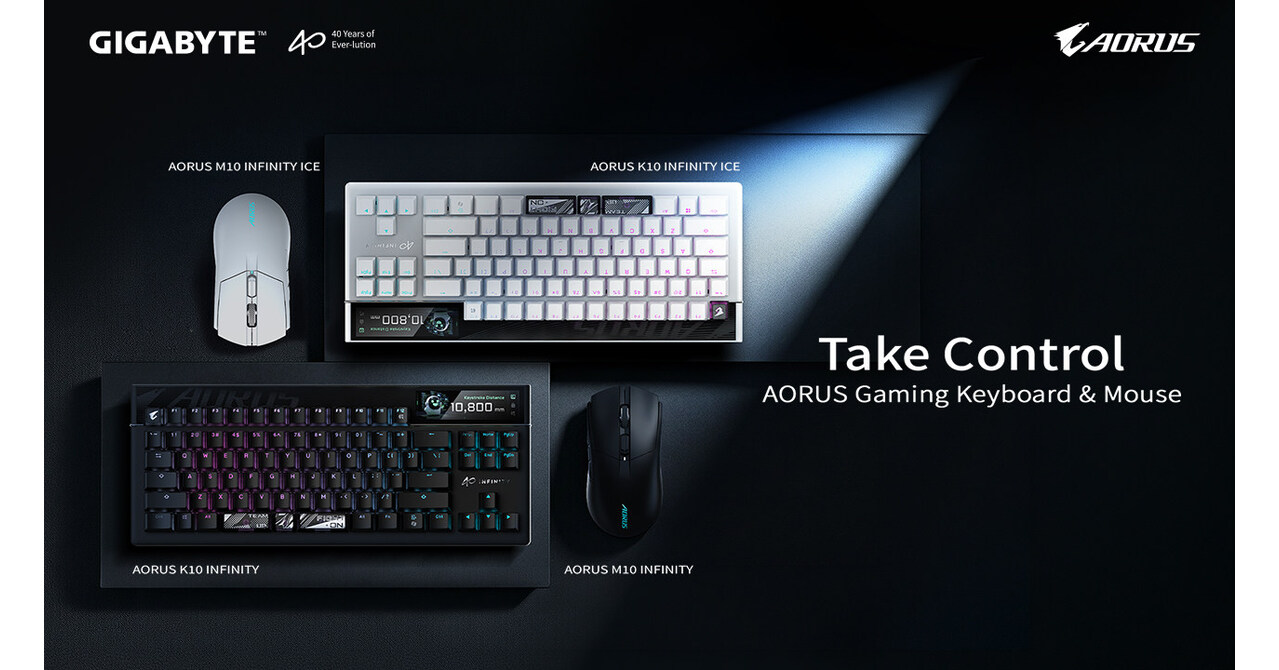
GIGABYTE Unveils Next-Generation Gaming Peripherals with AORUS K10 INFINITY Keyboard and M10 INFINITY Mouse at COMPUTEX 2026 – PR Newswire UK
The landscape of high-performance computing shifted significantly this week as GIGABYTE took center stage at COMPUTEX 2026. Marking a monumental 40th anniversary, the company didn’t just release a few updated components; it unveiled a comprehensive vision for the future of the gaming and AI ecosystem. The headline of the event, GIGABYTE Unveils Next-Generation Gaming Peripherals with AORUS K10 INFINITY Keyboard and M10 INFINITY Mouse at COMPUTEX 2026 – PR Newswire UK, signals a strategic pivot toward “Infinity” branding—a design philosophy that blends extreme performance with luxury materials and AI-driven utility.
For the enthusiast community, this announcement represents more than just a hardware refresh. By introducing the AORUS K10 and M10 Infinity series alongside a suite of “halo” products—including 3D-printed motherboards and wood-accented GPUs—GIGABYTE is attempting to redefine the “ultra-premium” segment. This move comes at a time when the line between professional workstations and gaming rigs is blurring, driven largely by the local execution of Large Language Models (LLMs) and the demand for hyper-personalized aesthetics.
The Crown Jewels: AORUS K10 INFINITY Keyboard and M10 INFINITY Mouse
At the heart of the peripheral announcement are the K10 and M10 Infinity devices. While GIGABYTE has long been a respected name in motherboards and graphics, the “Infinity” line represents an aggressive push to capture the high-end peripheral market, currently dominated by a handful of specialized gaming brands.
AORUS K10 INFINITY: Redefining Tactile Precision
The K10 INFINITY is not merely a keyboard; We see positioned as a centerpiece for the modern battle station. Early insights suggest that the “Infinity” moniker refers to the keyboard’s modularity and its integration with a wider software ecosystem. Key highlights include:
- Hybrid Switch Technology: A new generation of switches designed to bridge the gap between the instantaneous response of optical sensors and the satisfying tactile feedback of mechanical keys.
- Sustainable Luxury: In line with the broader Infinity theme, the K10 incorporates premium materials that move away from the “all-plastic” era of gaming gear, utilizing reinforced alloys and high-grade finishes.
- Deep Ecosystem Integration: The keyboard acts as a hub for the AORUS ecosystem, allowing users to map complex AI macros that can trigger system-wide optimizations across their motherboard, and GPU.
AORUS M10 INFINITY: The Pinnacle of Sensor Accuracy
Complementing the keyboard is the M10 INFINITY mouse, a device engineered for the most demanding eSports environments. The M10 focuses on the reduction of “input lag” to near-zero levels, utilizing a proprietary wireless protocol that rivals wired connections in stability and speed.
The M10 features a lightweight chassis that doesn’t sacrifice structural integrity, utilizing advanced composites. Its sensor is designed for “infinity tracking,” meaning it maintains perfect precision across virtually any surface, including glass and polished wood—a nod to the aesthetic themes seen in GIGABYTE’s other 40th-anniversary products.
“The Infinity series is not about incremental updates; it is about establishing a new ceiling for what gaming hardware can be. We are merging the raw power of AORUS with a level of craftsmanship previously reserved for luxury timepieces or high-end automotive interiors.”
The Infinity Ecosystem: Beyond Peripherals
While the peripherals captured the immediate attention of the gaming crowd, the broader “Infinity” rollout revealed a cohesive strategy to dominate the high-end PC market. GIGABYTE is leveraging its 40th anniversary to showcase “halo” products that push the boundaries of industrial design.
The X870 Infinity Next: A Masterpiece of Engineering
Perhaps the most shocking reveal was the X870 Infinity Next motherboard. Described by some as the most extreme consumer board ever conceived, it features metal 3D-printed elements. This is not merely for aesthetics; 3D printing allows for complex thermal geometries that are impossible with traditional stamping or casting, leading to superior heat dissipation for the VRMs (Voltage Regulator Modules) required by next-gen CPUs.
The Convergence of Nature and Tech: Infinity Wood and AERO Dark Wood
In a surprising stylistic shift, GIGABYTE introduced the RTX 5080 AORUS Infinity Wood graphics card and the AERO Dark Wood series. This “Organic Tech” trend reflects a growing desire among enthusiasts for “warm” aesthetics in an increasingly sterile digital world. By integrating real wood accents into the shrouds of GPUs and motherboards, GIGABYTE is targeting the “executive gamer” and the high-end creative professional who wants a machine that looks as good in a living room as it does in a gaming den.
| Product Line | Key Innovation | Target Audience |
|---|---|---|
| AORUS K10/M10 | Infinity Ecosystem Integration | Competitive Gamers / Enthusiasts |
| X870 Infinity Next | 3D-Printed Metal Components | Extreme Overclockers / Tech Early Adopters |
| RTX 5080 Wood | Organic Aesthetic / Premium Cooling | Luxury PC Builders / Creators |
| AI TOP Ecosystem | Local 405B LLM Support | AI Researchers / Enterprise Devs |
The AI Pivot: Introducing the ‘AI TOP’ Desktop Ecosystem
The most significant strategic move unveiled at COMPUTEX 2026 is the launch of the AI TOP ecosystem. GIGABYTE is recognizing that the next frontier of computing isn’t just higher frame rates in games, but the ability to run massive AI models locally without relying on the cloud.
Radeon AI PRO R9700: The LLM Powerhouse
Central to the AI TOP ecosystem is the Radeon AI PRO R9700 workstation. This is a specialized piece of hardware designed specifically for the execution of Large Language Models (LLMs). GIGABYTE claims this system can support models with up to 405 billion parameters.
To put this in perspective, most consumer-grade AI setups struggle with models over 70 billion parameters. By providing the memory bandwidth and VRAM necessary to handle a 405B model, GIGABYTE is positioning the AI TOP as a direct competitor to enterprise-grade server racks, but in a form factor that fits under a desk. This allows developers to iterate on AI agents, fine-tune models, and maintain data privacy by keeping everything on-premises.
This shift suggests that GIGABYTE views the “gamer” of 2026 not just as someone who plays titles like Cyberpunk or Call of Duty, but as a “power user” who uses AI to automate their workflow, generate assets, or manage complex data sets. For more on this transition, you might find a related explainer on the rise of local LLM hardware useful.
Industry Implications: Why This Matters Now
The timing of these releases is not accidental. As we enter the mid-2020s, the hardware industry is facing a plateau in traditional performance gains. To continue growing, manufacturers must find new value propositions. GIGABYTE is attacking this from three angles:
- Material Innovation: Using 3D-printed metals and natural woods to move hardware from “commodity” to “luxury.”
- Vertical Integration: Creating a seamless link between the mouse, keyboard, motherboard, and GPU (the Infinity Ecosystem) to increase brand loyalty.
- AI Democratization: Moving AI power from the cloud (OpenAI, Google) to the desktop (AI TOP), giving users total control over their intelligence tools.
Addressing Common Misconceptions
A common critique of “luxury” hardware is that aesthetic changes like wood accents or 3D-printed shrouds are “gimmicks” that don’t improve performance. However, in the case of the X870 Infinity Next, the 3D printing is fundamentally tied to thermal efficiency. The shift toward “Dark Wood” aesthetics is a response to the “RGB fatigue” currently sweeping the community, where users are moving away from neon lights in favor of sophisticated, muted tones.
The Road Ahead for AORUS and GIGABYTE
The announcements at COMPUTEX 2026 signal a company that is confident in its longevity. By celebrating 40 years with a leap into AI workstations and luxury peripherals, GIGABYTE is ensuring it isn’t pigeonholed as just a component vendor. The AORUS K10 and M10 Infinity devices are the first touchpoints of a larger strategy to own the entire user interface of the PC.
The success of this venture will depend on the software. Hardware is only as “infinite” as the software that controls it. If GIGABYTE can deliver a unified driver suite that truly leverages the AI TOP ecosystem to optimize the K10 and M10 peripherals in real-time, they may well set a new industry standard for the next decade.
Quick-Reference Summary of the 2026 Launch
- Primary Focus: 40th Anniversary “Infinity” Theme.
- Peripheral Highlights: AORUS K10 (Keyboard) and M10 (Mouse) featuring high-end materials and ecosystem synergy.
- Hardware Innovations: X870 Infinity Next (3D-printed metal) and RTX 5080 Wood (Organic design).
- AI Breakthrough: AI TOP ecosystem with Radeon AI PRO R9700 supporting 405B parameter LLMs.
- Design Trend: Transition from RGB-heavy designs to “AERO Dark Wood” and luxury finishes.
Frequently Asked Questions
What makes the AORUS K10 and M10 “Infinity” peripherals different from standard gaming gear?
The Infinity series focuses on a combination of luxury materials, extreme precision, and deep integration with the rest of the GIGABYTE ecosystem. Unlike standard peripherals, these are designed to work in tandem with AI TOP hardware to provide system-wide optimizations and are built with a level of craftsmanship meant to last for years, moving away from the disposable nature of many gaming peripherals.
Can the AI TOP system actually run a 405B parameter LLM?
Yes, according to GIGABYTE, the Radeon AI PRO R9700 workstation is specifically engineered with the VRAM and memory throughput required to host models of that scale. This is a significant jump from typical consumer GPUs, which usually require model quantization (reducing quality) to fit large LLMs into memory.
Is the “Infinity Wood” design just for looks, or does it help with performance?
While the wood accents are primarily an aesthetic choice aimed at the luxury and creative markets, they are integrated into shrouds that maintain high-performance cooling standards. In the case of the X870 Infinity Next motherboard, the 3D-printed metal elements specifically improve thermal management, proving that the “Infinity” design philosophy blends form and function.
When will the AORUS K10 INFINITY and M10 INFINITY be available for purchase?
While official dates are typically finalized after the COMPUTEX showcases, these products are expected to roll out in phases throughout the second half of 2026. Interested users should monitor official AORUS channels for regional availability and pricing.
Does the X870 Infinity Next support standard AMD CPUs?
Yes, the X870 chipset is designed for compatibility with the latest AMD Ryzen processors. The “Infinity Next” designation refers to the extreme power delivery and cooling capabilities of the board, making it ideal for those pushing their CPUs to the absolute limit via overclocking.
