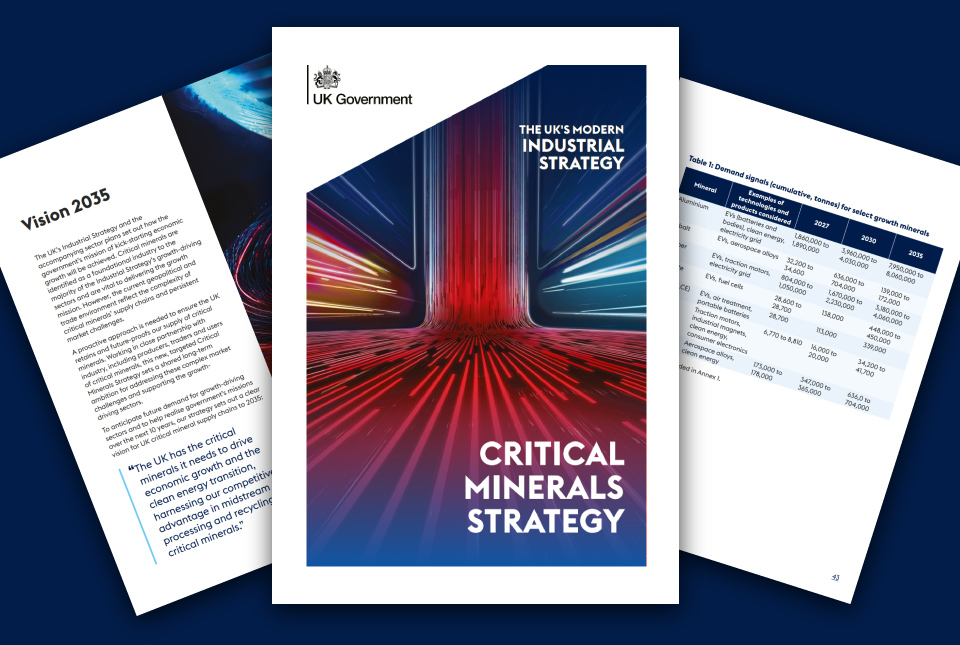
UK to Invest $66 Million in Critical Minerals to Reduce Import Reliance – Reuters
The UK government is allocating $66 million toward the procurement and development of critical minerals to lower its dependence on foreign imports, according to Reuters. This investment aims to strengthen national economic resilience and stabilize supply chains for essential metals required for green technology and defense, as detailed by GOV.UK.
Why is the UK investing $66 million in critical minerals?
The primary objective of the $66 million investment is to mitigate the risks associated with a heavy reliance on overseas suppliers for minerals essential to modern industry. According to GOV.UK, the funding is designed to boost economic resilience by ensuring a more secure and diversified supply of materials that are vital for national security and the transition to a net-zero economy.
Critical minerals—which typically include elements like lithium, cobalt, and rare earth elements—are indispensable for the production of electric vehicle batteries, wind turbines, and advanced military hardware. By investing in these resources, the UK intends to reduce the vulnerability of its domestic industries to geopolitical volatility and supply chain disruptions.
The strategy focuses on several key pillars:
- Diversification: Reducing the dominance of a few global suppliers in the mineral market.
- Domestic Capability: Exploring and enhancing the UK’s own capacity to extract and process minerals.
- Supply Chain Stability: Creating a buffer against price spikes and export restrictions imposed by foreign nations.
How does this investment align with UK economic resilience?
According to GOV.UK, the move to secure critical minerals is a direct effort to shield the UK economy from external shocks. When a nation relies almost entirely on imports for materials required for its energy transition, any trade dispute or political instability in the exporting country can lead to manufacturing delays and increased costs.
Industry analysis from the UK Mining Conference, as reported by International Mining, suggests that the scale of the opportunity to meet rising demand for metals and minerals is significant. The conference highlighted that developing a domestic or more secure mineral strategy does more than just secure materials; it potentially creates high-skilled jobs in mining, refining, and geological surveying.
The IOM3 report on delivering the vision for UK critical minerals supply emphasizes that a coordinated approach is necessary to move from strategic planning to actual delivery. This involves aligning government funding with industry capacity to ensure that the $66 million investment translates into tangible supply chain improvements.
| Strategic Goal | Mechanism | Intended Outcome |
|---|---|---|
| Reduce Import Reliance | $66 Million Investment | Lower vulnerability to foreign supply shocks |
| Economic Resilience | Diversified Sourcing | Stabilized pricing for green tech components |
| Net-Zero Transition | Secure Mineral Access | Consistent production of EVs and wind turbines |
Will the UK meet its 2035 critical mineral recycling goals?
While the government is investing in procurement and extraction, a significant gap remains in the circular economy. Mining Magazine reports that the UK is “unlikely” to meet its 2035 critical mineral recycling goals. This creates a tension between the goal of reducing import reliance through new investment and the goal of reducing reliance through recycling existing materials.

Recycling critical minerals is often more environmentally sustainable than primary mining, but the infrastructure for large-scale recovery of metals from spent batteries and electronics is not yet fully operational. The report from Mining Magazine suggests that without a drastic increase in recycling infrastructure and policy incentives, the UK will continue to rely on primary extraction—both domestic and foreign—to meet its needs.
The discrepancy between the investment in new supplies and the struggle to meet recycling targets indicates a two-pronged challenge:
- The Extraction Challenge: Finding and mining minerals domestically while meeting environmental standards.
- The Recovery Challenge: Building the industrial capacity to reclaim minerals from waste streams.
Experts at the UK Mining Conference, according to International Mining, noted that the rising demand for these metals is outpacing current recovery rates, making the $66 million investment in supply security a necessary immediate step, even as recycling goals remain elusive.
What is the long-term vision for UK mineral supply?
The long-term vision, as outlined by IOM3, involves a comprehensive framework for delivering a sustainable critical minerals supply. This vision extends beyond simple funding and focuses on the integration of exploration, extraction, and processing within the UK’s industrial strategy.
According to IOM3, the goal is to create a “vision for UK critical minerals supply” that balances economic necessity with environmental stewardship. This includes the development of “green mining” techniques that minimize the ecological footprint of extraction.
Key components of the long-term strategy include:
- Geological Mapping: Utilizing advanced technology to identify untapped mineral deposits within the UK.
- Processing Infrastructure: Investing in refineries so that raw ores do not have to be shipped abroad for processing before returning to the UK as finished products.
- Strategic Partnerships: Forming alliances with “friendly” nations to ensure a steady flow of minerals that cannot be sourced domestically.
The shift toward this model is viewed as a necessity because the demand for minerals is expected to grow exponentially as the UK pushes toward its climate goals. Related explainer on the global critical minerals market provides further context on how other nations are competing for these same resources.
Who are the primary stakeholders in this mineral strategy?
The effort to secure critical minerals involves a complex network of government bodies, private industry, and academic institutions. According to reports from GOV.UK and International Mining, the following stakeholders play central roles:

“The scale of opportunity to meet rising demand for metals and minerals requires a coordinated effort between government funding and private sector agility.” — Insights from the UK Mining Conference via International Mining.
Government Entities
The UK government provides the overarching policy framework and the $66 million in funding. Its role is to set the targets for import reduction and provide the financial incentives necessary to make domestic mining or strategic procurement viable.
Mining and Processing Companies
Private firms are responsible for the actual exploration and extraction. As noted by International Mining, these companies are looking for clear signals from the government that mining is a supported industry in the UK, as regulatory hurdles have historically slowed development.
Environmental Regulators
Because mining can have significant local environmental impacts, regulators must balance the need for critical minerals with the protection of biodiversity and water quality. This balance is a core part of the IOM3 vision for sustainable supply.
Technology Manufacturers
Companies producing electric vehicles (EVs) and renewable energy hardware are the end-users. Their need for price stability and guaranteed supply is what drives the government’s push for economic resilience.
Comparing Investment vs. Recycling: The Strategic Gap
There is a notable contrast in how the UK is approaching its mineral needs. On one hand, the government is deploying capital to secure new supplies; on the other, it is falling behind on its goals to reuse what it already has. This creates a strategic gap that could leave the UK vulnerable if new supply chains are not established quickly.
The Reuters report focuses on the immediate financial injection ($66 million), while Mining Magazine focuses on the long-term systemic failure (the 2035 recycling goals). If the UK cannot bridge this gap, it may find that even with increased investment, it remains dependent on imports because the “leakage” of minerals through waste is too high.
To address this, the IOM3 framework suggests that the vision for supply must include a “circularity” component where the $66 million investment also supports technologies that make recycling more economically viable. Without this integration, the UK risks spending millions to replace materials that it could have recovered domestically.
Related analysis of UK green energy targets explores how mineral shortages could potentially delay the rollout of wind and solar infrastructure.
Frequently Asked Questions
What are critical minerals?
Critical minerals are raw materials—such as lithium, cobalt, graphite, and rare earth elements—that are essential for modern technology and national security but are subject to high supply chain risk. According to GOV.UK, these are vital for the transition to net-zero emissions.

How will the $66 million be used?
According to Reuters and GOV.UK, the funds are intended to secure critical mineral supplies, boost economic resilience, and reduce the UK’s reliance on imports from potentially unstable or monopolistic foreign sources.
Why is the UK unlikely to meet its 2035 recycling goals?
Mining Magazine indicates that the UK lacks the necessary industrial infrastructure and policy frameworks to recover critical minerals from waste at the scale required to meet the 2035 targets.
Which industries benefit most from this investment?
The primary beneficiaries are the green energy sector (EV battery manufacturers, wind turbine producers) and the defense industry, both of which rely on these minerals for high-tech components.
Is the UK mining these minerals domestically?
While the UK has some domestic deposits, the strategy involves a mix of domestic extraction, strategic procurement, and diversifying import sources to ensure a stable supply, as highlighted by International Mining and IOM3.
