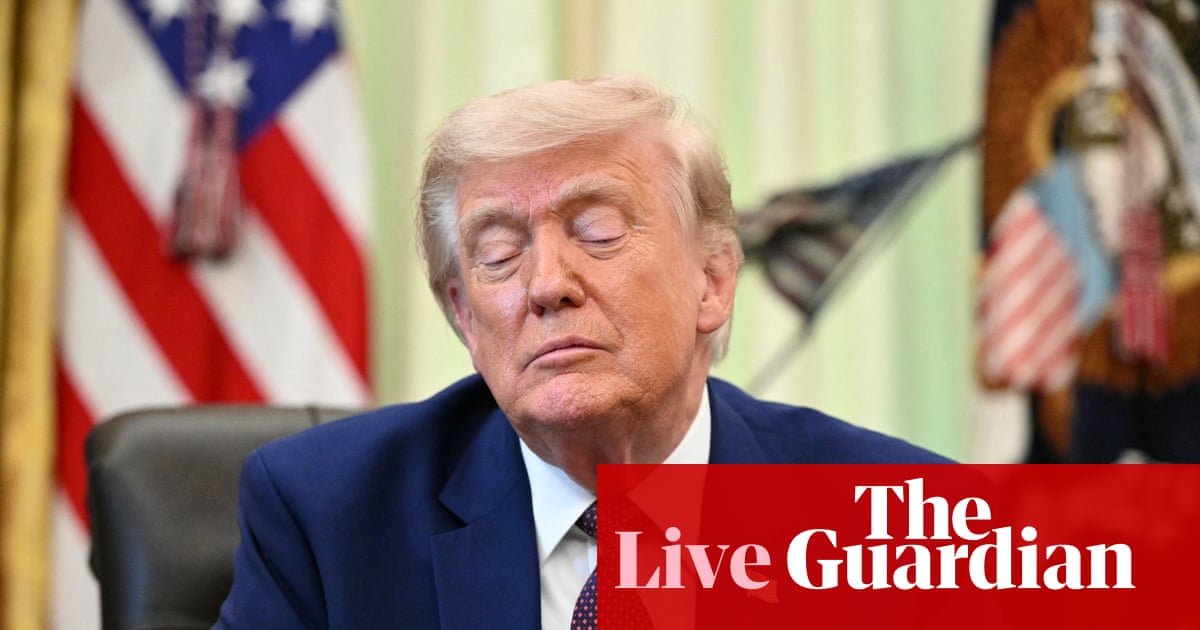
Donald Trump attacks his own party members as ‘unpatriotic’ after war powers resolution vote in House – US politics live – The Guardian
In a stark demonstration of the friction between executive ambition and legislative oversight, the political landscape in Washington D.C. Has shifted following a contentious vote in the House of Representatives. The core of the conflict centers on the War Powers Resolution, a legislative mechanism designed to limit the President’s ability to commit U.S. Forces to hostilities without explicit Congressional approval. When a group of Republicans broke ranks to support a resolution restricting military action against Iran, the reaction from the White House was swift and scathing.
The event, which has sparked widespread debate under the banner of Donald Trump attacks his own party members as ‘unpatriotic’ after war powers resolution vote in House – US politics live – The Guardian, highlights a deepening divide within the Republican Party. For the first time in recent memory, the perceived monolithic loyalty of the GOP toward the President has shown visible cracks, particularly regarding the use of military force and the constitutional balance of power.
The Legislative Clash: The War Powers Resolution Vote
The House of Representatives recently held a pivotal vote on a resolution aimed at blocking the administration from ordering further strikes on Iran. This move was not merely a policy disagreement but a direct challenge to the President’s authority to conduct foreign policy and military operations unilaterally. The resolution sought to assert the Congressional right to determine when and where the United States enters into a state of conflict.
While the administration argued that the President requires maximum flexibility to respond to threats from Tehran, a bipartisan coalition—including a surprising number of Republicans—argued that the risk of an unplanned escalation into a full-scale war was too high. The resulting vote to limit these powers served as a formal rebuke of the administration’s approach to the Iran crisis.
Key Details of the House Vote
- Objective: To restrict the executive branch from initiating further military strikes against Iranian targets without Congressional authorization.
- The Outcome: The resolution passed, signaling a rare moment of bipartisan agreement to curb presidential war powers.
- The Defection: A significant number of Republicans voted against the President’s wishes, prioritizing legislative oversight over party loyalty.
“The tension between the executive’s desire for agility in warfare and the legislature’s duty to prevent unnecessary conflict has reached a boiling point, manifesting in a public rift within the Republican party.”
The Rhetorical Fallout: ‘Unpatriotic’ and ‘Bad Republicans’
Following the vote, the President did not mince words. In a series of public statements and social media posts, he targeted the Republicans who voted in favor of the resolution, labeling them as “unpatriotic” and “bad Republicans.” This rhetoric marks a significant escalation in how the administration handles internal party dissent.
By framing a vote for legislative oversight as an act of disloyalty to the country, the President attempted to shift the narrative from a constitutional debate to a question of patriotism. This strategy has been a hallmark of the administration’s approach to critics, but applying it to his own party members in the House suggests a growing frustration with the limits of his influence over Congress.
The labeling of these members as “bad Republicans” serves a dual purpose: it alienates the dissenters from the party base and signals to other wavering members that breaking ranks will result in public condemnation. However, for the lawmakers involved, the decision to vote against the President was often framed as a commitment to the Constitution and a desire to avoid a protracted conflict in the Middle East.
Understanding the War Powers Act of 1973
To understand why this vote was so contentious, one must look at the history of the War Powers Resolution of 1973. Born out of the trauma of the Vietnam War, the Act was designed to ensure that the President could not engage the U.S. In a “forever war” without the consent of the people’s representatives.
Under the Act, the President can deploy troops in an emergency, but must notify Congress within 48 hours. The forces must be withdrawn within 60 to 90 days unless Congress grants an extension or declares war. The current struggle is a modern iteration of this historical tension: the President views these restrictions as “shackles” that hinder national security, while critics view them as the only safeguard against executive overreach.
| Perspective | Argument for Executive Power | Argument for Congressional Oversight |
|---|---|---|
| National Security | Rapid response is required to deter adversaries. | Unilateral action can lead to unplanned escalations. |
| Constitutional Role | The President is the Commander-in-Chief. | Only Congress has the formal power to declare war. |
| Political Risk | Appearing “weak” to foreign enemies. | Entering a conflict without public/legislative mandate. |
The Geopolitical Context: The Iran Crisis
The legislative battle is inseparable from the volatile relationship between the United States and Iran. The administration’s “maximum pressure” campaign, characterized by heavy sanctions and the assassination of key Iranian military leaders, had pushed the two nations to the brink of direct conflict.
The Republicans who broke with the President were largely motivated by the fear that a few more strikes could trigger a retaliatory cycle that would draw the U.S. Into another major war in the Middle East. These members argued that while the threat from Iran is real, the solution should be a coordinated national strategy rather than a series of unilateral executive decisions.
This split reveals a burgeoning divide within the GOP: the “populist/loyalist” wing, which supports the President’s instinctual approach to foreign policy, and the “traditionalist/institutionalist” wing, which remains wary of interventionism and values the checks and balances of the U.S. Government.
Analysis: A Weakening Grip on Congress?
For much of his tenure, the President has enjoyed an unprecedented level of support from his party in Congress. However, the Donald Trump attacks his own party members as ‘unpatriotic’ after war powers resolution vote in House – US politics live – The Guardian incident suggests that this grip may be loosening. This is not an isolated event but part of a broader “legislative losing streak” where the administration has struggled to pass key priorities or maintain total party unity.
Factors Contributing to the Erosion of Influence:
- Constitutional Anxiety: A growing number of lawmakers are concerned about the long-term precedents set by expanding executive power.
- Electoral Concerns: Moderate Republicans in “swing” districts may fear that being seen as “warmongers” could hurt their reelection prospects.
- Policy Divergence: The shift toward a more isolationist “America First” policy has clashed with the traditional neoconservative instincts of some GOP veterans.
When a President begins to publicly attack his own party members as “unpatriotic,” it often indicates that the internal mechanisms of persuasion—private meetings, political favors, and party discipline—are no longer sufficient. The transition to public shaming is a high-risk strategy that can either cow the opposition into submission or further alienate the very people the President needs to pass legislation.
Common Misconceptions Regarding War Powers
In the wake of this news, several misconceptions have surfaced regarding how war powers actually function in the United States. Clarifying these points is essential for a nuanced understanding of the current crisis.

Misconception 1: The President cannot act without Congress.
In reality, the President has significant leeway to conduct “limited” military operations and strikes under the guise of national defense or counter-terrorism. The War Powers Resolution is an attempt to define what “limited” means, but It’s frequently ignored or bypassed by administrations of both parties.
Misconception 2: A vote against the President is a vote for the enemy.
The Republicans who voted for the resolution did not express support for the Iranian government. Rather, they expressed a preference for a legal and collective process for initiating war. Their vote was a statement on process, not a statement on adversaries.
Misconception 3: The War Powers Resolution is a “suggestion.”
While the executive branch often treats the Act as optional, a formal resolution passed by the House and Senate carries immense political weight and can lead to the withholding of funding for military operations, effectively forcing the President’s hand.
Historical Parallels: Presidents vs. Their Parties
The current friction is not without historical precedent. The U.S. Political system is designed to create tension between the branches of government, and occasionally, that tension spills over into party infighting.
Similar dynamics were seen during the Lyndon B. Johnson era during the Vietnam War, where the “Gulf of Tonkin Resolution” initially gave the President broad powers, only for Congress to later attempt to claw those powers back as the conflict spiraled. The difference today is the public nature of the conflict. In previous eras, these battles were fought in smoke-filled rooms or through formal legislative debates. Today, the conflict is played out in real-time on social media, with the President directly engaging his critics in a way that bypasses traditional party leadership.
This shift toward “digital warfare” within a party changes the stakes. When a member of Congress is labeled “unpatriotic” in front of millions of followers, it becomes a personal and professional attack that transcends policy disagreement.
Frequently Asked Questions
Why did Donald Trump call some Republicans ‘unpatriotic’?
The President used this term because several members of his own party voted in favor of a House resolution that limited his authority to launch military strikes against Iran. He views any attempt to restrict his command as Commander-in-Chief during a national security crisis as a betrayal of the country’s interests.
What is the War Powers Resolution?
The War Powers Resolution is a federal law intended to check the U.S. President’s power to commit the United States to an armed conflict without the consent of the U.S. Congress. It requires the president to notify Congress within 48 hours of committing armed forces and limits their stay to 60-90 days without legislative authorization.
Did the House successfully block the President from striking Iran?
The House voted to pass a resolution that would restrict further strikes. However, the legal effectiveness of such a resolution often depends on whether it passes the Senate and is signed into law, or if it is used as a basis to block funding for such operations.
Is this a common occurrence in US politics?
While disagreements between a President and Congress are common, it is relatively rare for a President to publicly attack his own party’s members as “unpatriotic” over a specific legislative vote. This indicates a high level of tension and a breakdown in traditional party discipline.
What are the implications for the US-Iran relationship?
The internal US struggle suggests a lack of a unified national strategy. This uncertainty can be interpreted by adversaries as a sign of weakness or instability, potentially emboldening Iran, or conversely, it may signal to Tehran that the U.S. Is hesitant to enter a full-scale war.
The Path Forward for the GOP and the Executive
As the administration continues to navigate this legislative minefield, the central question remains: can the President maintain his coalition if he continues to weaponize patriotism against his own allies? The “unpatriotic” label is a powerful tool, but its efficacy diminishes if the dissenters feel they are defending a higher principle—the Constitution.
The coming months will likely see a continued tug-of-war between the White House and the Capitol. If the President continues to face losses on key votes, he may be forced to either moderate his approach or double down on his rhetoric to purge the “bad Republicans” from his inner circle. Meanwhile, the members of the GOP who broke ranks have set a precedent that party loyalty has its limits, especially when the prospect of war is on the table.
Observers should watch for upcoming budget votes and further foreign policy resolutions, as these will serve as the true litmus test for the President’s remaining influence over the House. The struggle over the War Powers Resolution is not just a dispute over Iran; it is a fundamental battle over who truly holds the keys to American warfare in the 21st century.
