What Famous Historic Battle is Depicted in the Bayeux Tapestry?
The Bayeux Tapestry depicts the Battle of Hastings, fought on October 14, 1066. This monumental embroidery chronicles the Norman Conquest of England, detailing the conflict between William, Duke of Normandy, and King Harold Godwinson, an event that fundamentally altered the political, social, and linguistic trajectory of England.
The Battle of Hastings: The Core Narrative
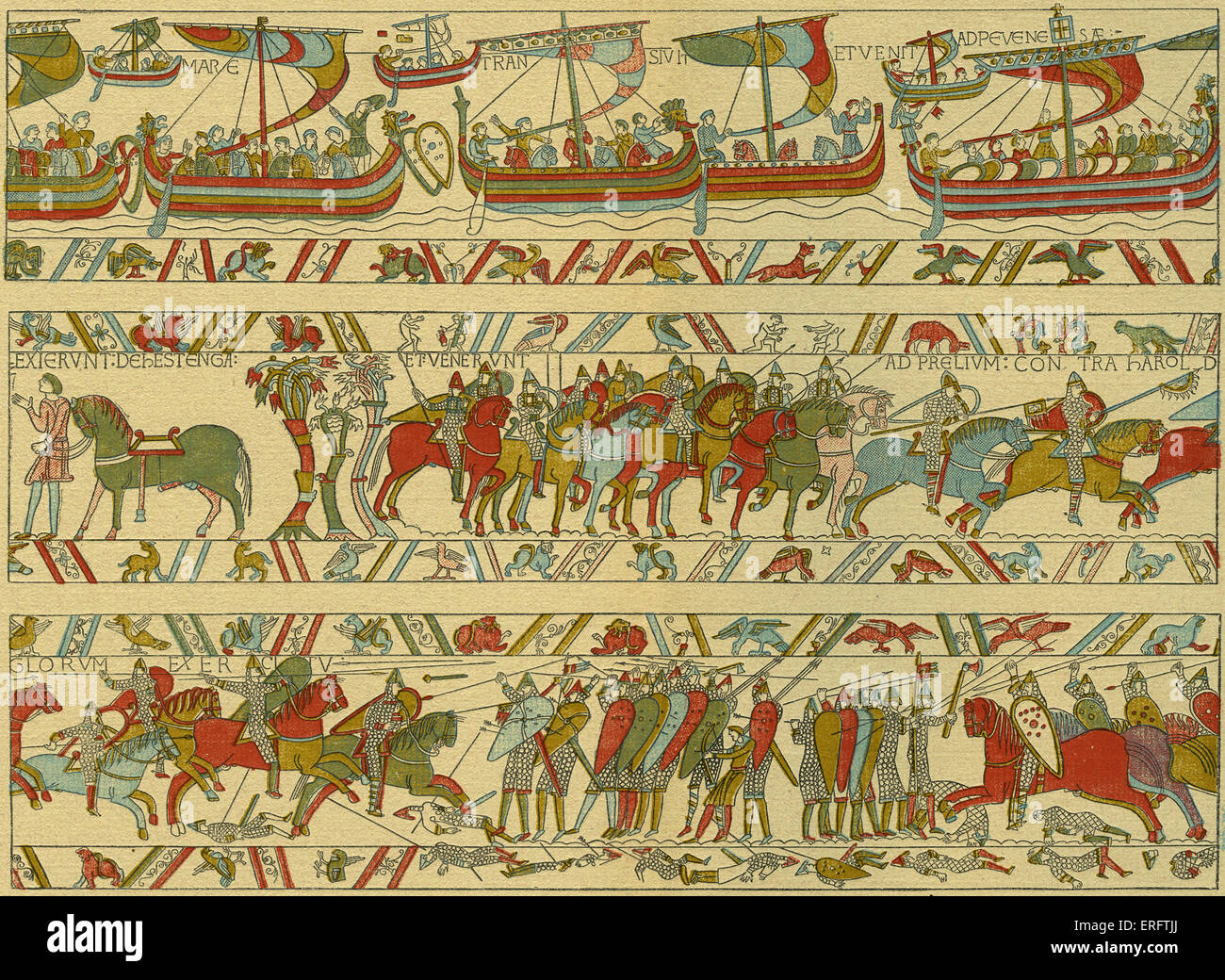
The climax of the Bayeux Tapestry focuses on the Battle of Hastings, a decisive engagement that ended Anglo-Saxon rule in England. According to historical records and the visual narrative of the cloth, the battle took place at Senlac Hill, near the town of Hastings. The conflict pitted the invading Norman-French army, led by William the Conqueror, against the English forces under King Harold Godwinson.
The tapestry captures the brutal reality of 11th-century warfare. It shows the English army forming a “shield wall,” a dense formation of overlapping shields that provided a formidable defense against Norman attacks. For much of the day, the Norman infantry and cavalry struggled to break this line. Historians note that the tide turned when the Normans employed “feigned retreats,” tricking the English into breaking their formation to pursue them, which left the Anglo-Saxons vulnerable to cavalry charges.
The most famous image in the sequence is the death of King Harold. The tapestry depicts a figure—widely identified as Harold—with an arrow in his eye, though some scholars suggest this may be a later restoration or a symbolic representation of his fall. The death of the king led to the collapse of the English army and the victory of William, who was crowned King of England on Christmas Day, 1066.
| Key Detail | Anglo-Saxon Forces | Norman Forces |
|---|---|---|
| Leader | King Harold Godwinson | William, Duke of Normandy |
| Primary Tactic | Shield Wall | Cavalry and Archery |
| Outcome | Defeated / King Killed | Victorious / Established Dynasty |
| Core Objective | Defend the English Throne | Claim the English Throne |
The Sequence of Events Leading to the Conflict
While the battle is the centerpiece, the tapestry functions as a linear storyboard. It does not begin with the battle but with the political intrigue that made the war inevitable. The narrative begins with the relationship between Edward the Confessor, the childless King of England, and William of Normandy.
The Broken Oath
A central theme of the artwork is the concept of legitimacy. The tapestry depicts Harold Godwinson traveling to Normandy, where he purportedly swears a sacred oath on holy relics to support William’s claim to the English throne. According to the Norman perspective presented in the embroidery, Harold’s subsequent acceptance of the crown upon Edward’s death in January 1066 was an act of perjury.
The Omen of Halley’s Comet
The tapestry includes a depiction of a “hairy star,” which historians identify as Halley’s Comet, appearing in 1066. In the medieval mind, such an event was not a scientific phenomenon but a divine omen. The artwork shows the English populace gazing at the comet with apprehension, interpreting it as a sign of impending doom for King Harold.
The Crossing of the Channel
The narrative details the logistical feat of the Norman invasion. It shows the construction of a massive fleet of ships, the transporting of horses, and the eventual landing at Pevensey. This section provides historians with rare visual evidence of 11th-century shipbuilding and military organization.
Is the Bayeux Tapestry Actually a Tapestry?
Despite its name, the Bayeux Tapestry is not a tapestry in the technical sense. A true tapestry is woven on a loom, where the design is integrated into the fabric as it is created. The Bayeux piece is actually an embroidery.
According to the Musée de la Tapisserie de Bayeux, the work consists of woolen yarns stitched into a linen backing using a variety of stitches, most notably the “Bayeux stitch” (a form of laid-and-couched work). This distinction is important because it reveals how the piece was produced: as a series of panels stitched by hand, likely by skilled English needleworkers, rather than woven in a commercial workshop.
- Material: Linen cloth with wool embroidery.
- Length: Approximately 68.3 meters (224 feet).
- Height: Roughly 50 centimeters (20 inches).
- Colors: Eight distinct shades of wool, including terracotta, blue-green, and yellow.
Who Commissioned the Artwork and Why?
The tapestry was not created as a neutral historical record but as a piece of political propaganda. Most historians agree that it was commissioned by Bishop Odo of Bayeux, William the Conqueror’s half-brother. Odo appears prominently in the tapestry, often depicted as a leader and organizer of the invasion.
“The Bayeux Tapestry serves as a visual justification for the Norman Conquest, framing William’s invasion not as a foreign aggression, but as the rightful reclamation of a promised throne.”
By emphasizing Harold’s broken oath and the divine signs favoring William, the tapestry sought to legitimize the new regime in the eyes of both the clergy and the nobility. It was likely displayed in the Bayeux Cathedral to remind visitors of the divine will that placed the Normans in power.
Military Insights and Historical Accuracy
The tapestry provides an invaluable window into the military technology of the 11th century. It offers specific details that written chronicles of the time often omit.
Armor and Weaponry
The figures are shown wearing “hauberks”—long shirts of chainmail that protected the torso and thighs. The Normans are depicted as a more diverse force, utilizing archers, infantry, and heavy cavalry. The Anglo-Saxons, conversely, are shown primarily as infantry armed with large kite shields and massive battle-axes, which were capable of cleaving through a horse and rider in a single blow.

The Role of Cavalry
One of the most significant details is the depiction of the Norman cavalry. The tapestry shows the riders sitting atop their horses with high-backed saddles, which allowed them to deliver powerful blows with lances without being knocked backward. This tactical advantage was a key factor in the eventual victory at Hastings.
For those interested in how these tactics compare to later medieval warfare, a related explainer on the evolution of medieval armor provides further context on the transition from chainmail to plate.
Common Misconceptions About the Narrative
Because the tapestry is often used as a primary source for school children and history students, several misconceptions have persisted over time.
The “Arrow in the Eye” Debate
The image of Harold being struck in the eye by an arrow is the most iconic part of the work. However, some art historians argue that the arrow was added during a later restoration. They point out that the figure immediately next to the “arrowed” Harold also appears to be falling, and that some versions of the story suggest Harold was actually hacked to death by a squad of Norman knights.
The Perspective of the “Loser”
While the tapestry is a Norman production, some scholars argue that the English embroiderers who actually stitched the cloth may have inserted subtle “Easter eggs” or critiques of the Normans. They suggest that the depiction of the English as courageous and disciplined in their shield wall was a nod to the skill of the Anglo-Saxons, even if the overall narrative favored William.
Preservation and the Tapestry’s Survival
The survival of a 1,000-year-old piece of linen is a rarity. The tapestry has survived fires, the French Revolution, and the threat of Nazi seizure during World War II.
During the French Revolution, there were reports that the tapestry was nearly used as a curtain for a local carriage or discarded as a relic of the aristocracy. It was eventually recognized as a national treasure and placed under state protection. Today, it is housed in a climate-controlled environment in Bayeux, Normandy, where light levels and humidity are strictly monitored to prevent the linen from decaying.
The museum uses specialized lighting to prevent the organic dyes of the wool from fading, ensuring that the terracotta and blue hues remain visible for future generations.
The Broader Impact of the Norman Conquest
The victory at the Battle of Hastings, as depicted in the tapestry, did more than just change the king of England. It triggered a total overhaul of English society.
Language and Culture
The imposition of Norman-French as the language of the court, law, and administration led to a linguistic blend. Over centuries, Old English merged with French to create Middle English. This is why modern English has a dual vocabulary (e.g., the Anglo-Saxon “cow” for the animal and the French “beef” for the meat).
The Feudal System
William introduced a more rigid version of feudalism. He claimed all the land in England as his own and leased it to his loyal Norman barons in exchange for military service. This led to the construction of hundreds of motte-and-bailey castles across the English landscape to maintain control over the hostile local population.
Readers can explore the architectural shift of this era in a related explainer on Norman castle design.
Frequently Asked Questions
What famous historic battle is depicted in the Bayeux Tapestry? – Herald Sun
The tapestry depicts the Battle of Hastings, which took place on October 14, 1066. The battle resulted in the victory of William the Conqueror over King Harold Godwinson, marking the beginning of the Norman Conquest of England.
Is the Bayeux Tapestry a real tapestry?
No, it is technically an embroidery. While a tapestry is woven on a loom, the Bayeux Tapestry consists of woolen yarn stitched onto a linen cloth backing.
How long is the Bayeux Tapestry?
The embroidery is approximately 68.3 meters (about 224 feet) long and roughly 50 centimeters (20 inches) high.
Who made the Bayeux Tapestry?
While it was likely commissioned by Bishop Odo of Bayeux (William the Conqueror’s half-brother), most historians believe the actual stitching was performed by skilled English embroiderers in England.
Where is the Bayeux Tapestry located today?
It is housed in the Musée de la Tapisserie de Bayeux in Bayeux, Normandy, France.
What does the tapestry tell us about 1066?
Beyond the battle itself, it provides visual evidence of 11th-century clothing, shipbuilding, military tactics (such as the shield wall), and the political beliefs of the era, specifically the importance of oaths and divine omens.
