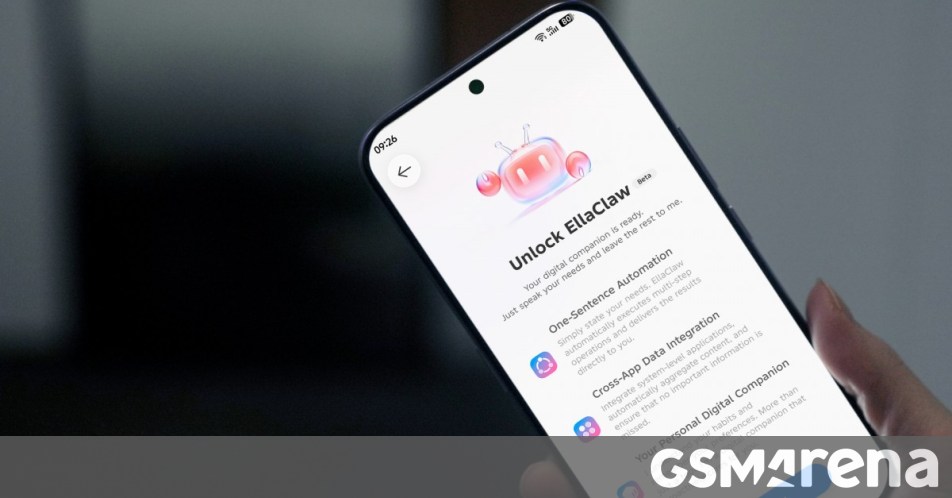
Tecno’s EllaClaw AI agent gains cross-app automation and system-level device optimization
Tecno has updated its EllaClaw AI agent to include cross-app automation and system-level device optimization, according to company specifications. These enhancements allow the AI to execute complex tasks across multiple third-party applications and directly manage hardware resources to improve battery life and processing efficiency.
What are the new capabilities of the EllaClaw AI agent?
The latest update to Tecno’s AI ecosystem transforms EllaClaw from a reactive virtual assistant into an active AI agent. According to Tecno, the primary shift is the move toward “action-oriented” AI. While previous versions focused on answering questions or generating text, the updated EllaClaw can now interact with the device’s user interface to perform tasks on behalf of the user.
Cross-app automation allows the agent to bridge the gap between separate software environments. Instead of a user manually copying information from a messaging app and pasting it into a calendar or ride-sharing service, EllaClaw handles the sequence. The agent interprets the user’s intent, identifies the necessary apps, and executes the required steps across those platforms.
Simultaneously, the agent now possesses system-level permissions. This means EllaClaw does not just sit on top of the operating system but integrates with the kernel and resource manager. It can adjust CPU clock speeds, manage background process hibernation, and optimize RAM allocation based on the user’s current activity and predicted needs.
- Inter-app Coordination: Moving data and triggering actions across different software packages.
- Hardware Governance: Direct control over system resources to prevent overheating and lag.
- Intent Recognition: Using Large Language Models (LLMs) to understand complex, multi-step commands.
- Predictive Optimization: Adjusting system settings before the user launches a resource-heavy application.
How does cross-app automation work in practice?
Cross-app automation relies on a combination of API integrations and UI-level interaction. According to technical documentation, the agent uses a semantic understanding layer to map a user’s natural language request to specific app functions. When a user provides a command involving multiple steps, the AI creates a “task graph” to determine the order of operations.
For example, if a user tells the agent to “Find the flight details in my email and add the hotel address to my maps,” EllaClaw performs several distinct actions. First, it accesses the email client to scan for specific keywords and dates. Second, it extracts the address. Third, it switches context to the navigation app and inputs the destination. This removes the need for the user to navigate the “app-switching” friction that typically defines the smartphone experience.
The transition from a chatbot to an agent marks a shift from providing information to providing utility. The AI no longer tells the user how to do something; it simply does it.
This capability is particularly relevant for productivity workflows. Users can automate repetitive sequences, such as extracting a contact’s phone number from a document and immediately initiating a WhatsApp chat. This reduces the cognitive load on the user and streamlines the interaction between fragmented apps.
| Feature | Traditional AI Assistant | EllaClaw AI Agent |
|---|---|---|
| Interaction | Query and Response | Intent and Action |
| App Boundary | Limited to specific app APIs | Cross-app navigation |
| System Access | User-level permissions | System-level optimization |
| Task Handling | Single-step tasks | Multi-step automation |
Why is system-level device optimization critical?
System-level optimization allows EllaClaw to act as a dynamic governor for the device’s hardware. Most Android skins use static profiles (e.g., “Power Saver” or “Performance Mode”), but Tecno’s implementation uses AI to adjust these parameters in real-time. According to the company, the AI analyzes usage patterns to allocate resources where they are most needed.
One of the core focuses is thermal management. By monitoring temperature sensors and CPU load, EllaClaw can throttle background processes that are not essential to the current task, preventing the device from overheating during intensive gaming or video editing. This ensures that the foreground application maintains a stable frame rate without triggering a drastic system-wide slowdown.
Battery longevity is another primary target. The agent identifies “zombie apps”—applications that consume power in the background without providing active value—and puts them into a deep sleep state. Unlike standard Android battery optimization, which often relies on fixed timers, EllaClaw uses predictive modeling to know when a user is likely to open a specific app, waking it up just before it is needed to avoid launch delays.
Key optimization areas include:
- RAM Management: Clearing cached data from unused apps to make room for heavy workloads.
- CPU Scheduling: Distributing tasks across high-performance and high-efficiency cores more effectively.
- Network Optimization: Managing data polling rates for background apps to reduce modem power consumption.
The broader industry shift toward Agentic AI
Tecno’s move toward an “agentic” model reflects a wider trend across the mobile industry. For years, AI in phones was limited to voice commands (Siri, Google Assistant) or generative text (ChatGPT). However, the industry is now moving toward “Large Action Models” (LAMs) or agents that can manipulate the OS.

This development puts Tecno in direct competition with other ecosystem-level AI efforts. Google is integrating Gemini more deeply into Android to allow it to “see” what is on the screen and take action. Apple is introducing Apple Intelligence to provide “onscreen awareness” and the ability to perform actions across apps. Samsung is similarly enhancing Galaxy AI to bridge the gap between its hardware and software services.
The competitive edge for Tecno lies in its target markets. In regions where mid-range hardware is dominant, system-level optimization is more valuable than in the high-end flagship market. A device with 8GB of RAM benefits significantly more from AI-driven memory management than a device with 16GB. By focusing on optimization alongside automation, Tecno is addressing the specific pain points of its primary user base.
Related explainer on the evolution of Large Action Models (LAMs).
Technical challenges and privacy implications
Implementing cross-app automation introduces significant technical and security hurdles. For an AI agent to move data between apps, it requires broad permissions that could potentially be abused. Tecno has not detailed the exact encryption methods used for this data transit, but the process generally involves a secure “sandbox” where the AI processes the intent before executing the action.
One major challenge is the “brittleness” of UI-based automation. If an app updates its layout or changes the location of a button, an AI agent relying on visual or structural cues might fail. To combat this, Tecno’s EllaClaw likely employs a mix of accessibility services and API hooks, allowing it to identify functions regardless of how they are visually presented on the screen.
Privacy concerns are also paramount. An agent that can read emails, access calendars, and interact with maps has a comprehensive view of a user’s life. The industry standard is moving toward “on-device AI,” where the processing happens locally on the NPU (Neural Processing Unit) rather than in the cloud. This ensures that sensitive data never leaves the device, though the specific balance of local versus cloud processing for EllaClaw remains a point of interest for security analysts.
Common Misconceptions about AI Agents
- Misconception: AI agents are just better chatbots.
Correction: Chatbots communicate; agents execute. A chatbot tells you the weather; an agent sees it will rain and suggests rescheduling your outdoor meeting in your calendar. - Misconception: System optimization is the same as “cleaning” apps.
Correction: Traditional cleaners delete cache files. AI optimization manages the actual behavior of the CPU and RAM in real-time. - Misconception: This requires a high-end flagship phone.
Correction: While NPUs help, many of these optimizations are designed specifically to make mid-range hardware perform like high-end hardware.
Comparing EllaClaw to other mobile AI ecosystems
When viewed alongside competitors, Tecno’s strategy focuses heavily on the intersection of software utility and hardware efficiency. While Google’s Gemini focuses on information retrieval and creativity, and Apple’s Intelligence focuses on personal context, EllaClaw is positioning itself as a “device manager.”
The integration of system-level optimization is a distinguishing factor. Most AI assistants are software layers; they cannot tell the CPU to slow down or the RAM to flush a specific cache. By granting EllaClaw these permissions, Tecno is treating the AI as part of the operating system’s core logic rather than an app that runs on top of it.
This approach mirrors how some gaming-centric phones handle “Game Modes,” where the system kills all background tasks to prioritize a single app. EllaClaw expands this logic to the entire user experience, applying “Game Mode” levels of optimization to daily productivity and general use.
Related explainer on on-device AI vs. cloud-based LLMs.
Potential long-term impact on user behavior
The proliferation of agents like EllaClaw could fundamentally change how users interact with smartphones. The current “app-centric” model requires users to know exactly which app holds which function. If the AI agent becomes the primary interface, the “app” becomes a background utility rather than a destination.
In this future scenario, the user interacts with a single AI layer, and the agent orchestrates the apps in the background. This could lead to a decline in the importance of app UI design, as the AI—not the human—becomes the primary consumer of the interface. For the user, this means a faster, more intuitive experience, but for developers, it means their apps must be “agent-friendly” to remain discoverable.
Furthermore, the emphasis on system-level optimization could extend the lifecycle of smartphones. If AI can effectively manage aging hardware to prevent the “slowdown” typically seen after two years of use, consumers may hold onto their devices longer, shifting the market focus from hardware specs to AI efficiency.
Frequently Asked Questions
What is the difference between EllaClaw and a standard voice assistant?
Standard assistants primarily provide information or perform simple, single-app tasks (like setting a timer). EllaClaw is an AI agent, meaning it can perform multi-step automations across different apps and directly optimize the phone’s hardware, such as managing RAM and CPU usage.
Will cross-app automation slow down my phone?
According to Tecno, the opposite is true. Because EllaClaw includes system-level optimization, it manages resources in real-time to ensure that the AI’s operations do not interfere with system performance. It suppresses unnecessary background tasks to free up resources for the active automation.

Does EllaClaw require an internet connection to work?
While some complex LLM tasks may require cloud processing, many of the system-level optimizations and basic automations are designed to run on-device using the phone’s NPU to ensure speed and privacy.
Which Tecno devices will support the updated EllaClaw?
Tecno typically rolls out these updates to its latest series of smartphones, particularly those with AI-capable chipsets. Users should check for system updates in their device settings to see if the new EllaClaw features are available for their specific model.
Is my data safe when EllaClaw moves information between apps?
The agent uses secure system permissions to handle data. Most modern AI agents are moving toward on-device processing to minimize the risk of data leaks, though users should always review the privacy settings within the AI agent’s menu to control what data the AI can access.
