Google launches $29 Pixel Tag tracker with UWB precision finding
Google's first official Bluetooth item tracker features Ultra Wideband precision locating and a slim capsule shape, though it lacks a built-in keyring attachment.
After years of leaving Android users to look elsewhere for Bluetooth tracking hardware, Google has finally introduced its own official item finder, yet its long-awaited debut comes with an immediate physical drawback. Unveiled at the Made by Google event on Wednesday, 12 August 2026, the $29 Pixel Tag arrives as a direct competitor to Apple's AirTag, promising advanced locating technology and seamless ecosystem integration. However, as Android Authority points out, the device features a baffling structural omission: it completely lacks a built-in hole for attaching it to a keyring, forcing buyers to purchase a separate accessory just to secure it to everyday items.
Despite that design friction, the hardware represents a major step forward for the Android Find Hub network, which taps into a global ecosystem of over a billion active devices according to Google's press release. Working with compatible devices running Android 9 or newer, the tracker allows owners to monitor belongings like wallets, suitcases, and keys directly on a map, share access with up to 10 people, and receive automated alerts if they leave an item behind or if an unknown tag travels alongside them as noted by Mashable Southeast Asia.
Related YouTube video


Locating mechanics go well beyond basic proximity chirps. Digital Trends reports that the device incorporates Bluetooth Channel Sounding — requiring Android 16 and Bluetooth 6.0 — which measures distance using radio phase shifts rather than standard signal strength to achieve sub-meter accuracy while resisting relay attacks. Additionally, the tag supports Ultra Wideband (UWB) for directional Precision Finding as highlighted by Android Authority, generating on-screen directional arrows that guide users directly to misplaced objects rather than forcing a frustrating game of hot-and-cold. An internal accelerometer also detects motion changes, while a built-in speaker lets users ring the tracker via compatible Pixel Watch models, Pixel Buds, or connected phones according to Android Authority.
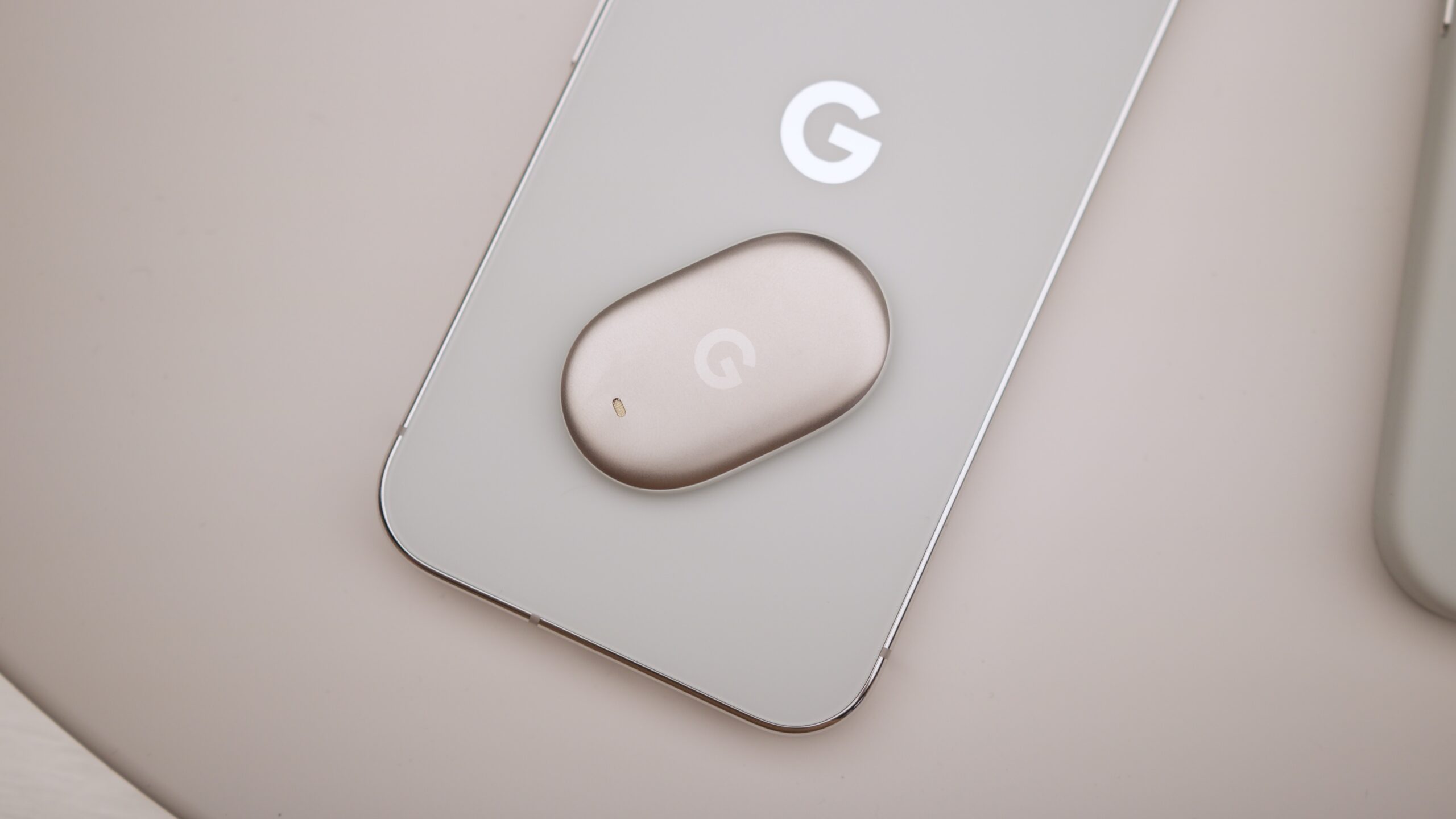
Physically, the Pixel Tag departs sharply from the coin-shaped silhouettes common to the category. Techcrunch notes that Google opted for an elongated capsule measuring 1.8 inches high and 1.1 inches wide. Digital Trends specifies precise dimensions of 46.1mm by 28mm with a thickness of just 5.4mm, roughly a third slimmer than competing devices, allowing it to slip easily into passport sleeves or tight wallets. Formed from a soft Fog-colored polycarbonate shell with a metal panel on the back stamped with Google's G logo as reported by Digital Trends, the hardware matches the AirTag's 0.4-ounce weight according to TechCrunch and includes an IP67 rating for dust resistance and submersion in up to one meter of water for 30 minutes noted by TechCrunch. Power is supplied by a user-swappable CR2032 coin-cell battery designed to last for over a year according to Android Authority.
Pricing matches market alternatives, retailing at $29 for an individual unit or $99 for a four-pack reported by Android Authority. However, consumers face a distinct wait: while companion hardware from the Made by Google event hits shelves in August, the Pixel Tag is scheduled to launch on November 11 noted by Android Authority, marking the precise moment Android users will finally test whether Google's late entry can genuinely rival Apple.
Network Integration and Market Context
The introduction of the Pixel Tag arrives alongside broader hardware updates across Google's ecosystem. According to Wired, Google has spent the past year actively upgrading its Find Hub network to rival Apple's Find My. The tracking accessory joins a wider product rollout that includes the Pixel 11 smartphone lineup and the Pixel Watch 5, both of which became available for pre-order on Wednesday, 12 August 2026, with in-store sales scheduled for Wednesday, 20 August 2026. The global release strategy highlights Google's push to secure a stronger footing in consumer accessories.
- Compatible with devices running Android 9 or newer, as reported by Mashable Southeast Asia.
- Features Bluetooth connectivity and Ultra Wideband for precision finding, alongside a built-in speaker and replaceable CR2032 battery according to TechCrunch.
- Retails for $29 for an individual unit and $99 for a four-pack reported by Android Authority.
Beyond standard smartphone alerts, the tracker's deep integration allows users to ring the device not only from connected phones but also via Wear OS smartwatches running the Find Hub app, or by asking Gemini through Pixel Buds according to Wired. This multi-device accessibility addresses a major pain point for users who may not have their phones immediately to hand when searching for misplaced belongings.
The next step for consumers eager to test the hardware's real-world reliability will be the official retail release on November 11, 2026, when the tracking devices finally land in stores.
How significant is this development?
Contribute your assessment to the aggregated reader intelligence ledger.
Archypedia is dedicated to independent, evidence-backed reporting. This briefing was synthesized from primary source reporting, corroborated across independent newsrooms, and verified against our Editorial Standards.
Transparency record
Evidence behind this report
This report synthesizes 7 distinct sources. Open the source ledger below to compare the underlying coverage.
- androidauthority.com
- theverge.com
- techcrunch.com
- sea.mashable.com
- digitaltrends.com
- wired.com
- soyacincau.com
Prepared under the Archypedia Editorial Policy by the Niko Vale editorial desk profile. AI-assisted tools may support drafting and verification; public accountability remains with Archypedia. Report an error.