Ancient human DNA recovered from prehistoric cave walls in Iberia
Researchers have successfully recovered ancient human DNA directly from cave walls in Spain and Portugal. This development allows scientists to study prehistoric human presence without relying on skeletal remains.
For the first time, researchers have successfully recovered ancient human DNA directly from the surfaces of cave walls in Spain and Portugal. This development expands the possibilities for archaeological research beyond traditional sources like bones, teeth, and floor sediments. By examining cave walls—some containing prehistoric art and others appearing bare—scientists are gaining new insights into the identity and behavior of ancient cave visitors.
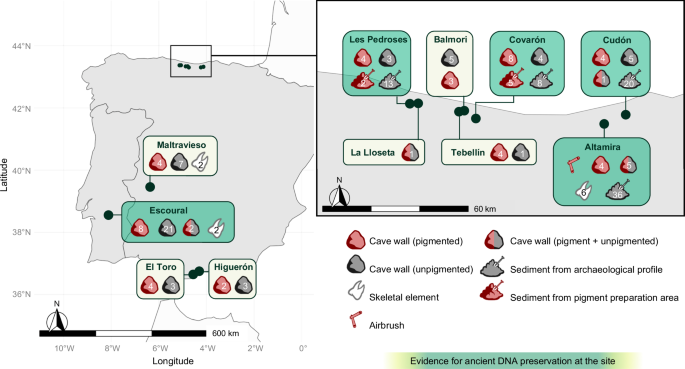
The interdisciplinary effort was conducted under the First Art project, a collaboration involving institutions across Spain, Portugal, the United Kingdom, China, and Germany. The project’s original focus was to date early cave art and analyze its chemical composition, but researchers from the Max Planck Institute for Evolutionary Anthropology extended the scope to include genetic analysis. The team scrutinized 24 rock art panels across 11 caves, collecting 54 samples that included pigmented calcite crusts, unpigmented wall surfaces, and even a prehistoric bird-bone airbrush found at the Cave of Altamira.
Of the collected samples, only five yielded authentic ancient human mitochondrial DNA. A pigmented calcite crust from Panel 11 at Escoural Cave in Portugal proved to be the only sample from a rock art panel to contain human DNA. In a notable finding, this sample was devoid of any animal DNA. The absence of faunal DNA in this sample suggests that the genetic material resulted from direct human contact, such as saliva, sweat, or other bodily fluids left behind when an individual touched or marked the stone.
In contrast, three other unpigmented samples taken from walls at Escoural and Covarón Cave in northern Spain contained mixtures of human and animal DNA. Researchers attribute this to indirect deposition, likely caused by water movement or the transport of sediments. While the team was unable to link the presence of DNA directly to the creation of the cave art, the discovery confirms that genetic signatures can persist on cave walls for thousands of years. Molecular damage patterns indicate that the traces are at least 2,000 years old, with the Escoural samples potentially dating back 4,000 to 5,000 years, based on the history of the site being sealed until 1963.
"This study fundamentally changes how we think about where ancient DNA can be found. We were surprised to see that ancient DNA can be recovered not only from pigmented samples, but also from cave walls that show no visible evidence of past human activity."
Matthias Meyer, senior author and palaeogeneticist at the Max Planck Institute for Evolutionary Anthropology
The study also allowed for specific demographic insights. Nuclear DNA recovered from two samples at Covarón Cave identified the individuals as members of the Western hunter-gatherer genetic cluster. In terms of biological sex, three of the successful samples were derived primarily from females, while one was derived from males; the final sample remains undetermined.
Not all attempts to recover DNA were successful. A bird-bone tool from the Cave of Altamira, historically used to spray red ochre onto cave surfaces, yielded no ancient DNA. Researchers believe this was likely due to extensive contamination from modern human handling over the decades since its discovery, highlighting the extreme fragility of ancient biological evidence.
"Although we cannot directly connect the traces of ancient human DNA we have found to the creation of rock art, this is the first evidence for human DNA preservation on cave walls for thousands of years. It is exciting to think that we may have uncovered a new way to study prehistoric human presence."
Alba Bossoms Mesa, first author and doctoral researcher at the Max Planck Institute for Evolutionary Anthropology
Moving forward, the team plans to refine their sampling methods to increase the success rate of DNA recovery. Future efforts will focus on testing additional sites and varied art styles, such as hand stencils, provided the techniques remain minimally invasive. The goal is to better understand how ancient populations moved through deep cave systems, putting genetic identities to the individuals who left their marks on the stone long ago.
How significant is this development?
Contribute your assessment to the aggregated reader intelligence ledger.
Archypedia is dedicated to independent, evidence-backed reporting. This briefing was synthesized from primary source reporting, corroborated across independent newsrooms, and verified against our Editorial Standards.
Transparency record
Evidence behind this report
This report synthesizes 6 distinct sources. Open the source ledger below to compare the underlying coverage.
Prepared under the Archypedia Editorial Policy by the Niko Vale editorial desk profile. AI-assisted tools may support drafting and verification; public accountability remains with Archypedia. Report an error.