
Ocean Miles Deep May Have Once Covered Region of Mars New Rover Will Land In – autoevolution
The European Space Agency’s (ESA) Rosalind Franklin rover is targeting a Martian region that may have once been submerged under an ocean miles deep. By exploring a vast bed of clay, the mission seeks to identify biomarkers and signs of ancient life preserved beneath the surface, away from harsh radiation.
What is the target for the new Mars rover?
The upcoming mission involving the Rosalind Franklin rover is focused on a specific, high-potential area of Mars characterized by a vast bed of clay. According to reports from the European Space Agency and astrobiology.com, this region is of critical interest because it may have once been the floor of an ocean that reached depths of several miles. The presence of these clay deposits suggests a history of prolonged interaction between water and rock, creating an environment that could have supported ancient life.
The search for life on Mars has shifted from simply “following the water” to searching for specific geological environments that can preserve organic material. Clay is one of the most effective minerals for this purpose. Because clays can trap and protect organic molecules over billions of years, the vast clay region targeted by the ExoMars rover represents one of the most promising sites for astrobiological discovery.
- Primary Target: A vast Martian clay deposit.
- Environmental History: Potential site of an ancient, deep-water ocean.
- Scientific Goal: Searching for well-preserved organic material and biomarkers.
How will the Rosalind Franklin rover search for life?
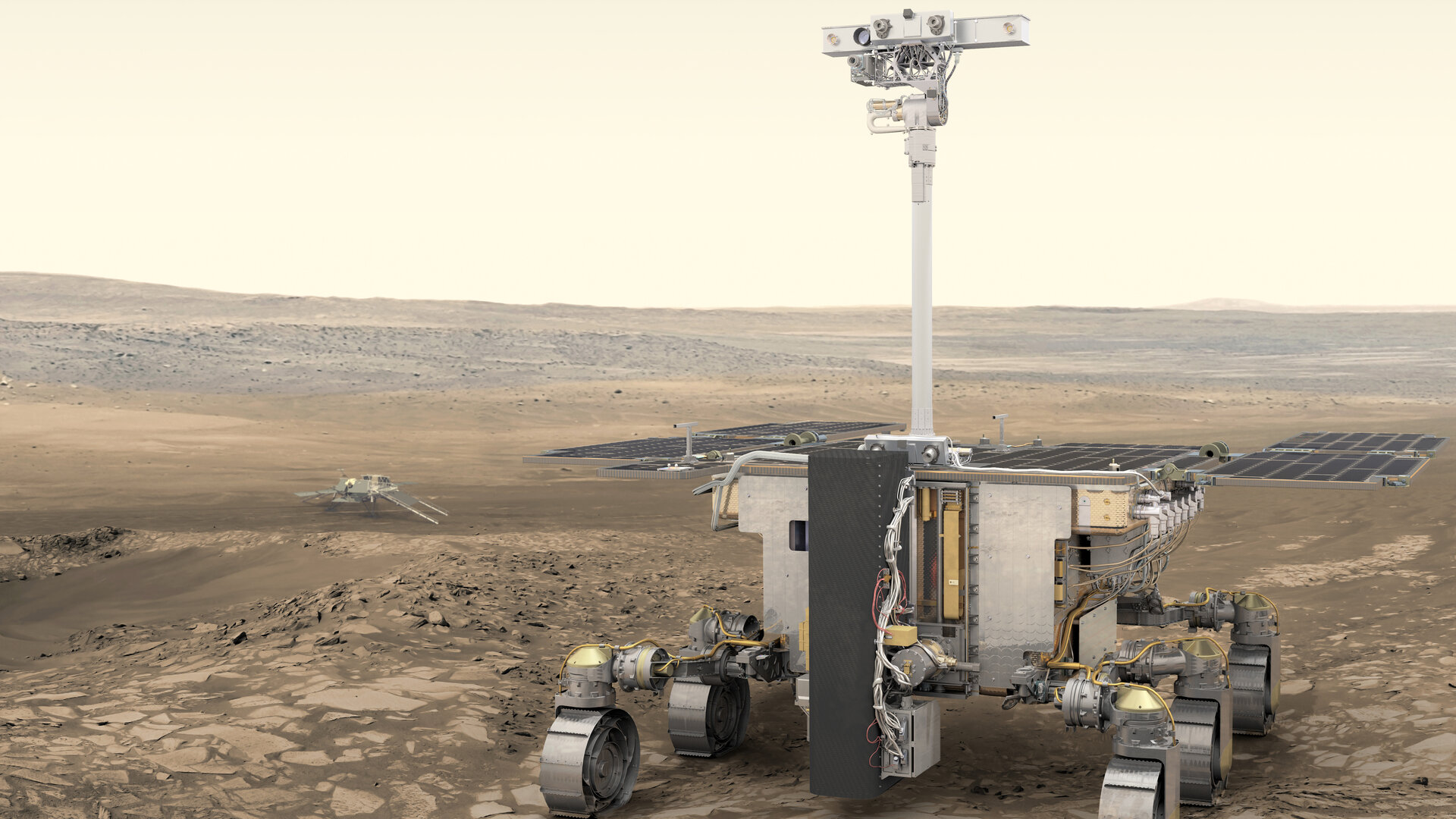
Unlike previous rovers that primarily analyzed the surface or shallow soil, the Rosalind Franklin rover is designed for depth. According to the European Space Agency, the rover will be the first mission to combine the ability to move across the Martian surface with the capability to study the planet at significant depth.
The centerpiece of this capability is a specialized drill. The rover is equipped to collect samples from as deep as 2 meters below the surface. This is a critical technical requirement because the Martian surface is a hostile environment. The tenuous atmosphere provides almost no protection from solar radiation and photochemistry, which destroy organic compounds near the surface. By drilling deep into the clay deposits, the mission can access materials that have been shielded from these destructive forces for eons.
Underground samples are more likely to include biomarkers, since the tenuous martian atmosphere offers little protection from radiation and photochemistry at the surface.
Once the samples are extracted from the depths, they will be analyzed using next-generation instruments within an onboard laboratory. This allows the rover to conduct complex chemical analyses in situ, rather than relying solely on surface imaging or shallow scoops.
Why is a vast bed of clay significant for astrobiology?
The targeting of a “vast bed of clay” is not incidental; it is a strategic choice based on the principles of astrobiology. As noted by starlust.org and astrobiology.com, clay minerals are formed through the chemical weathering of other minerals in the presence of water. This process often creates a stable environment where organic molecules—the building blocks of life—can be adsorbed and preserved.
If Mars once hosted an ocean miles deep, the bottom of that ocean would have been a site of intense sedimentation. The resulting clay layers act as a geological archive. If microbial life existed in these ancient waters, the evidence would likely be trapped within these clay layers, protected from the subsequent drying and radiation-blasting that transformed Mars into the desert world seen today.
Surface vs. Subsurface Exploration
To understand why the Rosalind Franklin rover’s approach is different, it is helpful to compare surface exploration with the proposed subsurface strategy.
| Feature | Surface Exploration | Subsurface Exploration (Rosalind Franklin) |
|---|---|---|
| Radiation Exposure | High (Destroys organics) | Low (Shielded by regolith) |
| Sample Depth | Centimeters | Up to 2 meters |
| Preservation Potential | Low to Moderate | High (especially in clay) |
| Primary Tool | Cameras and surface scoops | Deep-reach drill and onboard lab |
Understanding the ExoMars Programme goals
The search for an ancient ocean miles deep is part of the broader ExoMars programme. The primary objective of this initiative is to land the rover at a site with the highest potential for finding well-preserved organic material, specifically from the very early history of the planet. This timeframe is crucial because it represents the era when Mars was most similar to Earth, with a thicker atmosphere and liquid water on its surface.
The mission’s strategy involves not just finding water, but finding the right kind of water-driven geology. The transition from a water-rich planet to a frozen wasteland means that any remaining evidence of life is likely buried. The Rosalind Franklin rover is engineered to bridge this gap, moving several kilometers across the terrain to ensure a wide range of the clay region is sampled.
Related explainer on Martian geological history may provide further context on how these oceans formed and eventually disappeared.
Common misconceptions about Martian water
A common oversimplification in the news is the idea that finding “water” is equivalent to finding “life.” While liquid water is a prerequisite for life as we know it, the mere presence of ancient lakebeds or ocean floors does not guarantee biological discovery. The challenge is preservation.
Many sites on Mars show evidence of water, but the harsh surface conditions have erased the biological signatures. This is why the “Ocean Miles Deep May Have Once Covered Region of Mars New Rover Will Land In – autoevolution” angle is so important. It isn’t just about the existence of an ocean, but the specific depth and the resulting clay deposits that provide the necessary shielding for biomarkers to survive for billions of years.
Key technical milestones for the mission
For the Rosalind Franklin rover to succeed in its search for ancient life, several technical hurdles must be cleared. The mission relies on a sophisticated chain of events:
- Precision Landing: Landing the rover exactly within the vast clay region to ensure the most promising materials are accessible.
- Drilling Integrity: Successfully penetrating 2 meters of Martian crust without compromising the sample or the drill mechanism.
- Onboard Processing: Using the onboard laboratory to analyze samples without contaminating them with Earth-based organic matter.
- Mobility: Traveling several kilometers to sample different strata of the ancient ocean floor.
The ability to combine mobility with deep-drilling represents a significant leap in planetary exploration technology, moving the search for life from a “surface survey” to a “deep-core investigation.”
Frequently Asked Questions
What is the Rosalind Franklin rover?
The Rosalind Franklin is a rover developed as part of the European Space Agency’s (ESA) ExoMars programme. It is specifically designed for astrobiology, featuring a drill capable of reaching 2 meters below the surface to search for signs of ancient life.
Why is the rover landing in a clay region?
Clay minerals are excellent at preserving organic materials and biomarkers. Because the target region may have once been the bottom of an ocean miles deep, the clay deposits there are among the most likely places to find evidence of ancient Martian life.
How does the rover protect samples from radiation?
The rover doesn’t protect the samples from radiation—the Martian ground does. By drilling 2 meters deep, the rover accesses material that has been naturally shielded from the sun’s radiation and photochemistry by the planet’s own surface layers.
What makes this mission different from previous Mars rovers?
While previous rovers have analyzed surface soil and rocks, the Rosalind Franklin rover is the first to combine surface mobility with the ability to drill and analyze samples from significant depths (up to 2 meters) using an onboard laboratory.
What are biomarkers?
Biomarkers are chemical signatures or physical fossils that provide evidence of past or present life. The ExoMars mission targets clay deposits specifically because they are known to preserve these signatures more effectively than other geological formations.
