Dark Energy Survives Major Challenge as Universe Keeps Accelerating
Dark energy continues to drive the accelerated expansion of the universe, according to recent cosmological data. While new measurements from the Dark Energy Spectroscopic Instrument (DESI) suggested the force might evolve over time, the core theory that dark energy dominates the cosmos remains the most viable explanation for observed galactic movements and the large-scale structure of space.
What is the current status of dark energy research?
The prevailing scientific consensus maintains that dark energy is the primary driver of the universe’s expansion, accounting for approximately 68% of the total energy density of the cosmos. Recent data from the Dark Energy Spectroscopic Instrument (DESI) introduced a potential challenge to the “standard model” of cosmology, but the fundamental observation remains: the universe is not just expanding, it is doing so at an increasing rate.
According to the DESI collaboration, the first year of data provided a hint that dark energy might not be a constant value—known as the cosmological constant—but could instead change over billions of years. If dark energy evolves, it would require a rewrite of the $Lambda$CDM (Lambda Cold Dark Matter) model, which has served as the bedrock of cosmology for decades. However, the “survival” of dark energy as a concept refers to the fact that even if the force is dynamic, it still exists and continues to push galaxies apart.
Key points regarding the current state of the research include:
- Acceleration persists: Regardless of whether dark energy is constant or evolving, the acceleration of the universe is a verified physical fact.
- Model tension: There is a growing discrepancy, known as the “Hubble Tension,” between the expansion rate measured from the early universe (via the Cosmic Microwave Background) and the rate measured from the local universe (via supernovae).
- Data volume: The DESI survey is creating the largest 3D map of the universe to date, providing the statistical power needed to test these theories.
Why did the latest data challenge the standard model?
For years, physicists have treated dark energy as the “cosmological constant” ($Lambda$). In this view, dark energy is a property of space itself; as the universe expands and more space is created, the total amount of dark energy increases, maintaining a constant density that pushes the universe outward. This is the simplest mathematical explanation and fits most observations.
The challenge arose when the DESI team analyzed the distribution of millions of galaxies. By using a technique called Baryon Acoustic Oscillations (BAO)—essentially measuring the “frozen” imprints of sound waves from the early universe—researchers can determine how the expansion rate has changed over time. The DESI data suggested that the density of dark energy might have been higher in the past and decreased slightly over time, or vice versa.
According to researchers involved in the project, a varying dark energy would imply that the force is not an inherent property of space, but perhaps a dynamic field, often referred to as “quintessence.” This would shift dark energy from a static number in an equation to a physical entity that can change, similar to how the strength of a magnetic field changes based on distance or time.
“The possibility that dark energy evolves is a significant departure from the cosmological constant, but it does not eliminate the need for dark energy itself,” according to analysis of the DESI findings.
How does the $Lambda$CDM model explain the universe?
The $Lambda$CDM model is the current mathematical framework used to describe the evolution of the universe. The “$Lambda$” represents the cosmological constant (dark energy), and “CDM” stands for Cold Dark Matter.
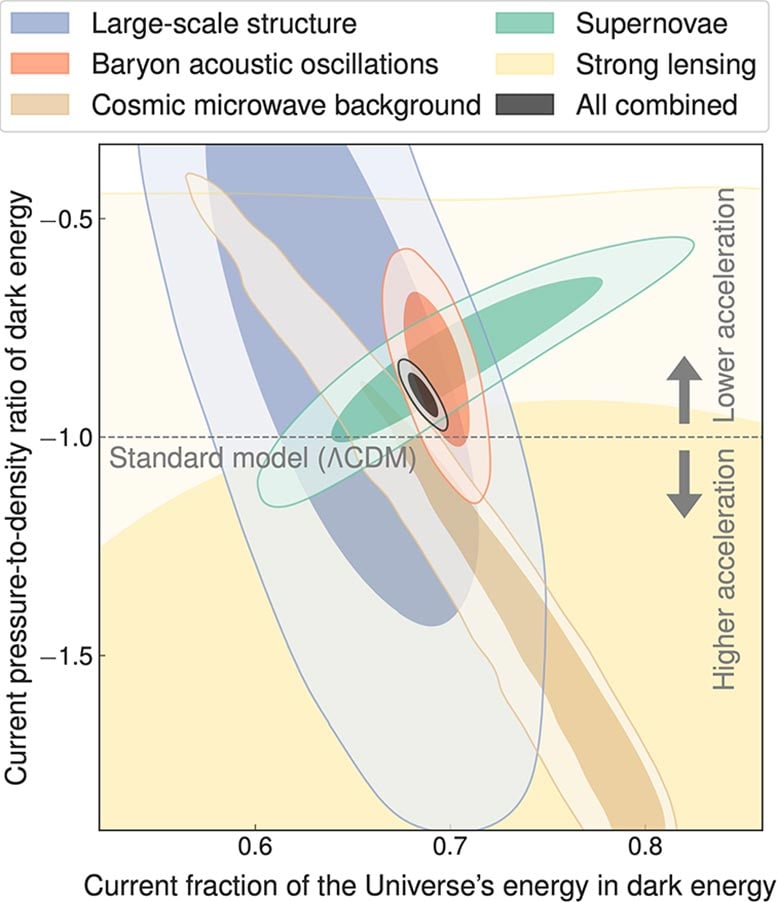
According to this model, the universe’s history is a tug-of-war between two invisible forces:
- Gravity: Driven by both visible matter and dark matter, gravity attempts to pull everything together, slowing down the expansion.
- Dark Energy: This repulsive force acts against gravity, pushing galaxies away from one another.
For the first few billion years after the Big Bang, gravity was the dominant force, and the expansion of the universe was slowing down. However, as the universe grew larger and matter became more diluted, dark energy became the dominant influence. According to Planck satellite data, this transition occurred roughly 5 to 6 billion years ago, at which point the expansion began to accelerate.
The current challenge is not that the acceleration is missing, but that the $Lambda$CDM model’s prediction of a *constant* acceleration may be slightly off. If the DESI results are confirmed by further data, the “$Lambda$” in the model will need to be replaced by a variable function.
Comparing Constant vs. Evolving Dark Energy
To understand the implications of these findings, it is helpful to compare the two primary theories regarding the nature of the force driving the universe’s expansion.
| Feature | Cosmological Constant ($Lambda$) | Evolving Dark Energy (Quintessence) |
|---|---|---|
| Nature | Static property of space | Dynamic scalar field |
| Energy Density | Remains constant over time | Changes over cosmic time |
| Standard Model | Core of $Lambda$CDM | Extension or replacement of $Lambda$CDM |
| Predicted Fate | “The Big Freeze” (Heat Death) | Big Rip or Big Crunch (depending on direction) |
| Current Evidence | Strongly supported by CMB data | Suggested by recent DESI BAO data |
What tools are scientists using to measure the expansion?
Measuring the expansion of the universe requires “standard candles” and “standard rulers”—objects or patterns whose size or brightness is known and can be used to calculate distance.
The Dark Energy Spectroscopic Instrument (DESI)
DESI is a wide-angle survey that uses 5,000 robotic fiber-optic positioners to capture the light of millions of galaxies. By analyzing the spectra of these galaxies, scientists can determine their redshift—the degree to which their light has been stretched by the expansion of space. This allows them to map the history of the expansion with unprecedented precision.

Type Ia Supernovae
These are stellar explosions with a very consistent peak brightness. Because they are so bright, they can be seen across billions of light-years. By comparing their known brightness to how they appear from Earth, astronomers can calculate exactly how far away they are and how fast they are moving away from us.
The Cosmic Microwave Background (CMB)
The CMB is the “afterglow” of the Big Bang, dating back to roughly 380,000 years after the start of the universe. Data from the Planck satellite provides a snapshot of the early universe’s density and composition, which serves as the starting point for all expansion calculations.
For more on the tools used in deep-space observation, see a related explainer on the James Webb Space Telescope’s role in cosmology.
What are the implications for the fate of the universe?
The nature of dark energy determines how the universe will end. Because dark energy is the dominant force, its behavior dictates whether the universe expands forever or eventually collapses.
The Big Freeze (Heat Death)
If dark energy remains a constant ($Lambda$), the universe will continue to expand at a steady accelerating rate. Galaxies will move so far apart that they become invisible to one another. Stars will run out of fuel, black holes will evaporate via Hawking radiation, and the universe will reach a state of maximum entropy—a cold, dark, and empty void.
The Big Rip
If dark energy is not constant but increases in strength over time (phantom dark energy), the acceleration will eventually become so violent that it overcomes all other forces. First, galaxy clusters will be torn apart, then galaxies, then solar systems, and finally, atoms themselves will be ripped asunder in a “Big Rip.”
The Big Crunch
If the DESI data indicates that dark energy is weakening and could eventually reverse its sign, gravity might regain control. In this scenario, the expansion would stop and reverse, pulling all matter back into a single, infinitely dense point—a mirror image of the Big Bang.
Addressing common misconceptions about dark energy
Because the terminology is abstract, several common misunderstandings persist in public discussions about cosmology.
Misconception 1: “Dark energy is just another name for dark matter.”
Dark matter and dark energy are opposites. Dark matter provides extra gravity that helps hold galaxies together; dark energy provides a repulsive force that pushes galaxies apart. One is an “attractive” invisible mass, and the other is a “repulsive” invisible energy.
Misconception 2: “The universe is expanding into something.”
According to general relativity, the universe is not expanding *into* an empty void. Rather, space itself is stretching. The distance between two points is increasing, but there is no “outside” or “edge” into which the universe is growing.
Misconception 3: “If dark energy is challenged, it means it doesn’t exist.”
As noted in the recent DESI findings, challenging the nature of dark energy (whether it is constant or evolving) is not the same as denying its existence. The acceleration of the universe is observed; the debate is simply over the mechanism driving that acceleration.
The role of upcoming observatories in resolving the tension
The current debate between the cosmological constant and evolving dark energy will likely be resolved by a new generation of telescopes and surveys designed specifically to probe the “dark sector” of the universe.
The Euclid Space Telescope, launched by the European Space Agency (ESA), is currently mapping the geometry of the dark universe. By observing billions of galaxies across a third of the sky, Euclid aims to determine if the “dark energy challenge” seen in DESI data is a statistical fluke or a fundamental discovery.
Additionally, the Vera C. Rubin Observatory in Chile will begin its Legacy Survey of Space and Time (LSST). This facility will provide a “movie” of the sky, capturing changes in brightness and position over a decade. This will allow astronomers to track supernovae and weak gravitational lensing with a level of detail that could finally settle the Hubble Tension.
For further context on the current race to map the cosmos, read a related report on the Euclid mission’s first data releases.
Frequently Asked Questions
What is the “major challenge” mentioned in recent dark energy news?
The challenge refers to data from the Dark Energy Spectroscopic Instrument (DESI), which suggests that dark energy might change in density over time. This contradicts the standard $Lambda$CDM model, which assumes dark energy is a constant value (the cosmological constant).
Does this mean the universe might stop expanding?
Not necessarily. While evolving dark energy opens the possibility of a “Big Crunch” if the force weakens and reverses, the current data still shows the universe is accelerating. The “challenge” is about the rate and nature of the acceleration, not the fact that it is happening.
What is the difference between the Big Freeze and the Big Rip?
The Big Freeze occurs if dark energy remains constant, leading to a cold, empty universe where everything is too far apart to interact. The Big Rip occurs if dark energy becomes stronger over time, eventually tearing apart galaxies, stars, and atoms.
How do scientists know the universe is accelerating if they can’t see dark energy?
Scientists observe the effects of dark energy on visible objects. By measuring the redshift of distant galaxies and the brightness of Type Ia supernovae, they can see that distant objects are moving away from us faster now than they were in the past.
Why is this discovery important for physics?
If dark energy evolves, it suggests that Einstein’s cosmological constant is incomplete and that there is a new, dynamic field in the universe. This could lead to a “Theory of Everything” that finally unites general relativity (the physics of the very large) with quantum mechanics (the physics of the very small).
