NASA’s Proposed EVE Mission Aims to Solve the Radius Valley Mystery
NASA has proposed the EVE mission to investigate the “radius valley,” a distinct gap in the size distribution of exoplanets between 1.5 and 2 times the radius of Earth. According to mission proposals, the spacecraft will analyze planetary atmospheres to determine if this gap is caused by stellar radiation stripping away gases or internal planetary heat, providing a definitive answer to how small planets evolve.
What is the Radius Valley and why is it a mystery?
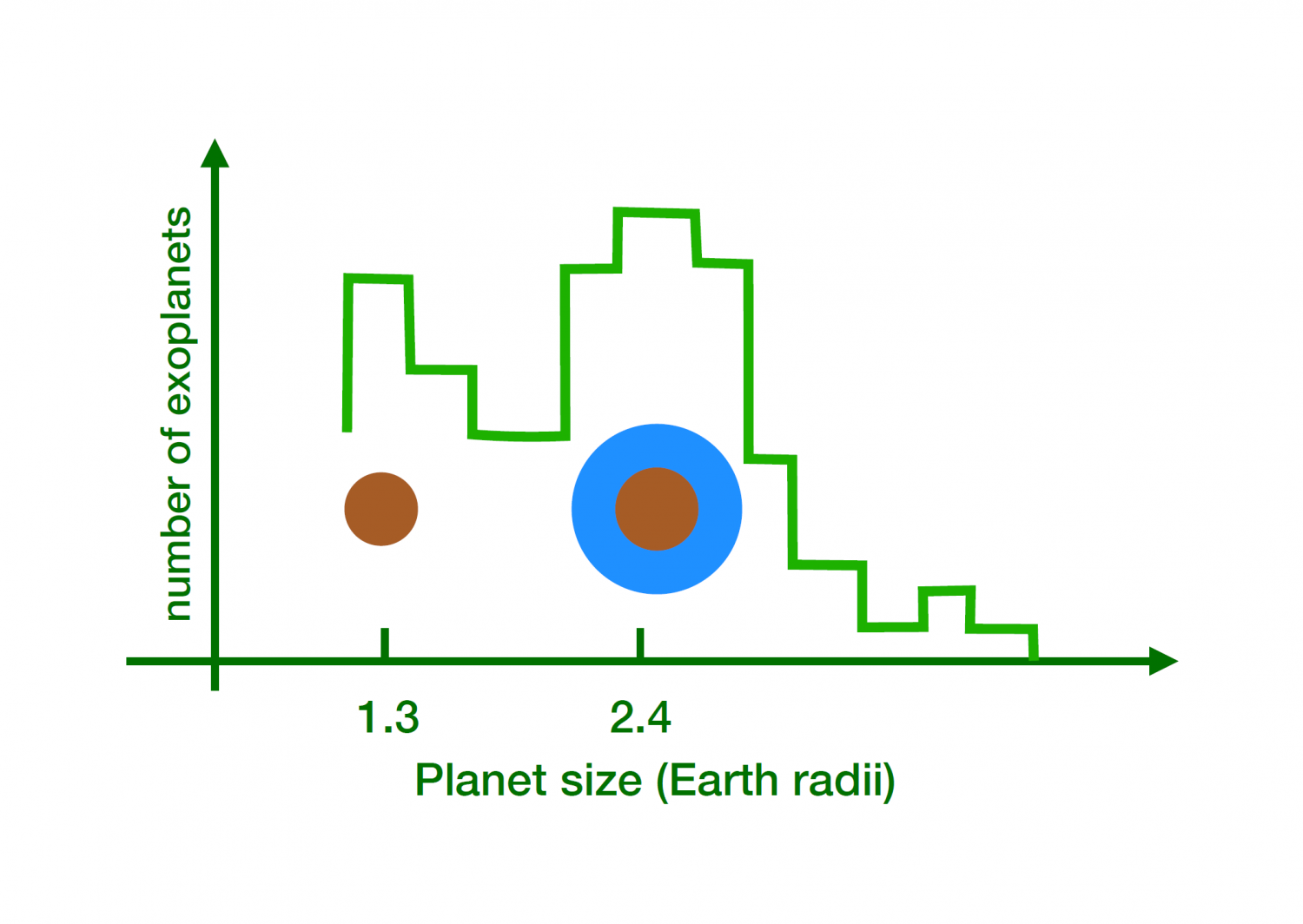
Astronomers have observed a strange statistical void in the population of exoplanets, a phenomenon often referred to as the “Fulton Gap” or the radius valley. When plotting the sizes of thousands of discovered worlds, researchers found a surprising lack of planets with a radius between 1.5 and 2 Earth radii. Instead, the data shows two distinct populations: smaller, rocky “super-Earths” and larger, gas-shrouded “sub-Neptunes.”
According to data derived from the Kepler Space Telescope, this distribution suggests that planets do not simply stay the size they were born. Instead, the radius valley implies a transformative process that pushes planets out of that middle-size range. A planet that starts as a sub-Neptune may lose its thick hydrogen-helium envelope, shrinking until it becomes a rocky super-Earth. However, the mechanism driving this atmospheric loss remains a subject of intense debate within the astrophysical community.
The mystery centers on two primary competing theories:
- Photoevaporation: This theory posits that high-energy X-ray and ultraviolet (XUV) radiation from the host star blasts the planet’s atmosphere into space. This process is most aggressive in the early stages of a star’s life.
- Core-Powered Mass Loss: This theory suggests that the heat remaining from the planet’s own formation drives the atmosphere away from the inside out, independent of the star’s immediate radiation.
Distinguishing between these two processes is critical because it reveals whether a planet’s ultimate fate is determined by its environment (the star) or its inherent properties (the core mass and composition).
How will the proposed EVE mission solve this puzzle?
The proposed EVE mission is designed to move beyond simple size measurements and instead examine the chemical composition of planetary atmospheres. By targeting planets on both sides of the radius valley, EVE aims to identify the “fingerprints” left behind by the different mass-loss mechanisms.
According to the mission’s conceptual framework, EVE will utilize high-precision spectroscopy to analyze the light filtering through a planet’s atmosphere as it passes in front of its star. This technique, known as transmission spectroscopy, allows scientists to detect specific elements and molecules. If photoevaporation is the dominant force, the remaining atmospheres should show a specific correlation with the star’s radiation history. Conversely, if core-powered mass loss is responsible, the atmospheric signatures should correlate more closely with the planet’s internal heat and mass.
“The goal is to determine if the radius valley is a result of the star’s influence or the planet’s own internal evolution,” according to the mission’s scientific objectives.
To achieve this, EVE will likely focus on a curated sample of planets that sit right on the edge of the valley. By comparing a “bare” super-Earth with a “puffy” sub-Neptune orbiting the same type of star, researchers can isolate which variable—stellar flux or internal heat—is the primary driver of atmospheric erosion.
Photoevaporation vs. Core-Powered Mass Loss: A Comparison
The debate between these two models is not just academic; it changes how we calculate the probability of finding habitable worlds. If photoevaporation is the primary driver, planets orbiting active stars are far more likely to be stripped of their air, regardless of their initial size. If core-powered mass loss dominates, a planet’s ability to hold onto an atmosphere depends more on its own internal structure.
| Feature | Photoevaporation | Core-Powered Mass Loss |
|---|---|---|
| Primary Driver | Stellar X-ray/UV Radiation | Internal Planetary Heat |
| Timing | Most intense in early stellar life | Gradual loss over longer periods |
| Dependency | Distance from star / Stellar activity | Planet mass / Core composition |
| Atmospheric Result | Rapid stripping of outer layers | Slow leakage of gases |
The technical challenges of detecting atmospheric loss
Solving the radius valley mystery requires detecting incredibly subtle signals. The atmospheres of sub-Neptunes are often shrouded in high-altitude clouds or hazes, which act like a curtain, blocking the light that spectroscopy needs to analyze. This “muted” signal has plagued previous observations, including some early data from the James Webb Space Telescope (JWST).
EVE is proposed to address this by using a specialized instrument suite capable of observing in wavelengths that can penetrate these hazes. According to the mission’s technical goals, the focus is on achieving a signal-to-noise ratio high enough to distinguish between a hydrogen-dominated atmosphere (typical of sub-Neptunes) and a heavier, secondary atmosphere composed of water vapor or carbon dioxide (typical of evolved super-Earths).
The role of the transit method
EVE will rely heavily on the transit method. When a planet crosses the disk of its star, it blocks a tiny fraction of the light. However, a sliver of that light passes through the planet’s atmosphere. Different gases absorb different wavelengths of light, leaving a “barcode” in the spectrum. By analyzing this barcode, EVE can determine:

- Mean Molecular Weight: Whether the atmosphere is light (hydrogen/helium) or heavy (nitrogen/oxygen/CO2).
- Chemical Abundance: The ratio of metals to hydrogen, which indicates where the planet formed in the protoplanetary disk.
- Temperature Profiles: How heat is distributed, which helps distinguish between stellar heating and internal cooling.
For more on how these detection methods work, see our related explainer on transmission spectroscopy.
Why the Radius Valley matters for the search for life
The radius valley is more than a statistical oddity; it is a roadmap for finding Earth-like planets. If NASA’s proposed EVE mission aims to solve the radius valley mystery, it is because the answer tells us which planets are capable of maintaining an atmosphere over billions of years.
A planet that has been stripped of its atmosphere via photoevaporation is likely a dead, airless rock, regardless of whether it sits in the “habitable zone” where liquid water could exist. However, if core-powered mass loss is the primary driver, it suggests that some planets might retain thick, protective atmospheres even under harsh stellar conditions, provided their cores are structured correctly.
Furthermore, understanding the transition from sub-Neptune to super-Earth helps astronomers identify “transition worlds”—planets currently in the process of losing their envelopes. These worlds represent a critical evolutionary stage. If we can identify the exact moment a planet becomes “rocky,” we can better predict which distant stars are likely to host planets with surfaces we could actually walk on.
Comparing EVE to the James Webb Space Telescope (JWST)
While the JWST is a general-purpose observatory capable of seeing the first galaxies and analyzing exoplanet atmospheres, EVE is designed as a targeted mission. JWST provides incredible depth but has limited time to spend on any single target due to its massive demand from the global scientific community.
According to mission strategists, EVE would complement JWST by providing a systematic survey. While JWST might look at a few “celebrity” planets in great detail, EVE would survey a statistically significant population of planets across the radius valley. This population-level data is the only way to prove a general rule about planetary evolution, rather than observing an isolated exception.
Key differences in approach include:
- Breadth vs. Depth: JWST focuses on deep characterization of specific targets; EVE focuses on a broad demographic survey.
- Specialization: EVE’s instruments would be optimized specifically for the transition zone of the radius valley, whereas JWST is a multi-instrument facility.
- Objective: JWST seeks to find “what” is there; EVE seeks to find “why” the distribution of planets looks the way it does.
Common misconceptions about exoplanet sizes
One common misconception is that a planet’s size is a permanent characteristic. In reality, as the radius valley demonstrates, planets are dynamic. A planet that appears as a sub-Neptune today may have been much larger during its first 100 million years of existence.
Another frequent misunderstanding is the belief that “super-Earths” are simply larger versions of Earth. According to planetary scientists, many super-Earths in the radius valley are actually the “corpses” of sub-Neptunes. They are not larger versions of Earth, but rather smaller versions of Neptune that lost their gas. This distinction is vital because the geology and potential habitability of a “shrunken Neptune” are vastly different from those of a “grown Earth.”
The broader impact on planetary science
The success of the EVE mission would provide a benchmark for all future exoplanet missions. By confirming whether stellar radiation or internal heat dominates atmospheric loss, NASA would essentially create a “filter” for future missions. Instead of spending resources analyzing every planet in a habitable zone, astronomers could prioritize planets that have the right mass and stellar environment to have survived the radius valley transition.
This research also informs our understanding of our own solar system. While we don’t have a sub-Neptune in our immediate vicinity, the processes that shaped the radius valley likely occurred during the early formation of Earth and Mars. Understanding how atmospheres are stripped in other systems allows scientists to reconstruct the early history of the solar system’s own volatile loss.
The mission represents a shift in exoplanetary science from the “discovery phase”—where the goal was simply to find planets—to the “characterization phase,” where the goal is to understand the physics of how these worlds function and evolve over eons.
Frequently Asked Questions
What exactly is the “Radius Valley”?
The radius valley is a gap in the size distribution of exoplanets. Data shows a shortage of planets between 1.5 and 2 times the size of Earth, meaning most planets are either smaller (rocky super-Earths) or larger (gas-rich sub-Neptunes).
How does the EVE mission differ from other NASA telescopes?
Unlike the James Webb Space Telescope, which is a general-purpose observatory, EVE is a proposed targeted mission specifically designed to study the atmospheres of planets around the radius valley to determine why the gap exists.
Why is the “Fulton Gap” important for finding aliens?
If we understand why planets lose their atmospheres, we can better identify which planets are likely to have kept their air. Since an atmosphere is a prerequisite for life as we know it, solving the radius valley mystery helps narrow the search for habitable worlds.
Is the EVE mission currently flying?
No, EVE is a proposed mission. It represents a scientific goal and a technical proposal that NASA would need to formally approve and fund for launch.
What is the difference between a super-Earth and a sub-Neptune?
A super-Earth is generally a rocky planet larger than Earth but smaller than Neptune. A sub-Neptune is a planet that possesses a significant envelope of hydrogen and helium gas, making it larger and less dense than a rocky super-Earth.
