Medical evacuation Singapore: What travellers need to know – The Straits Times
For most international travellers, the prospect of a medical emergency while abroad is a distant fear, often overshadowed by the excitement of exploration or the urgency of business. However, when a critical health crisis strikes in a region with inadequate facilities, the difference between recovery and tragedy often hinges on a single, complex process: medical evacuation. In the context of Southeast Asia, Singapore stands as a primary nexus for these operations, serving both as a destination for high-end tertiary care and a logistical launchpad for repatriation efforts.
Understanding the intricacies of medical evacuation Singapore: what travellers need to know – The Straits Times style reporting emphasizes that this is not merely a matter of booking a flight. It is a high-stakes coordination of aviation logistics, critical care medicine, and insurance negotiations. For those navigating the complexities of global travel, knowing how these systems operate—and where the financial and legal pitfalls lie—is essential for risk mitigation.
The Anatomy of a Medical Evacuation
Medical evacuation, or “medevac,” is the process of transporting a patient from a location where they cannot receive adequate care to a facility that can provide the necessary life-saving or stabilizing treatment. Unlike standard medical repatriation, which might involve moving a stable patient home for long-term recovery, a medevac is typically an urgent, time-sensitive intervention.
These operations generally fall into three categories, depending on the patient’s stability and the distance involved:
- Air Ambulance (Fixed-Wing): These are private jets configured as intensive care units (ICUs). They are equipped with ventilators, cardiac monitors, and a specialized medical crew. This is the gold standard for long-distance, critical transfers.
- Commercial Escort: For patients who are stable enough to fly but require professional monitoring, a medical escort (nurse or doctor) accompanies them on a standard commercial flight. In some cases, the airline may allow the installation of a stretcher, which typically requires blocking off several rows of seats.
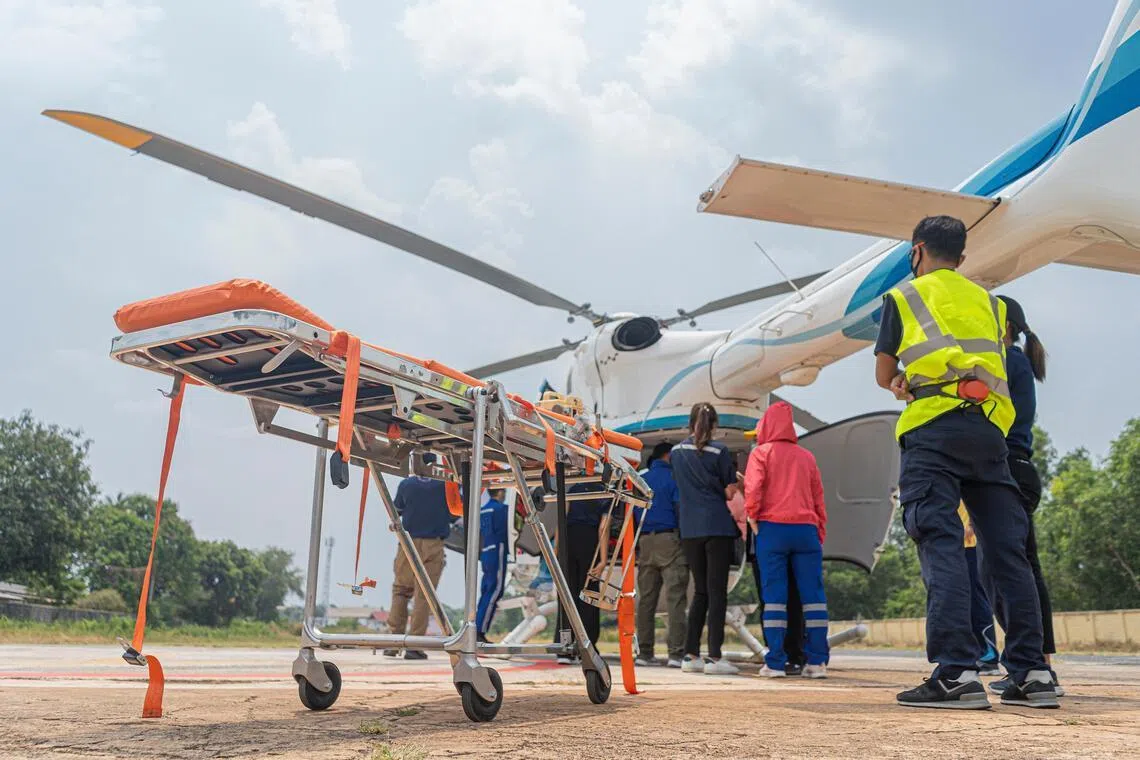
- Rotary-Wing (Helicopter): Used primarily for the “first mile” of evacuation—moving a patient from a remote area, a cruise ship, or a disaster zone to the nearest airfield or hospital.
“The primary objective of a medical evacuation is not just transport, but the maintenance of a clinical environment in the air. The aircraft effectively becomes a flying ICU, where the patient’s physiological stability is managed against the pressures and oxygen fluctuations of high-altitude flight.”
Singapore’s Role as a Regional Medical Hub
Singapore is uniquely positioned in the global healthcare landscape. With world-class institutions such as the National University Hospital (NUH) and Singapore General Hospital (SGH), the city-state often serves as the primary destination for critical patients evacuated from neighboring countries in Southeast Asia.
The efficiency of medical evacuation in Singapore is bolstered by Changi Airport’s infrastructure and the presence of specialized aeromedical coordinators. When a patient is flown into Singapore, the process involves a seamless transition from the aircraft’s medical team to a ground ambulance, and finally to a specialist ward. This “bed-to-bed” service is what distinguishes professional evacuation from simple transport.
Why Singapore is a Preferred Destination
Several factors contribute to Singapore’s status as a medevac hub:
- Tertiary Care Capabilities: Access to cutting-edge cardiology, oncology, and trauma surgery.
- Logistical Connectivity: One of the world’s most efficient airports, allowing for rapid customs clearance for medical emergencies.
- Regulatory Standards: High benchmarks for patient safety and clinical governance.
The Financial Reality: Costs and Insurance
Perhaps the most daunting aspect of medical evacuation is the cost. A private air ambulance flight is not a standard travel expense; it is a specialized medical operation. Depending on the distance, the level of care required, and the type of aircraft, the costs can be astronomical.
| Transport Type | Estimated Cost Range (Regional) | Patient Condition | Key Feature |
|---|---|---|---|
| Commercial Escort | $5,000 – $20,000 | Stable/Semi-stable | Medical supervision on airline |
| Fixed-Wing Air Ambulance | $30,000 – $150,000+ | Critical/Unstable | Full ICU equipment on board |
| Helicopter Transfer | $2,000 – $10,000 (per hour) | Acute/Remote | Rapid extraction from site |
For the vast majority of travellers, paying these sums out-of-pocket is impossible. This is where travel insurance becomes critical. However, not all insurance policies are created equal. Many basic policies cover “medical expenses” but have incredibly limited or non-existent coverage for “emergency medical evacuation.”
The “Medical Necessity” Clause
Insurance companies do not automatically approve every evacuation request. They operate based on the principle of medical necessity. An insurance provider will typically only fund a medevac if the local medical facilities are deemed incapable of treating the patient’s condition. If a local hospital can stabilize the patient, the insurer may refuse to pay for a flight to Singapore or the patient’s home country, regardless of the patient’s preference for a specific doctor or hospital.

To navigate this, it is vital to understand the Guarantee of Payment (GOP). This is a document issued by the insurer to the medical transport provider, ensuring that the costs will be covered. Without a GOP, air ambulance companies often require a significant upfront deposit before the aircraft takes off.
The Operational Process: From Crisis to Care
A medical evacuation is a choreographed sequence of events. When a request is initiated, the following steps typically occur:
1. Clinical Assessment
The evacuation team’s flight physician reviews the patient’s medical records. They must determine if the patient is “fit to fly.” Some conditions, such as certain types of pneumothorax or unstable cardiac events, can be exacerbated by the drop in cabin pressure, making flight dangerous without specific interventions.
2. Logistics and Permitting
Flight coordinators arrange the aircraft and secure overflight permits from the countries the plane will traverse. In emergency cases, “diplomatic clearances” may be fast-tracked to allow the aircraft to land at military or private airfields.
3. The Bed-to-Bed Transfer
The medical team arrives at the patient’s current location. The patient is stabilized for transport and moved via ambulance to the airfield. Once airborne, the medical crew continues intensive care. Upon landing in Singapore, the patient is met by a ground team and transported directly to the receiving hospital’s ICU or specialist ward.

For more information on managing health risks while traveling, you may find a related explainer on international health insurance useful.
Common Misconceptions and Pitfalls
There are several frequent misunderstandings regarding medical evacuations that can lead to financial or medical distress.
Misconception: “My standard health insurance covers me globally.”
Many domestic health plans provide very limited coverage outside the home country. Even those that do may only reimburse a fraction of the cost of a private air ambulance. It is imperative to have a dedicated travel insurance policy that specifically lists emergency medical evacuation and repatriation with a high coverage limit (ideally $500,000 or more).
Misconception: “The embassy will pay for my evacuation.”
This is a dangerous fallacy. Embassies and consulates provide diplomatic assistance, help contact family, and can suggest medical providers, but they almost never pay for medical treatment or evacuation. The financial burden remains entirely with the individual or their insurance provider.
Misconception: “Any plane can be a medical plane.”
A chartered private jet is not the same as an air ambulance. A standard charter may have a doctor on board, but it lacks the specialized mounting for ventilators, oxygen supplies, and the specific certifications required for critical care transport. Using a non-specialized aircraft for a critical patient can be fatal.
Strategic Advice for Frequent Travellers
To ensure you are protected, a proactive approach to medical risk is necessary. The following steps are recommended for those who travel frequently through Asia and beyond:
- Audit Your Policy: Look specifically for the “Medical Evacuation” section of your insurance. Check if it covers “hospital of choice” or only “nearest adequate facility.”
- Maintain a Medical Dossier: Keep a digital copy of your blood type, allergies, current medications, and chronic conditions. In a crisis, the evacuation team needs this data immediately to determine the flight configuration.
- Identify Regional Hubs: Be aware of where the nearest high-quality medical hubs are. In Southeast Asia, Singapore is the primary hub, but Bangkok and Kuala Lumpur also offer significant capabilities.
- Verify Pre-existing Condition Coverage: Many insurers exclude medevacs resulting from pre-existing conditions unless a specific waiver was purchased.
If you are planning a trip to remote areas, you might also consider a related explainer on remote area rescue services to supplement your standard insurance.
Navigating the Legal and Ethical Dimensions
Medical evacuations also enter a complex legal grey area, particularly regarding “informed consent.” If a patient is unconscious, the decision to evacuate falls to the next of kin or a legal proxy. This can lead to disputes if the family disagrees with the medical team’s recommendation or if the insurance company disputes the necessity of the move.
the ethics of “medical tourism” sometimes blur with emergency evacuation. There is a distinct difference between a patient choosing to fly to Singapore for elective surgery and a patient being evacuated for a life-threatening emergency. Insurance providers are strictly focused on the latter, and any attempt to frame an elective procedure as an emergency can lead to fraud investigations and denial of claims.
Key Considerations for Families
When a loved one requires evacuation, families are often in a state of shock. It is recommended to designate one family member as the primary point of contact for the insurance company and the medical team to avoid conflicting instructions and delays in the GOP process.
Summary of Critical Requirements for Medevac
To synthesize the essential elements of the process, the following checklist outlines what must be in place for a successful evacuation to Singapore:
- Medical Clearance: Documentation from the treating physician stating the patient is stable enough for flight.
- Receiving Facility Acceptance: A confirmed bed and accepting physician at a Singapore hospital.
- Financial Guarantee: A GOP from an insurance provider or a confirmed wire transfer of funds.
- Logistical Clearance: Flight permits and customs/immigration arrangements for the patient and medical crew.
Frequently Asked Questions
What is the difference between medical evacuation and repatriation?
Medical evacuation is the urgent movement of a patient to the nearest adequate facility to save their life or stabilize them. Repatriation is the process of moving a patient back to their home country once they are stable enough for transport, often for long-term care or recovery.

Will my travel insurance cover a medevac if I have a pre-existing condition?
It depends on your policy. Many standard policies exclude pre-existing conditions. However, some offer “pre-existing condition waivers” if the insurance was purchased within a specific window (usually 14-21 days) of the initial trip deposit. Always check your policy’s specific exclusions.
How long does it take to organize a medical flight to Singapore?
Depending on the aircraft’s location and the urgency, a medevac can be organized in as little as 12 to 24 hours. However, delays can occur due to weather, flight permits, or delays in receiving the Guarantee of Payment from the insurance company.
Can I choose which hospital in Singapore I am evacuated to?
In a critical emergency, the decision is usually made based on which facility has the immediate capacity and the specific specialist required. While you can request a particular hospital, the medical team and insurance provider will prioritize the fastest access to necessary care.
What happens if my insurance refuses to pay for the evacuation?
If the insurer deems the evacuation “not medically necessary,” the cost falls to the patient or their family. In such cases, you may need to negotiate a payment plan with the air ambulance provider or seek alternative, less expensive transport options, such as a commercial escort.
